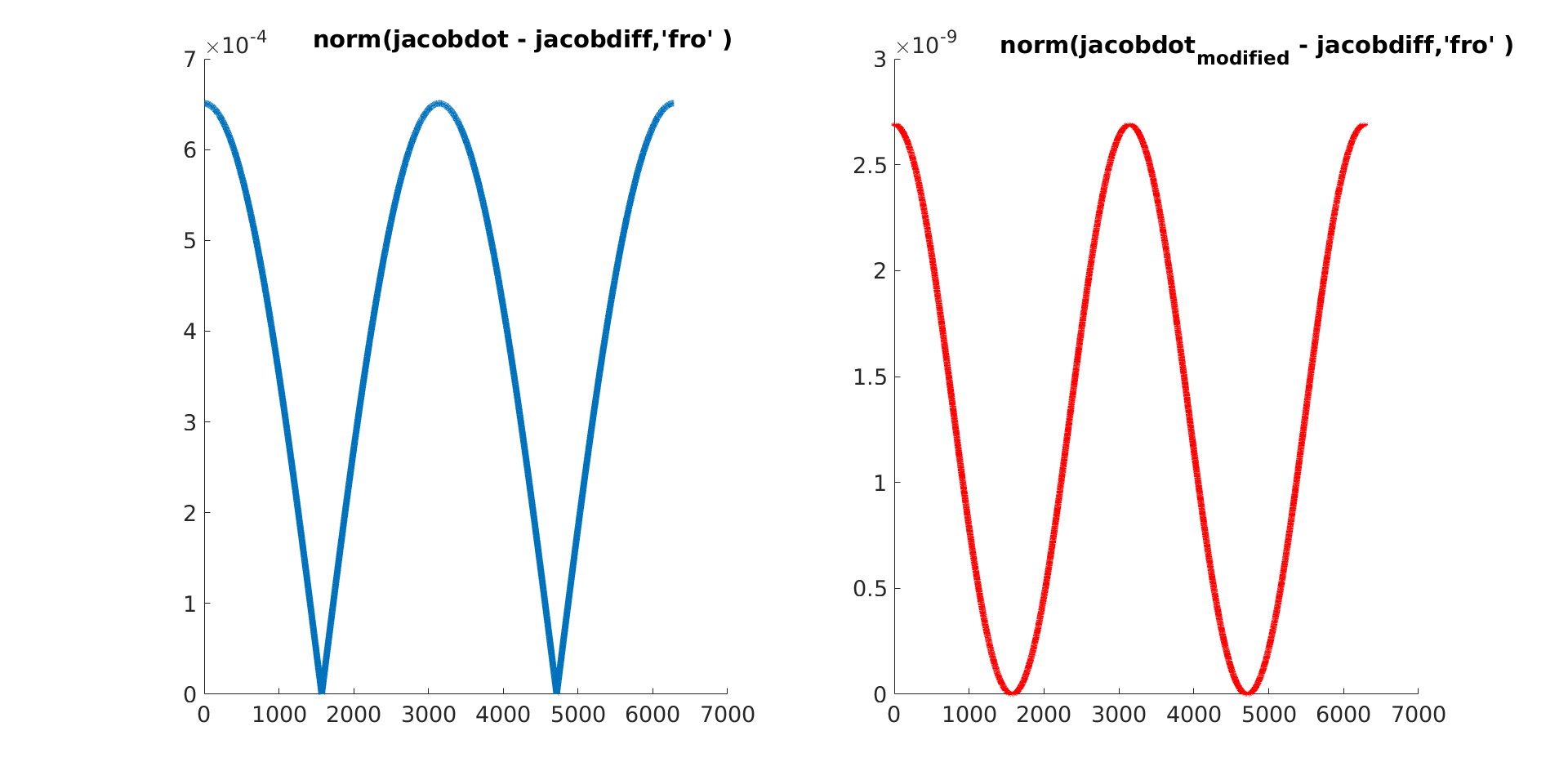
Inaccurate results using jacobian_dot(q, q_dot) #2

Description

The method jacobian_dot(q, q_dot) returns inaccurate results. I performed a comparison test using a derivative Jacobian matrix analytically computed (using a two planar links robot) vs jacobian_dot. The results are not the same.
I realized that the method computes the time derivative Jacobian until joint ith. This is great, but, x_effector and J are computed until joint obj.links. Furthermore, I believe that J(:,1:i) must be computed using jacobian(theta, ith) instead of taking a column from matrix J.
I modified the method in this way:
    function J_dot = jacobian_dot(obj,theta,theta_dot, ith)
        % J_dot = jacobian_dot(theta,theta_dot) returns the Jacobian
        % time derivative.
        % J_dot = jacobian_dot(theta,theta_dot,ith) returns the first
        % ith columns of the Jacobian time derivative.
        % This function does not take into account any base or
        % end-effector displacements.

        if nargin == 4
            n = ith;
        else
            n = obj.links;
        end


        %x_effector = obj.raw_fkm(theta);
        %J = obj.raw_jacobian(theta);

        x_effector = obj.raw_fkm(theta, n);

        Jj = obj.jacobian(theta,n);
        Jaux = zeros(8,obj.links);
        Jaux(:,1:n) = Jj;
        J = Jaux;


        vec_x_effector_dot = J*theta_dot;

        x = DQ(1);
        J_dot = zeros(8,n-obj.n_dummy);
        jth=0;

        for i = 0:n-1
            % Use the standard DH convention
            if strcmp(obj.convention,'standard')
                w = DQ.k;
                z = DQ(obj.get_z(x.q));
            else % Use the modified DH convention
                w = DQ([0,0,-sin(obj.alpha(i+1)),cos(obj.alpha(i+1)),0,0,-obj.a(i+1)*cos(obj.alpha(i+1)),-obj.a(i+1)*sin(obj.alpha(i+1)) ] );
                z = 0.5*x*w*x';
            end

            if ~obj.dummy(i+1)

                if jth == 0
                        Ji = zeros(8, obj.links);
                else
                        %ji = obj.jacobian_(theta,ith, obj.links);

                        Jj = obj.jacobian(theta,jth);
                        Jaux = zeros(8,obj.links);
                        Jaux(:,1:jth) = Jj;
                        Ji = Jaux;
                end

                %vec_zdot = 0.5*(haminus8(w*x') + hamiplus8(x*w)*DQ.C8)*J(:,1:i)*theta_dot(1:i);
                vec_zdot = 0.5*(haminus8(w*x') + hamiplus8(x*w)*DQ.C8)*Ji*theta_dot;
                J_dot(:,jth+1) = haminus8(x_effector)*vec_zdot + hamiplus8(z)*vec_x_effector_dot;
                x = x*obj.dh2dq(theta(jth+1),i+1);
                jth = jth+1;
            else
                % Dummy joints don't contribute to the Jacobian
                x = x*obj.dh2dq(0,i+1);
            end
        end
    end
Using the modified method, the analytical derivative Jacobian matrix matched with the jacobian_dot. Furthermore, I performed the jacobian_time_derivative.m example. Using the modified method the error is lower.