Repository navigation
8. Kepler's Laws
We have enough Calc III now to look at a very cool result in astronomy: Kepler's Laws of orbital motion. Kepler proposed these rules in the 17th century after studying astronomy data. Decades later, Newton proved the rules using calculus. We will prove whatever we have time for in class tomorrow (likely, one or two of the laws).
The purposes of this lecture are: (1) this is cool stuff, (2) this uses all kinds of things we've been studying (vectors, cross products, dot products, derivatives, limits, and components), and (3) this is quite difficult, so we will gain an appreciation of how all this works in real problems and of the genius of Newton.
The main reading for today is to watch this video (it's slow, so watch it at double speed), and try to decide what this blue cartoony guy is supposed to be (does his moustache have hands?).
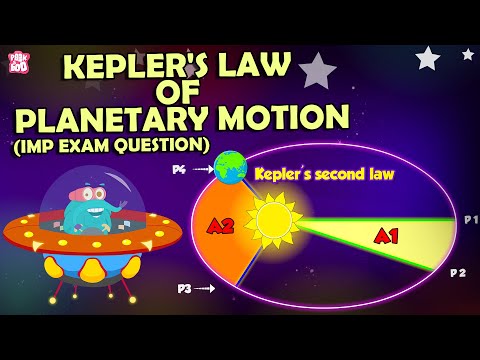
Here are a few facts that we'll need (some are new, some are just reminders of things we've seen). We are not expected to have all these memorized, but it may help to see/remember them before the derivation in class:
- The vector triple product:
$\large \vec{a}\times\left(\vec{b}\times\vec{c}\right)=\left(\vec{a}\cdot\vec{c}\right)\vec{b}+\left(\vec{a}\cdot\vec{b}\right)\vec{c}$ $\large \vec{a}\cdot\left(\vec{b}\times\vec{c}\right)=\left(\vec{a}\times\vec{b}\right)\cdot\vec{c}$ $\large \vec{r}(t)\cdot \vec{r}(t)=|\vec{r}(t)|^2$ - If
$\large |\vec{r}(t)|=1$ , then$\large \vec{r}(t)\cdot\vec{r'}(t)=0$ . - Product rule:
$\large \displaystyle \frac{d}{dt}\left(\vec{r}(t)\times\vec{u}(t)\right)=\vec{r'}(t)\times\vec{u}(t)+\vec{r}(t)\times\vec{u'}(t)$ - Distributive property:
$\large \vec{a}\times \left(\vec{b}+\vec{c}\right)=\vec{a}\times\vec{b}+\vec{a}\times\vec{c}$ - If
$\large \vec{r}$ is parallel to$\large \vec{u}$ , then$\large \vec{r}\times\vec{u}=\vec{0}$ . - Area of the parallelogram shown is
$\large |\vec{a}\times\vec{b}|$ .

This material is a bonus! We will not be asked about it on HW or tests this semester. It is a very cool application that involves vectors and vector valued functions, though.