Repository navigation
Tutorial Mixed PCR qPCR
This tutorial walks through a complete, realistic insilicoPCR run using public data you download yourself — no synthetic sequences. In one single run it combines:
- a conventional PCR assay and a TaqMan qPCR assay in the same primer file (mixed mode),
- a genome assembly (FASTA) and raw Illumina reads (FASTQ) as inputs,
- a positive control (Listeria monocytogenes) and a negative control (Listeria innocua, the classic hly-negative near-neighbor used for exclusivity testing).
Everything below uses the command line from an extracted portable release; the same inputs work in the GUI.
Both assays target hly (listeriolysin O, hlyA), which is present in L. monocytogenes and absent from L. innocua:
| Assay | Type | Expected product |
|---|---|---|
hly702 |
conventional PCR (F + R) | 702 bp |
hlyQ |
TaqMan qPCR (F + R + probe) | 112 bp |
The hlyQ primers and probe are the hlyA-177 5'-nuclease assay of Nogva et al. 2000, Appl Environ Microbiol 66:4266–4271 (sequences as tabulated by Iwaniak et al. 2017, J Vet Res); the hly702 pair is a widely used conventional hlyA primer set (as tabulated, e.g., in this virulence-gene primer table).
Save this as listeria_assays.fasta:
>hly702-F
CCTAAGACGCCAATCGAA
>hly702-R
AAGCGCTTGCAACTGCTC
>hlyQ-F
TGCAAGTCCTAAGACGCCA
>hlyQ-R
CACTGCATCTCCGTGGTATACTAA
>hlyQ-P
CGATTTCATCCGCGTGTTTCTTTTCG
Note the naming convention: -F/-R/-P suffixes group primers into assays, and the probe-less hly702 assay can share the file with the probe-based hlyQ assay — the probe requirement is applied per assay (see Standard PCR vs qPCR).
mkdir -p tutorial_input && cd tutorial_input

# Positive control assembly: L. monocytogenes EGD-e reference genome (NCBI)
curl -L -o lmono_EGDe.fasta.gz "https://ftp.ncbi.nlm.nih.gov/genomes/all/GCF/000/196/035/GCF_000196035.1_ASM19603v1/GCF_000196035.1_ASM19603v1_genomic.fna.gz"

# Negative control assembly: L. innocua Clip11262 reference genome (NCBI)
curl -L -o linnocua_CLIP11262.fasta.gz "https://ftp.ncbi.nlm.nih.gov/genomes/all/GCF/000/195/795/GCF_000195795.1_ASM19579v1/GCF_000195795.1_ASM19579v1_genomic.fna.gz"
gunzip *.gz

# Positive control reads: L. monocytogenes Illumina WGS run SRR17090570 (ENA, ~52 MB)
curl -L -O "https://ftp.sra.ebi.ac.uk/vol1/fastq/SRR170/070/SRR17090570/SRR17090570_1.fastq.gz"
curl -L -O "https://ftp.sra.ebi.ac.uk/vol1/fastq/SRR170/070/SRR17090570/SRR17090570_2.fastq.gz"

# Negative control reads: L. innocua Illumina WGS run ERR6501878 (ENA, ~39 MB)
curl -L -O "https://ftp.sra.ebi.ac.uk/vol1/fastq/ERR650/008/ERR6501878/ERR6501878_1.fastq.gz"
curl -L -O "https://ftp.sra.ebi.ac.uk/vol1/fastq/ERR650/008/ERR6501878/ERR6501878_2.fastq.gz"

cd ..
The _1/_2 FASTQ pairs are automatically grouped into one paired-end sample each, and the FASTQ compression is handled transparently.
From the extracted portable release folder:
./runtime/linux/jdk/bin/java -jar insilicoPCR.jar \
  -i tutorial_input/ \
  -p listeria_assays.fasta \
  -o tutorial_results/ \
  -t 8 \
  --gel
What happens, per sample:
- the two assemblies are BLASTed directly against the primer database;
- the two read sets are first baited twice with BBDuk and micro-assembled with Tadpole, and the resulting contigs are BLASTed;
- accepted hits are paired into amplicons (convergent orientation, ≤ 5000 bp by default, perfect 3' ends — see Amplicon Calling);
-
--geladditionally renders the synthetic gel image (requires a graphical environment).
The run takes well under a minute on a desktop machine.
tutorial_results/consolidated_report/report.tsv (columns abridged):
| Sample | Gene | GenomeLocation | AmpliconSize | Contig | Fwd/Rev mismatches | Strand | Probe | ProbeMismatches |
|---|---|---|---|---|---|---|---|---|
| SRR17090570 | hly702 | 660-1361 | 702 | contig_0 (Tadpole) | 0 / 0 | - | ||
| SRR17090570 | hlyQ | 1257-1368 | 112 | contig_0 (Tadpole) | 0 / 0 | - | hlyQ-P | 0 |
| lmono_EGDe | hly702 | 205963-206664 | 702 | NC_003210.1 | 0 / 0 | + | ||
| lmono_EGDe | hlyQ | 205956-206067 | 112 | NC_003210.1 | 0 / 0 | + | hlyQ-P | 0 |
How to read it:
- Both L. monocytogenes samples (assembly and reads) are positive for both assays, with the expected product sizes (702 bp and 112 bp) and zero mismatches.
- The
hlyQrows carry the probe columns — the probe was found inside the amplicon, which is required for a qPCR assay to be called positive. The conventionalhly702rows leave the probe columns empty. - The hly coordinates from the read samples differ from the EGD-e coordinates because they are positions on the Tadpole-assembled contig, not on a reference genome.
-
Strandis-for the read sample: Tadpole happened to assemble the hly region in the opposite orientation, so the assay matched the reverse strand — a reminder that assays are detected on either strand. - Neither L. innocua sample produces a row: the primers have no acceptable binding sites. An empty result for the negative control is the expected outcome. (You may notice a harmless
Warning: [blastn] Query is Empty!in the console: baiting the L. innocua reads with hly primers catches nothing, so there is no assembly to search.) - Bonus insight: this L. monocytogenes strain carries a single SNP at position 4 (from the 5' end) of
hly702-R, visible indetailed_report/SRR17090570/SRR17090570.tsvas a 5'-trimmed alignment. 5'-proximal mismatches barely affect priming, so the hit is accepted (--5p-truncation, default 5) — exactly what a real PCR would do.
--gel wrote tutorial_results/synthetic_gel_report.png:
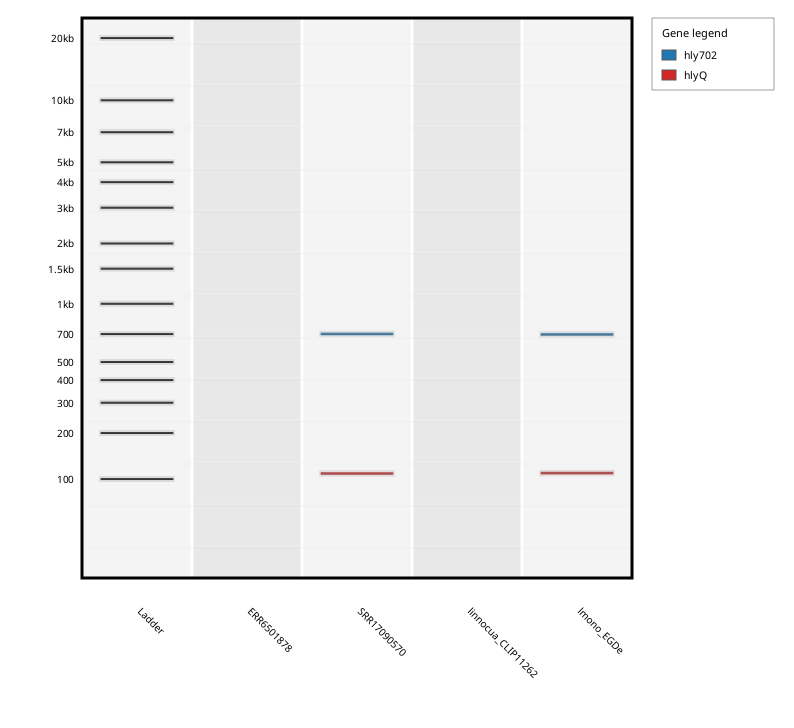
Each positive lane shows the two bands you would expect on a real gel — the 702 bp conventional product and the 112 bp qPCR product — while the negative-control lanes are loaded but empty, exactly like a wet-lab exclusivity control. Bands are colored by assay with a gene legend, matching the "Color by gene" option of the interactive GUI viewer (View Gel Image), which additionally offers hover tooltips, pagination, and SVG/PDF export.
- Re-run with
-m 2and watch the report stay identical — the assays match their target perfectly, and near-neighbor sites still fail the 3'-end rules. - Re-run with
-l 100: the 112 bp qPCR product now exceeds the maximum length and disappears;--min-length 200would drop it too. - Add your own assay for a different gene to the primer FASTA — mixed files are fine as long as every ID ends in
-F,-R, or-P. - Open
tutorial_results/detailed_report/<sample>/<sample>.tsvto audit the raw BLAST hits behind every call.