synchronize Job Notification to fix join() (fixes #148) #153
Conversation


 jukzi
force-pushed
the
574883_fix
branch
2 times, most recently
from
jukzi
force-pushed
the
574883_fix
branch
2 times, most recently
from
69f59bb to
82cccad
Compare


|
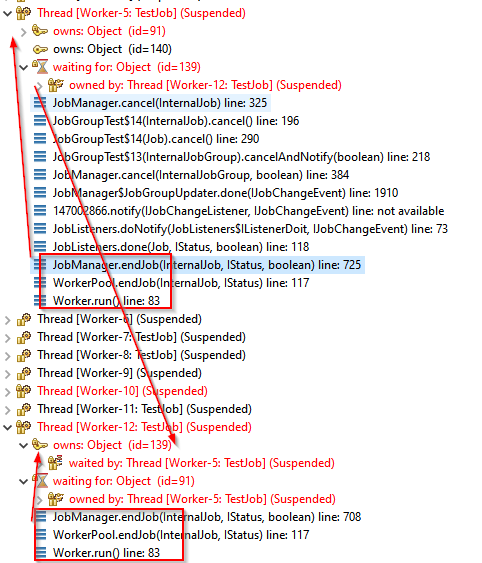
damn now notification can deadlock. as happens in org.eclipse.core.tests.runtime.jobs.JobGroupTest.testShouldCancel_4() where endJob notifies JObGroupTest which tries to cancel. |

|
Don't know if such a thing exits, but for me it seems it would be useful to have a Flow-Chart of the Job API where one can see the (desired) valid flows, e.g when does a Job transitions to what state, what listeners are the called and if its allowed for a listener to reschedule a job. It seems currently not all Workflows are visible and thus it makes it hard to decide how to properly synchronize. |
I would prefer if the events happen in a intuitive order instead of this &/%&%" - as in the example the same Job is ending two times in parallel. Need to find a way that a job is not started again before all its events have been processed. |
But what is intuitive order? That's what I mean, should one really expect some "order" of events, or are these actually only notifications?
That's another point that needs to be decided is it valid to schedule a job twice? If not one could simply skip the schedule if the job is marked for scheduling already... |

No need to be decided anything, it is valid. |
Sorry I wanted to write 'describe' instead, but in that case it is valid what was tried to be fixed here and actually only the client code might decide if it should schedule the job? |
|
Two hours ago the test did not fail on my local computer. now they reproducible fail. its driving me nuts. AAAAAAAAAAAAAAAAAAAAAAAAA |
|
Please review. Bug_574883.testJoinLambdaOften still fails but in average after much more iterations on my computer |

and add a more reliable failing example
Bug 574883 - Job.getJobManager().join(family) doesn't wait for a
re-scheduled job

1. Do not restart the Job (in another thread) before it's notifications
have been processed by the join listener. That is also wanted for other
Listeners since they should be able to decide if the Job
should start again (see JobTest.testCancelFromAboutToRun(),
JobGroupTest-testShouldCancel_4()) and could use the information about
how the previous job ended.
Previously it was possible that the Job notifications was send and
processed in different threads and - since not synchronized - in
arbitrary order. Especially a job
could restart in another worker thread before the notification was
processed that previous job execution was done.
Still the events are processed in different threads, but the
notification order is fixed.

2. Perform reschedule while holding lock to prevent unsynchronized
moments where Jobs that are rescheduled are neither running, sleeping or
waiting

3. Synchronize read/write access to InternalJob.flags to atomically
change bits.

The benefit is shown by JUnit Test Bug_574883.testJoinLambdaOften().
Basic functionality is tested by JobTest, JobGroupTest

The join() implementation is still not 100% bullet proof but the chance
of false joins are reduced by some reasons.


| /** | ||
| * This signal is used to synchronize Job listener notification | ||
| */ | ||
| volatile boolean waitForNotificationFinsished; |

There was a problem hiding this comment.
There is a type in the name of the field. Should be Finished rather than Finsished

4 participants


Bug 574883 - Job.getJobManager().join(family) doesn't wait for a
re-scheduled job
Add and use a Job specific lock to make sure the notification that a
job stopped is send before the job is reported to be started again
(in another thread).
JobManager.schedule() - when called from endJob() - is called within
the synchronized(lock)) instead of using a second (non atomic)
synchronized(lock) afterwards. The notification is still send outside
that synchronized(lock).
Previously it was possible that the Job notifications was send and
processed in different threads and - since not synchronized - in
arbitrary order. Especially a job
could restart in another worker thread before the notification was
processed that previous job execution was done.
Still the events are processed in different threads, but the
notification order is fixed.
=> The same Job will not start again before all listeners noticed that
the Job was finished. That is also wanted for other Listeneres then the
join() Listener since the Listeners should be able to decide if the Job
should start again (see JobTest.testCancelFromAboutToRun())
The benefit is proven by JUnit Test Bug_574883.testJoinLambdaOften().
Basic functionality is tested by JobTest.