Cross LLM Comparison
How much does the LLM generation matter for autonomous hyperparameter optimization? This page tracks cross-generation comparison experiments: the same dataset, same hardware, same codebase, same training budget — but different Claude model versions driving the optimization.
Stock Baseline Comparison — ClimbMix Complete (3 models). All models start from identical stock upstream defaults (AR=64). Haiku 4.5 wins ClimbMix (1.2953) by discovering architecture changes both Sonnets missed. Sonnet 4.0 finishes last (1.3588) — it never tried changing ASPECT_RATIO, staying at AR=64 for all 100 experiments.
Sonnet 4.0 vs 4.6 (pre-optimized): Complete (5/5 datasets). Sonnet 4.6 wins 3–2 on absolute val_bpb from pre-optimized baselines.
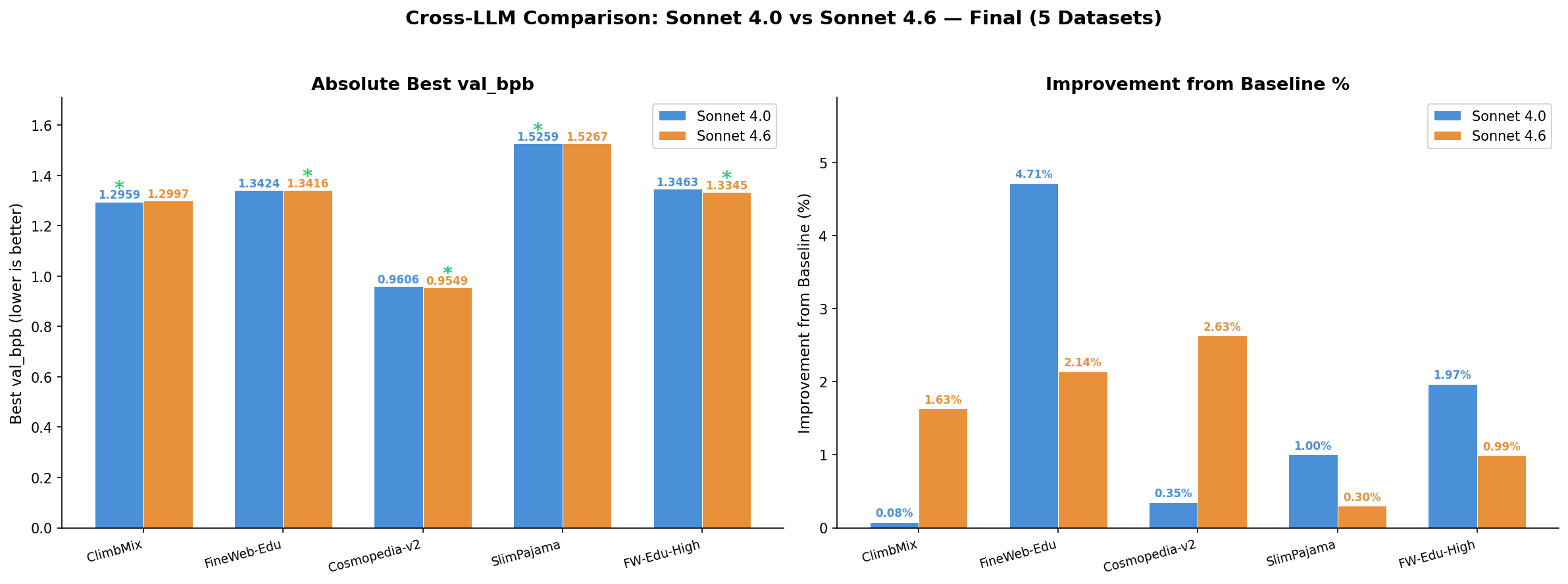
| Metric | ClimbMix | FineWeb-Edu | Cosmopedia-v2 | SlimPajama | FineWeb-Edu-High |
|---|---|---|---|---|---|
| S4.0 baseline | 1.2969 | 1.4088 | 0.9640 | 1.5410 | 1.3730 |
| S4.6 baseline | 1.3213 | 1.3710 | 0.9806 | 1.5312 | 1.3478 |
| S4.0 best | 1.2959 | 1.3424 | 0.9606 | 1.5259 | 1.3463 |
| S4.6 best | 1.2997 | 1.3416 | 0.9549 | 1.5267 | 1.3345 |
| S4.0 improvement | −0.08% | −4.71% | −0.35% | −1.0% | −1.97% |
| S4.6 improvement | −1.63% | −2.14% | −2.63% | −0.30% | −0.99% |
| S4.0 keeps | 1 | 17 | 4 | 3 | 20 |
| S4.6 keeps | 8 | 18 | 16 | 2 | 13 |
| S4.0 crashes | 11 | 2 | 2 | 0 | 5 |
| S4.6 crashes | 5 | 1 | 0 | 2 | 2 |
| Winner (absolute) | S4.0 | S4.6 | S4.6 | S4.0 | S4.6 |
Final scorecard: Sonnet 4.6 wins 3–2 on absolute val_bpb (FineWeb-Edu, Cosmopedia-v2, FineWeb-Edu-High). Sonnet 4.0 wins on ClimbMix and SlimPajama — both general text datasets where it started from pre-optimized baselines.
Note: The Sonnet runs used inconsistent baselines (S4.0 started from pre-optimized configs, S4.6 from partially-reset defaults). Future model comparisons (Haiku, Opus) will use stock upstream defaults for fair comparison — see methodology.
| Metric | Sonnet 4.0 (Mar 19) | Sonnet 4.6 (Mar 22) | Winner |
|---|---|---|---|
| Best val_bpb | 1.2959 | 1.2997 | Sonnet 4.0 |
| Improvement | −0.08% | −1.63% | Sonnet 4.6 (20×) |
| Keeps | 1 (1.0%) | 8 (6.8%) | Sonnet 4.6 |
| Crashes | 11 (11.0%) | 5 (4.2%) | Sonnet 4.6 |
Sonnet 4.0 wins on absolute val_bpb (pre-optimized baseline advantage), but Sonnet 4.6 found 20× more improvement and 7× more keeps.
| Metric | Sonnet 4.0 (Mar 17) | Sonnet 4.6 (Mar 22) | Winner |
|---|---|---|---|
| Best val_bpb | 1.3424 | 1.3416 | Sonnet 4.6 (by 0.0008) |
| Improvement | −4.71% | −2.14% | Sonnet 4.0 (more room) |
| Keeps | 17 (19.3%) | 18 (18.0%) | Comparable |
| Crashes | 2 (2.3%) | 1 (1.0%) | Sonnet 4.6 |
Near-identical results via completely different configs — 8 of 10 parameters differ. Proves FineWeb-Edu has multiple near-equivalent optima.
| Metric | Sonnet 4.0 (Mar 20) | Sonnet 4.6 (Mar 24) | Winner |
|---|---|---|---|
| Best val_bpb | 0.9606 | 0.9549 | Sonnet 4.6 (by 0.006) |
| Improvement | −0.35% | −2.63% | Sonnet 4.6 (7.5×) |
| Keeps | 4 (3.9%) | 16 (16.0%) | Sonnet 4.6 (4×) |
| Crashes | 2 (1.9%) | 0 (0.0%) | Sonnet 4.6 |
Sonnet 4.6's strongest showing. Discovered ASPECT_RATIO=21 (vs AR=32), breaking the AR=32 consensus from all Sonnet 4.0 runs. Zero crashes.
| Metric | Sonnet 4.0 (Mar 20) | Sonnet 4.6 (Mar 25) | Winner |
|---|---|---|---|
| Best val_bpb | 1.5259 | 1.5267 | Sonnet 4.0 (by 0.0008) |
| Improvement | −1.0% | −0.30% | Sonnet 4.0 |
| Keeps | 3 (3.0%) | 2 (2.0%) | Comparable |
| Crashes | 0 (0.0%) | 2 (2.0%) | Sonnet 4.0 |
The hardest dataset to optimize. Both models find SlimPajama nearly impervious — total improvements of just 1.0% and 0.30%. Sonnet 4.6 went 62 experiments without a single keep before finding a triple-synergy combination (β1, FINAL_LR_FRAC, WARMDOWN_RATIO together). Sonnet 4.0 edges out on absolute val_bpb.
| Metric | Sonnet 4.0 (Mar 21) | Sonnet 4.6 (Mar 25) | Winner |
|---|---|---|---|
| Best val_bpb | 1.3463 | 1.3345 | Sonnet 4.6 (by 0.012) |
| Improvement | −1.97% | −0.99% | Sonnet 4.0 (more room) |
| Keeps | 20 (20.0%) | 13 (12.9%) | Sonnet 4.0 |
| Crashes | 5 (5.0%) | 2 (2.0%) | Sonnet 4.6 |
Sonnet 4.6 wins decisively on absolute val_bpb (1.3345 vs 1.3463). The signature finding: a spectacular β2 walk — 5 consecutive keeps as β2 decreased from 0.98→0.975→0.970→0.968→0.966→0.964. Sonnet 4.0 had more keeps (20 vs 13) but started from a worse baseline with more room to improve.
FineWeb-Edu-High Configuration Comparison (click to expand)
| Parameter | Sonnet 4.0 | Sonnet 4.6 | Same? |
|---|---|---|---|
| ASPECT_RATIO | 32 | 21 | ❌ |
| MATRIX_LR | 0.047 | 0.068 | ❌ |
| EMBEDDING_LR | 0.375 | 0.60 | ❌ |
| SCALAR_LR | 0.39 | 0.18 | ❌ |
| WEIGHT_DECAY | 0.10 | 0.08 | ≈ |
| WARMDOWN_RATIO | 0.48 | 0.75 | ❌ |
| FINAL_LR_FRAC | 0.085 | 0.05 | ❌ |
| ADAM β1 | 0.66 | 0.45 | ❌ |
| ADAM β2 | 0.95 | 0.964 | ❌ |
| WINDOW_PATTERN | SSSL | SSSS | ❌ |
| MLP_RATIO | 4.25 | 4.0 | ❌ |
Every single parameter differs. Yet Sonnet 4.6 achieves 0.9% better val_bpb — the largest absolute gap in any comparison.
Starting with Haiku 4.5, all model comparison runs use stock upstream defaults as their baseline. This ensures every model starts from an identical, unoptimized configuration:
# Stock upstream defaults (used for all new model comparisons)
ASPECT_RATIO = 64       # Original upstream default
EMBEDDING_LR = 0.6
MATRIX_LR = 0.04
SCALAR_LR = 0.5
WEIGHT_DECAY = 0.2
ADAM_BETAS = (0.8, 0.95)
WARMDOWN_RATIO = 0.5
FINAL_LR_FRAC = 0.0
WINDOW_PATTERN = "SSSL"
The --reset-defaults flag in run_suite.py resets train_mlx.py to these values before each dataset, preventing cross-model and cross-dataset contamination.
Why this matters: The initial Haiku run (aborted) inherited Sonnet 4.6's accumulated config (AR=21, β2=0.964), giving it a baseline (1.2966) that already beat Sonnet 4.0's best (1.2959). That invalidated the comparison. Stock defaults ensure each model is measured by its own optimization ability.
| Metric | Sonnet 4.0 | Haiku 4.5 | Winner |
|---|---|---|---|
| Stock baseline | 1.4159 | 1.4085 | ~same |
| Best val_bpb | 1.3588 | 1.2953 | Haiku (by 0.0635) |
| Δ from baseline | −4.03% | −8.04% | Haiku (2× better) |
| Keeps | 15 (15.0%) | 10 (10.0%) | S4.0 |
| Crashes | 0 (0.0%) | 3 (3.0%) | S4.0 |
| First keep | exp3 | exp6 | S4.0 |
| AR explored | Never (stayed AR=64) | AR=32 (2 keeps) | Haiku |
| Depth explored | Once (catastrophic) | Yes (3 keeps) | Haiku |
| Window pattern | SSSL (never changed) | LLLL (1 keep) | Haiku |
| β1 walk | 0.8→0.635 (5 keeps) | 0.8→0.77 (via synergy) | Both |
| Multi-param synergy | No | Yes (exp90) | Haiku |
| Final throughput | 27.3K tok/sec (251 steps) | 76.0K tok/sec (697 steps) | Haiku (2.8×) |
| Final memory | 26.1 GB | 11.6 GB | Haiku (56% less) |
Full Sonnet 4.0 analysis → | Full Haiku 4.5 analysis →
The architecture gap is decisive. Haiku discovered AR=32, depth reduction, and LLLL attention — tripling throughput from ~207 to 697 steps. Sonnet 4.0 never changed architecture, staying at AR=64 with only 251 steps. More gradient steps = better optimization, regardless of how well-tuned the optimizer parameters are.
Sonnet 4.0 is a better optimizer-tuner. Higher keep rate (15% vs 10%), zero crashes, faster first keep (exp3 vs exp6), and a precise β1 walk (0.8→0.635 in 5 keeps). But it only explores one dimension of the search space.
Why didn't Sonnet 4.0 try architecture changes? It attempted one depth increase (exp75) that produced a catastrophic result (1.6795, +18.7%). This single bad experience may have permanently deterred architecture exploration — a classic negative transfer from one data point.
Sonnet 4.0 and Haiku 4.5 ClimbMix complete. FineWeb-Edu, Cosmopedia-v2, SlimPajama, FineWeb-Edu-High next. Sonnet 4.6 stock baseline runs also planned.
Same methodology: stock defaults, same 5 datasets, same hardware.
| Dataset | S4.0 Best | S4.6 Best | Gap | Winner |
|---|---|---|---|---|
| ClimbMix | 1.2959 | 1.2997 | +0.0038 | S4.0 |
| FineWeb-Edu | 1.3424 | 1.3416 | −0.0008 | S4.6 |
| Cosmopedia-v2 | 0.9606 | 0.9549 | −0.0057 | S4.6 |
| SlimPajama | 1.5259 | 1.5267 | +0.0008 | S4.0 |
| FineWeb-Edu-High | 1.3463 | 1.3345 | −0.0118 | S4.6 |
Sonnet 4.0's wins are narrow (0.0038 and 0.0008) and benefited from pre-optimized baselines. Sonnet 4.6's wins are larger (up to 0.0118 on FineWeb-Edu-High) and came despite starting from worse baselines.
| Dataset | Sonnet 4.0 | Sonnet 4.6 | Reduction |
|---|---|---|---|
| ClimbMix | 11.0% | 4.2% | 2.6× fewer |
| FineWeb-Edu | 2.3% | 1.0% | 2.3× fewer |
| Cosmopedia-v2 | 1.9% | 0.0% | ∞ (zero crashes) |
| SlimPajama | 0.0% | 2.0% | S4.0 wins |
| FineWeb-Edu-High | 5.0% | 2.0% | 2.5× fewer |
| Total | 20 / 494 (4.0%) | 10 / 521 (1.9%) | 2.1× fewer |
Sonnet 4.6 crashes half as often overall. The sole exception is SlimPajama, where Sonnet 4.0 had zero crashes.
| Dataset | S4.0 params changed | S4.6 params changed |
|---|---|---|
| ClimbMix | 1 | 3 |
| FineWeb-Edu | 6 | 9 |
| Cosmopedia-v2 | 4 | 10 |
| SlimPajama | 3 | 4 |
| FineWeb-Edu-High | 8 | 10 |
| Average | 4.4 | 7.2 |
Sonnet 4.6 consistently explores 60% more parameter dimensions and builds compositional improvements across all datasets.
| Dataset | S4.0 AR | S4.6 AR | Agreement? |
|---|---|---|---|
| ClimbMix | 32 | 32 | ✅ |
| FineWeb-Edu | 32 | 32 | ✅ |
| Cosmopedia-v2 | 32 | 21 | ❌ |
| SlimPajama | 32 | 21 (inherited) | ❌ (different defaults) |
| FineWeb-Edu-High | 32 | 21 (inherited) | ❌ (different defaults) |
Sonnet 4.6's Cosmopedia-v2 AR=21 discovery propagated to subsequent runs via defaults. Neither SlimPajama nor FineWeb-Edu-High tried to change it — both explored narrower (AR=14, 16) and wider (AR=24, 26, 28) alternatives and found AR=21 near-optimal.
Sonnet 4.6 wins 3–2 on absolute val_bpb, but the margins are small on 4 of 5 datasets. The optimization landscape has natural performance floors that both models can approach. The exception is FineWeb-Edu-High, where Sonnet 4.6's β2 walk found a clearly better optimum.
By every meta-metric, Sonnet 4.6 outperforms:
- Crashes: 1.9% vs 4.0% (2.1× fewer)
- Parameter dimensions explored: 7.2 vs 4.4 per run (60% more)
- Compositional optimization: Consistently builds synergistic multi-parameter improvements
- β2 discovery: Systematic β2 walks (never attempted by Sonnet 4.0) produced keeps on 3 of 5 datasets
Sonnet 4.0 found AR=32 optimal on all 5 datasets. Sonnet 4.6 found AR=21 optimal on Cosmopedia-v2 and the result propagated — neither SlimPajama nor FineWeb-Edu-High reverted it. The "hardware-optimal architecture" depends on the LLM's exploration strategy, not just the hardware.
On FineWeb-Edu, both models find the same val_bpb via completely different configs (8/10 parameters differ). On FineWeb-Edu-High, every single parameter differs yet Sonnet 4.6 still beats Sonnet 4.0. The optimization landscape has multiple basins at similar or different depths.
Both models find SlimPajama nearly impervious to optimization (0.30–1.0% improvement, 2–3 keeps). Its 7-source diversity creates a flat optimization landscape where no parameter adjustment can meaningfully improve the model's ability to compress such varied data in 5 minutes.
-
Would AR=21 improve Sonnet 4.0's results? Sonnet 4.0 never tested AR<32 on any dataset. Running Sonnet 4.0 with AR=21 on Cosmopedia-v2 would reveal whether the AR=21 advantage is model-specific or universal.
-
Can we combine the best insights from both models? The models found complementary strategies (e.g., low WD vs low momentum on FineWeb-Edu). A hybrid config might beat both.
-
Is Sonnet 4.6's β2 walk transferable to Sonnet 4.0 datasets? The β2 walk was Sonnet 4.6's signature discovery. Testing β2<0.96 on Sonnet 4.0's best configs could unlock further improvements.
-
What would a different model tier find? ➜ Partially answered. Haiku 4.5 on ClimbMix (67 exp) rediscovers AR=32 but also finds novel improvements (depth reduction, LLLL attention, UNEMBEDDING_LR) that both Sonnets missed. Different model tiers explore different parameter dimensions. Full Haiku analysis →
See individual run pages: H4.5 ClimbMix (Mar 25) | S4.6 FineWeb-Edu-High (Mar 25) | S4.6 SlimPajama (Mar 25) | S4.6 Cosmopedia-v2 (Mar 24) | S4.6 FineWeb-Edu (Mar 22) | S4.6 ClimbMix (Mar 22) | S4.0 FineWeb-Edu-High (Mar 21) | S4.0 SlimPajama (Mar 20) | S4.0 Cosmopedia-v2 (Mar 20) | S4.0 ClimbMix (Mar 19) | S4.0 FineWeb-Edu (Mar 17) | Cross-Dataset Comparison