How do one add a description to a request body? #5992


-
First Check
Commit to Help
Example Codefrom fastapi import FastAPI
app=FastAPI()
@app.post("/items")
async def create_item(item: Item = Body(description="new")):
return {"item": item.dict()}DescriptionThe api doc should normally allocate the description to the request body, however it does not. Operating SystemWindows Operating System DetailsNo response FastAPI Versionfastapi==0.91.0 Python Version3.11.1 Additional Context
|

Beta Was this translation helpful? Give feedback.
Replies: 4 comments 2 replies

-
|
I just watch https://youtu.be/SORiTsvnU28?t=1149 where I learned the annotation is the place to document
|

Beta Was this translation helpful? Give feedback.

-
|
It doesn't answer my question |
Beta Was this translation helpful? Give feedback.

-
|
I misread the question. |
Beta Was this translation helpful? Give feedback.

-
|
I think (please, anyone correct me if I'm wrong) you can't do this without customization. By default, any extra key sent to the Body field is registered as a custom field for the schema. But if I understand correctly, in your case, you want to populate the You can check this in the source code here: An alternative solution is to customize the openapi with a function Note in the example below that I'm accessing the openapi_schema object explicitly (with a lot of chained dict access) to make the path clear and my example easy to understand 😅 from fastapi import FastAPI, Body
from fastapi.openapi.utils import get_openapi
from pydantic import BaseModel
class Item(BaseModel):
"""
Docstring from Pydantic
"""
basename: str
app = FastAPI()
@app.post("/items")
async def create_item(item: Item = Body(description="Body Description")):
"""Endpoint description"""
return {"item": item.dict()}
def custom_openapi():
if app.openapi_schema:
return app.openapi_schema
openapi_schema = get_openapi(title="", version="", routes=app.routes )
original_docstring = openapi_schema["paths"]["/items"]["post"]["requestBody"]["content"]["application/json"]["schema"]["description"]
openapi_schema["paths"]["/items"]["post"]["requestBody"]["description"] = original_docstring
app.openapi_schema = openapi_schema
return app.openapi_schema
app.openapi = custom_openapi
if __name__ == "__main__":
import uvicorn
uvicorn.run("x:app", reload=False)
Does this answer your question? |
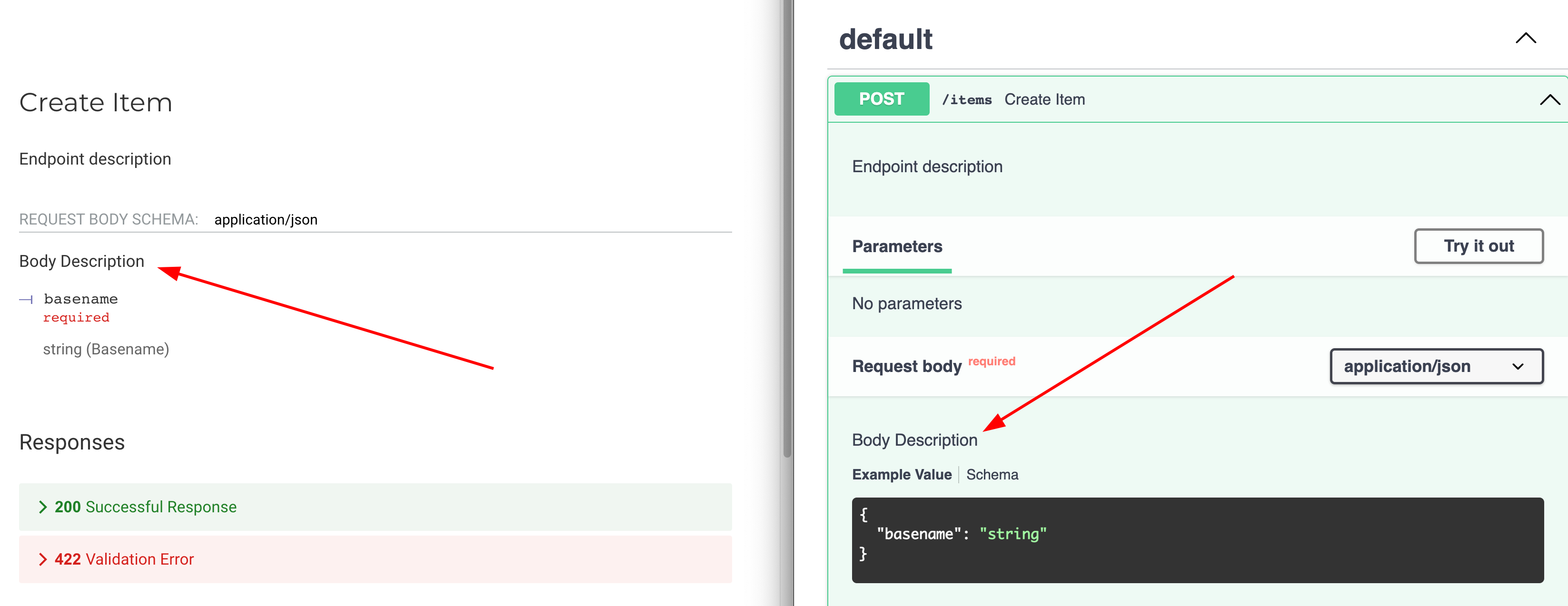
Beta Was this translation helpful? Give feedback.

-
|
I haven't figured out a solution different than the one @williamjamir has above. But just to point out one thing that may cause some confusion, it appears to me that the example Swagger UI that @clemens-tolboom shared is using OpenAPI 2.x (or Swagger). I am basing this on the fact that the screenshot shows the body as a parameter, and the description as a parameter description. FastAPI current version generates an OpenAPI 3.x, in which the requestBody replaced the body as a parameter. Here's info on that change: You can see this difference if you look at the petstore example and look at the /pet endpoint put verb: 2.x here (body is a parameter): And compare to the 3.x here (uses requestBody): Note: here's the issue that states FastAPI doesn't support OpenAPI 2.x |
Beta Was this translation helpful? Give feedback.

-
|
The correct way to specify description for request body is to use from fastapi import Body, FastAPI
from pydantic import BaseModel
app = FastAPI()
class Item(BaseModel):
name: str
@app.post(
"/items",
openapi_extra={"requestBody": {"description": "Request body description"}},
)
async def create_item(item: Item = Body()):
passFastAPI doesn't take description from @app.post("/items")
async def create_item(
item: Item = Body(description="Description 1"),
something: AnotherModel = Body(description="Description 2"),
):
pass |
Beta Was this translation helpful? Give feedback.


The correct way to specify description for request body is to use
openapi_extra={"requestBody": {"description": "Request body description"}}:FastAPI doesn't take description from
Body(description="...")because there might be multiple body parameters in your endpoint: