Future Roadmap
Signal's roadmap is organized around two distinct concerns: the intelligence synthesis layer and the supporting infrastructure beneath it.
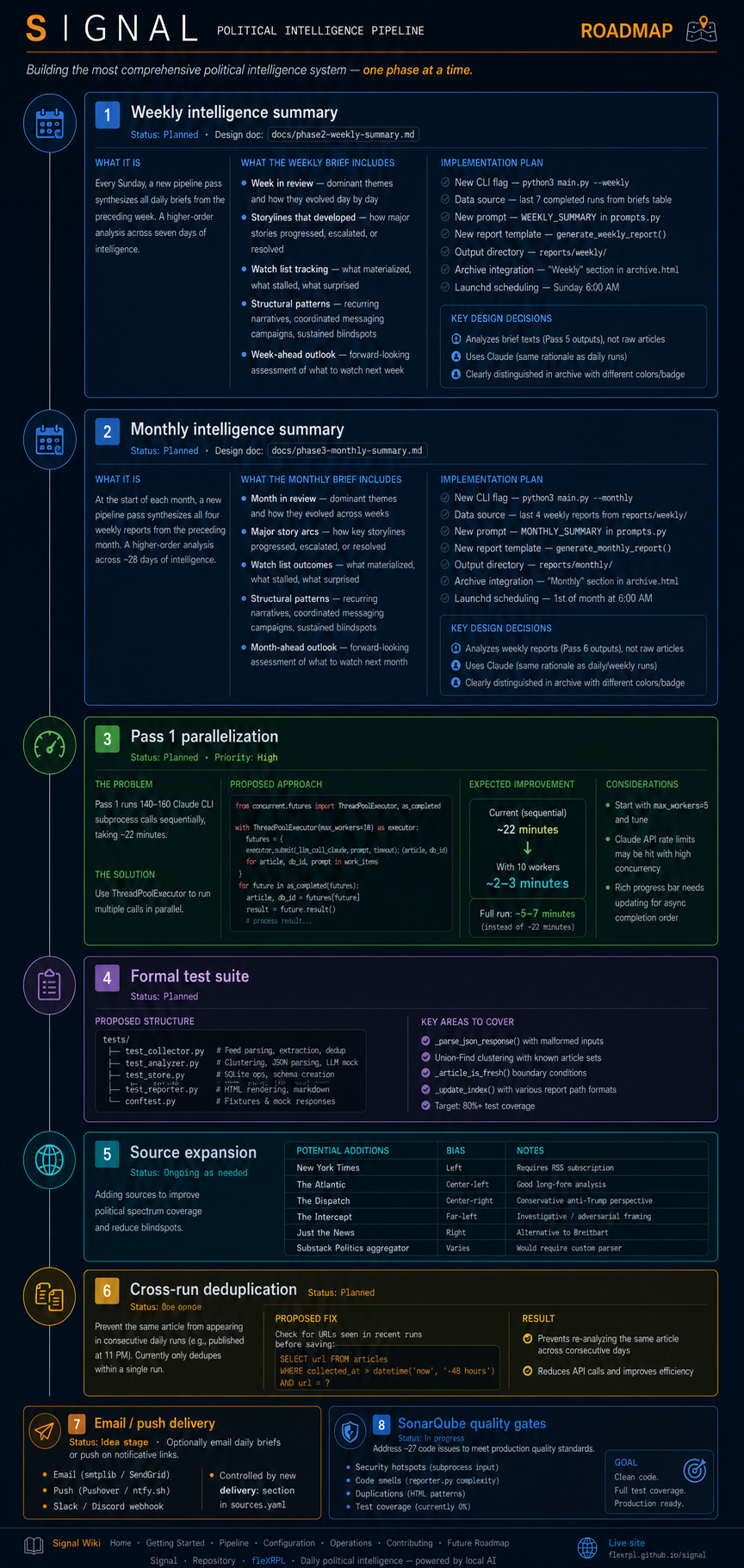
The core value of Signal is not the pipeline — it is the longitudinal reduction of noise into insight. Each synthesis pass operates at a longer time horizon and produces analysis that is only possible because of the layer below it:
Raw articles   →  Daily brief       (tactical signals)
Daily briefs   →  Weekly report     (emerging patterns)
Weekly reports →  Monthly report    (strategic shifts)      ← Phase 3
Monthly reports → Quarterly report  (structural trends)     ← future horizon
This mirrors how actual intelligence organizations reduce noise. The monthly and quarterly layers are not simply "summaries of summaries" — they enable analysis that is structurally impossible at shorter time horizons: narrative momentum tracking, forecast validation, persistent blindspot detection, and cross-cycle trend emergence.
Everything else — SonarQube cleanup, source expansion, cross-run deduplication, delivery — supports the synthesis layer but does not define it.
Status: ✅ Complete (May 2026). See Weekly-Reports for full documentation.
Every Sunday at 11:00 PM, a separate launchd job runs the weekly synthesis pipeline (Pass 6). It reads the past 7 days of daily briefs and correlation analyses from signal.db and makes a single LLM call to produce a weekly intelligence brief.
The weekly brief contains:
- Week in Review — the dominant political dynamic of the week as a whole
- Story Arc Tracker — how the top 3–5 stories evolved day by day
- What Escalated — items that grew in significance as the week progressed
- What Was Buried — stories that appeared then disappeared without resolution
- Blindspot of the Week — the most significant story both sides systematically underreported
- Watch List: Next Week — concrete forward-looking items with named entities and deadlines
- Analyst Note — a weekly assessment of trajectory
-
Read from DB, not HTML files — the structured JSON in
correlation_analysesandcluster_analysesis richer than re-parsing HTML. Each day'sSITUATION OVERVIEW,WATCH LIST, narrative patterns, and anomalies are extracted and fed to Pass 6. - Single LLM call — unlike daily Pass 1 (one call per article), the weekly synthesis is one large-context call. Claude handles this well; Ollama would struggle with the context window.
-
Gold/amber visual identity — weekly reports use a gold accent scheme (
#e3b341) instead of the daily blue, making them immediately distinguishable in the archive and on the landing page. -
Separate
weekly_briefsDB table — weekly runs never interfere with daily data. - Schedule: Sunday 11:00 PM — captures the full week including Sunday morning news, and publishes before Monday morning.
| File | Purpose |
|---|---|
pipeline/weekly.py |
Pass 6 — reads DB, formats daily summaries, calls LLM |
scripts/run_weekly_and_publish.sh |
Shell wrapper: runs weekly pipeline + git push |
scripts/com.flexrpl.signal.weekly.plist |
launchd configuration for Sunday 11 PM |
Status: Planned (target: late June 2026, once four weekly reports exist as inputs)
Every month, a monthly synthesis pass will read the four weekly briefs and produce a higher-order analysis focused on month-scale trends — story arc completion, what materialized from the watch list, and what dominated the month overall.
The pattern mirrors Phase 2 exactly. A new pipeline/monthly.py module (Pass 7) reads from the weekly_briefs table instead of briefs, condenses each week's brief into key sections, and makes a single LLM call.
| Dimension | Daily (Passes 1–5) | Weekly (Pass 6) | Monthly (Pass 7) |
|---|---|---|---|
| Input | RSS articles | 7 daily briefs | 4 weekly briefs |
| LLM calls | ~150 | 1 | 1 |
| DB source |
articles, briefs
|
briefs, correlation_analyses
|
weekly_briefs |
| Schedule | Daily 5:00 AM | Sunday 11:00 PM | 1st of month, 12:01 AM |
| Output | brief_YYYYMMDD_HHMM.html |
weekly_YYYYWNN_HHMM.html |
monthly_YYYY-MM_HHMM.html |
| Theme accent | Blue #58a6ff
|
Gold #e3b341
|
Green #3fb950
|
These sections are deliberately distinct from the weekly format. Monthly analysis is only meaningful because it can see across four separate weeks simultaneously.
- Month in Review — the dominant political dynamic of the month as a whole
- Narrative Momentum Index — which storylines gained or lost importance across the four weeks; what grew, what faded, what stalled
- Story Arc Completion — which stories that opened in the month resolved, escalated, or quietly disappeared
- Forecast Scorecard — compare each week's watch list against what actually happened the following week; a self-evaluation of the pipeline's predictive accuracy
- Persistent Blindspots — topics that were repeatedly omitted by one side of the spectrum across multiple weeks, revealing structural rather than incidental editorial bias
- Emerging Actors — people and organizations that became increasingly central across the month; signals of rising influence
- Cross-Month Trend Detection — themes that would be invisible in a 24-hour or 7-day window but become clear across 28+ days
- Watch List: Next Month — forward-looking items with named entities and expected timelines
- Analyst Note — monthly trajectory assessment
The Forecast Scorecard is the most structurally novel section — it is the first point in the pipeline where Signal evaluates its own prior analysis rather than just producing new analysis.
| File | Purpose |
|---|---|
pipeline/monthly.py |
Pass 7 — reads weekly_briefs, formats weekly summaries, calls LLM |
pipeline/prompts.py |
Add MONTHLY_BRIEF prompt constant |
scripts/run_monthly_and_publish.sh |
Shell wrapper: runs monthly pipeline + git push |
scripts/com.flexrpl.signal.monthly.plist |
launchd configuration for 1st of month, 12:01 AM |
At least four weekly reports must exist in signal.db before the monthly pipeline can run meaningfully. The first full month of weekly data will be available at the end of June 2026.
Status: Future horizon. Not planned for active development until Phase 3 is stable and at least two months of monthly reports exist.
Quarterly is where genuine political trend analysis begins to emerge rather than news analysis. A quarter of data — ~90 daily briefs, ~13 weekly reports, ~3 monthly reports — is long enough to detect structural shifts in the political landscape that are invisible at shorter time horizons.
Unique quarterly analytical outputs would include:
- Structural Shift Detection — which political dynamics fundamentally changed vs. which only appeared to change
- Narrative Lifecycle Analysis — full arc from emergence to resolution or institutionalization for major stories
- Actor Trajectory Index — which people and organizations rose, fell, or consolidated influence over 90 days
- Seasonal Pattern Recognition — distinguishing genuine political shifts from recurring seasonal news cycles
- Forecast Accuracy Review — evaluate monthly Forecast Scorecards against outcomes; a meta-level assessment of intelligence quality
The quarterly layer also enables something the shorter layers cannot: retrospective correction. A monthly event that looked significant at the time can be re-evaluated at 90 days with the benefit of what happened next.
Status: Deferred. Not necessary for current usage — the ~22 minute daily run completes well before the 5:00 AM window closes.
Current: Pass 1 runs 140–160 Claude CLI subprocess calls sequentially, taking ~22 minutes.
Proposed: Use concurrent.futures.ThreadPoolExecutor to run multiple calls in parallel:
from concurrent.futures import ThreadPoolExecutor, as_completed

with ThreadPoolExecutor(max_workers=10) as executor:
    futures = {
        executor.submit(_llm_call_claude, prompt, timeout): (article, db_id)
        for article, db_id, prompt in work_items
    }
    for future in as_completed(futures):
        article, db_id = futures[future]
        result = future.result()
        # process result...
Expected improvement: 10 workers × ~9 sec/call = Pass 1 completes in ~2–3 minutes instead of ~22. Full run time drops from 22 minutes to ~5–7 minutes.
Considerations:
- Claude API rate limits — Anthropic's API allows high concurrency on Pro/Max plans, but sustained 10-parallel subprocess calls may hit limits. Start with
max_workers=5and tune. - The Rich progress bar needs updating to work with async completion order.
Status: ✅ Complete (May 2026). See Testing for full documentation.
164 tests across all five pipeline modules. 91% overall coverage. analyzer.py at 100%. All LLM calls and network I/O are mocked — the suite runs in under two seconds.
Status: Ongoing as needed
Potential additions to improve spectrum coverage:
| Source | Bias | Notes |
|---|---|---|
| New York Times | left | Requires RSS subscription |
| The Atlantic | center-left | Good long-form analysis |
| The Dispatch | center-right | Conservative anti-Trump perspective |
| The Intercept | far-left | Investigative/adversarial framing |
| Just the News | right | Alternative to Breitbart |
| Substack Politics aggregator | varies | Would require custom parser |
Status: Planned
Currently, if an article is published at 11 PM, it may appear in both the Day 1 run (within the 24-hour window) and the Day 2 run (still within the window at 5 AM). URL deduplication is only within-run.
Proposed fix: Before saving articles in store.py, query for URLs already seen in recent runs:
SELECT url FROM articles
WHERE collected_at > datetime('now', '-48 hours')
AND url = ?
This would prevent re-analyzing the same article across consecutive days.
Status: Idea stage
Instead of only publishing to GitHub Pages, optionally email the daily brief to a subscriber list or push a notification with the report link.
Options:
-
Email: Send the HTML report via
smtplibor a service like SendGrid - Push notification: Use a service like Pushover or ntfy.sh
- Slack/Discord webhook: Post a summary and link to a channel
This would be controlled by a new delivery: section in sources.yaml.
Status: In progress
Remaining issues are cognitive complexity warnings in reporter.py and main.py — primarily due to the large HTML template functions. Test coverage is no longer a blocker (91% overall). Key remaining categories:
-
Code smells — overly complex functions in
reporter.py(_render_story_cards,_render_brief_sections) and_update_index()inmain.py - Duplications — repeated HTML generation patterns across daily and weekly templates