

Multi-stage behaviour classifier for text messages, expressed as raw text or within a CSV file. The main feature is the prediction of a behaviour for each message, using a user-modelling theory called Interaction Process Analysis [1]. With the prediction of the behaviour detected in the interactions of a given user, it is possible to automatically produce collaborative user profiles. This enables and enhances the efficiency of group arrangements.
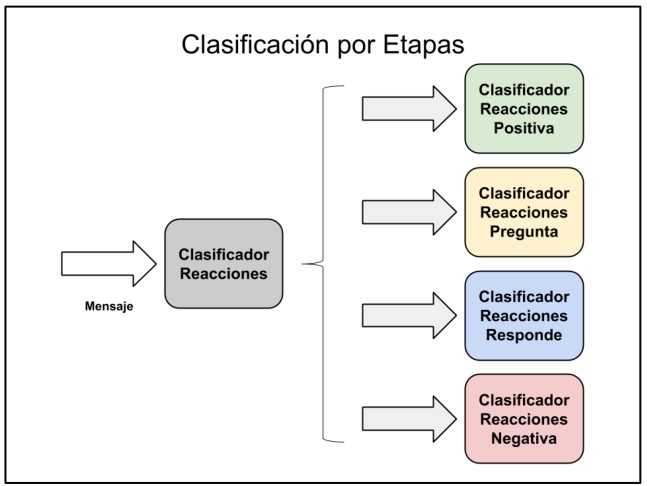
The IPA model establishes a series of 12 categories of behaviour, which can be grouped into 4 reactions: Positive, Negative, Asks and Answers. This grouping provides the possibility of classifying the behaviour in two stages, using five classifiers. The first classifier (first stage) predicts a reaction, while the remaining ones (second stage) predict the final behaviour, given the reaction.
The text messages are mapped to sentence-embeddings. Given a message, it is splitted in words, where each of them is mapped to a pre-trained word-embedding [2], e.g., a 5-word message, is mapped into 5 word-embedding. Then these vectors are averaged, producing a final vector (sentence-embedding) which represents the original sentence.
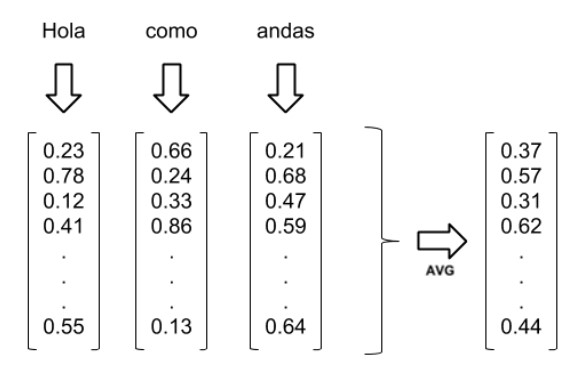
(ilustrative example)
Experiments were made with four types of neural networks, which vary in complexity and results. The best metrics were achieved with the last approach, based on Convolucional-Recurrent Neural Networks.
- 1st Approach: Regular Deep Neural Networks based on dense layers
- 2nd Approach: Convolutional Neural Networks
- 3rd Approach: LSTM-based Recurrent Neural Networks
- 4th Approach: Hybrid model based on Convolution followed by a Recurrent (CRNN)
[1] Bales, R. F. (1950). Interaction process analysis; a method for the study of small groups.
[2] Cristian Cardellino: Spanish Billion Words Corpus and Embeddings (March 2016), https://crscardellino.github.io/SBWCE/