An identity runtime for safely delegating GitHub operations to autonomous AI agents




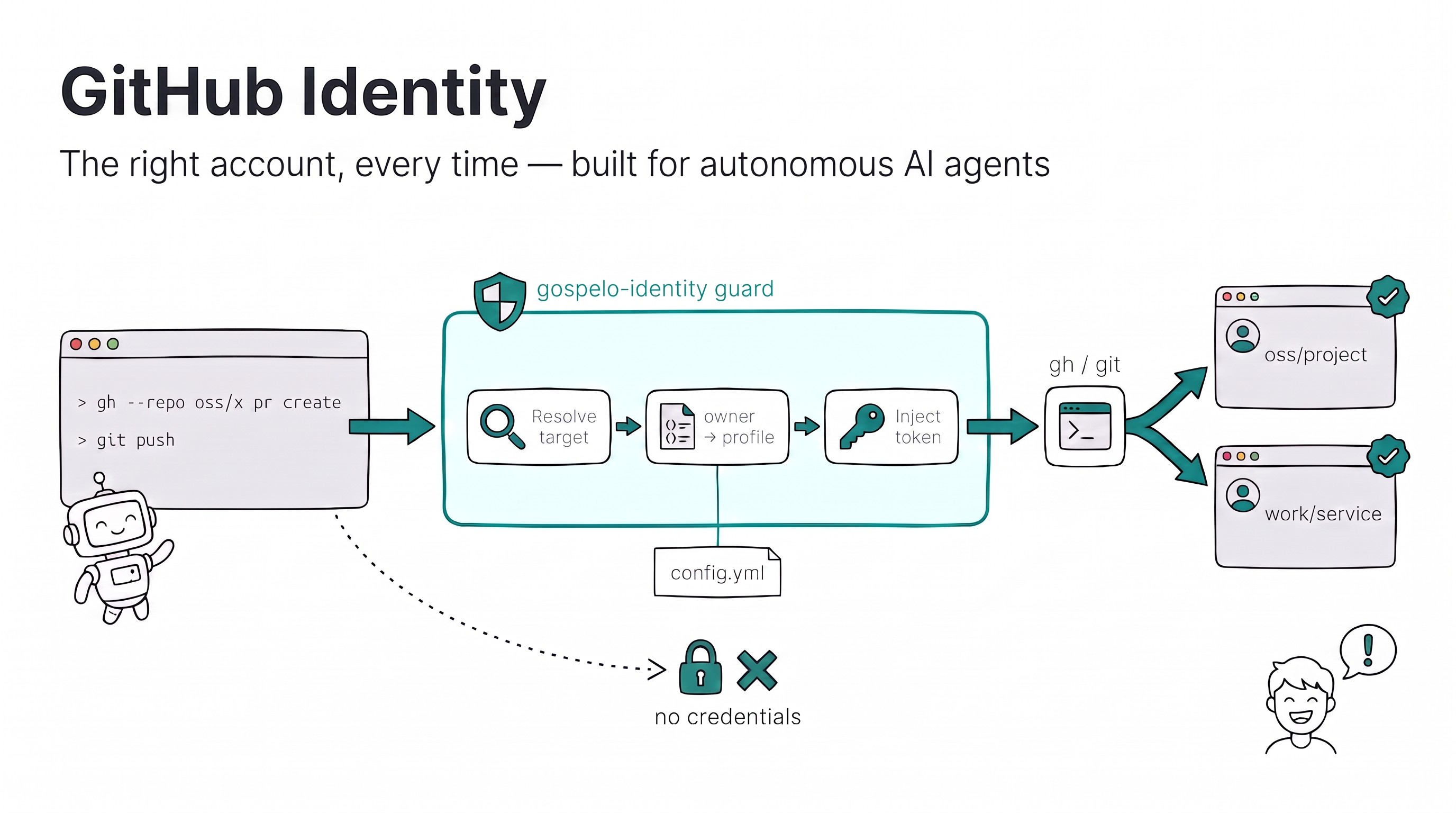
An identity runtime for entrusting GitHub writes — git push, gh pr create, gh release — to autonomously operating AI agents (Claude Code, Copilot, CI bots). It is not a convenience helper for human command-line use: it is designed for agents operating gh / git against the outside world, safely.
Identity is derived from the target repository of the operation, not from "the directory you happen to be in" (target-aware); the correct token is injected per invocation (enforce); and paths that do not go through the guard have no credentials at all (fail-closed). Because nothing depends on shell hooks or interactive prompts, it works with the same strength in an agent's non-interactive shell (bash -c ...) as in a human's interactive one.
Run an autonomous agent on a machine that juggles several GitHub accounts (personal OSS, employer, client) and human-oriented identity management collapses at its premises:
- Agents run in non-interactive shells — shell hooks like direnv only fire when a prompt is drawn, so
.envrcis never evaluated under an agent'sbash -c(direnv/direnv#262) - cwd and the operation target don't match — agents run
gh --repo owner/x pr createandgit -C /path/to/x pushfrom arbitrary places; cwd-based mechanisms never look at the target - The
ghaccount is one per machine — the active account is global state, not bound to a repository, and automatic switching based on pwd / remote is explicitly out of scope for gh itself (cli/cli multiple-accounts.md)
The result is an accident that assembles itself while no human is watching: a write to the right repo with the wrong account.
| Layer | Where identity is bound | Protected by |
|---|---|---|
| ① git author | target repo's local git config |
switch applies it; check / doctor verify it |
| ② SSH push auth | host alias in the remote URL + IdentitiesOnly |
doctor audits key pinning |
| ③ gh account | machine-global by nature ← the hole | guard injects a token derived from the operation target, per invocation |
Layers ① and ② can be pinned to the target repo with standard tooling. gospelo-github-identity brings ③ into the same "identity is bound to the target" structure, making all three layers target-local.
direnv (GH_TOKEN injection) |
gh auth switch |
gospelo-github-identity guard | |
|---|---|---|---|
| Non-interactive shells (agents) | ❌ hook never fires | — (manual) | ✅ always on via PATH shim |
| Identity derived from | cwd | machine-global | the target repository |
| When bypassed | ❌ global account goes through | ❌ same | ⭕ no credentials — fails safely |
Three design principles:
- target-aware — identity is derived from the
--repoargument /git -C/ the target repo's remote; cwd is only the last fallback - enforce — instead of inspecting and warning, the guard reverse-maps the target repo's owner to a profile and injects that profile's token as
GH_TOKENinto the real command - fail-closed — an unresolvable target, an undeclared owner, or a bypassed shim all degrade to "refuse to run / fail with an auth error", never to "succeed with the wrong identity"
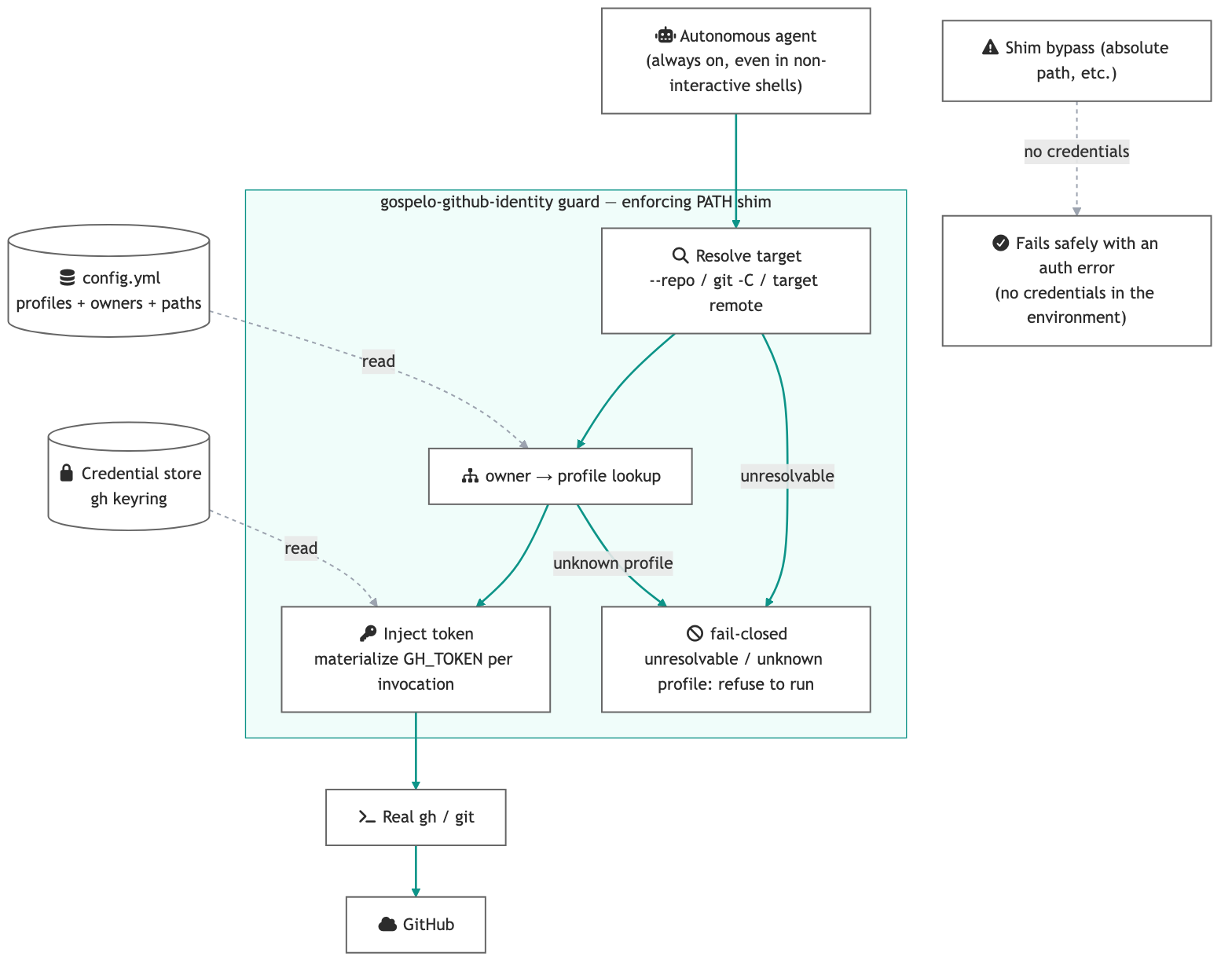
Diagram source (Mermaid)
flowchart TB
    Agent["fa:fa-robot Autonomous agent<br/>(always on, even in non-interactive shells)"]
    subgraph Guard["gospelo-github-identity guard — enforcing PATH shim"]
        Resolve["fa:fa-magnifying-glass Resolve target<br/>--repo / git -C / target remote"]
        Map["fa:fa-sitemap owner → profile lookup"]
        Inject["fa:fa-key Inject token<br/>materialize GH_TOKEN per invocation"]
        Deny["fa:fa-ban fail-closed<br/>unresolvable / unknown profile: refuse to run"]
    end
    Config[("fa:fa-database config.yml<br/>profiles + owners + paths")]
    Store[("fa:fa-lock Credential store<br/>gh keyring")]
    Real["fa:fa-terminal Real gh / git"]
    Hub["fa:fa-cloud GitHub"]
    Bypass["fa:fa-triangle-exclamation Shim bypass (absolute path, etc.)"]
    Fail["fa:fa-circle-check Fails safely with an auth error<br/>(no credentials in the environment)"]

    Agent --> Resolve
    Resolve --> Map
    Map --> Inject
    Inject --> Real
    Real --> Hub
    Resolve -->|unresolvable| Deny
    Map -->|unknown profile| Deny
    Config -.->|read| Map
    Store -.->|read| Inject
    Bypass -.->|no credentials| Fail

    classDef node fill:#FFFFFF,stroke:#666666,stroke-width:1.5px,color:#2C2C2C
    class Agent,Resolve,Map,Inject,Deny,Config,Store,Real,Hub,Bypass,Fail node
    style Guard fill:#F0FDFA,stroke:#0D9488,color:#2C2C2C

    %% normal flow = solid teal / reads & bypass = dashed grey
    linkStyle 0,1,2,3,4,5,6 stroke:#0D9488,stroke-width:2px
    linkStyle 7,8,9 stroke:#9CA3AF,stroke-width:1.5px,stroke-dasharray:4 4
Dashed arrows are reads or bypass paths; solid arrows are the enforced flow that leads to a write. Fail-closed is the keystone: the PATH shim can be bypassed with an absolute path, but if no GH_TOKEN lives in the environment (no direnv needed) and no global active account is kept, there are no credentials on the far side of the bypass — so a bypass degrades into an auth error, not a success under the wrong account. doctor audits that this discipline is being maintained.
pip install gospelo-github-identityRequires Python 3.11+, with git and the gh CLI on PATH.
A human runs the setup once; from then on the machine stays in a state agents can operate safely:
# 1. Create the config interactively (declare profiles / paths / owners)
gospelo-github-identity init

# 2. Audit the setup and the fail-closed state
#    (bare remotes, aliases with no pinned key, GH_TOKEN lingering in the env ...)
gospelo-github-identity doctor --sweep

# 3. Install the guard (shadow gh / git with PATH shims)
gospelo-github-identity install-guard --tools gh,git
export PATH="$HOME/.gospelo-github-identity/bin:$PATH"   # add to ~/.zshrc / ~/.bashrc

# 4. Verify — identity is selected from the target repo, from any cwd
gospelo-github-identity check
gh --repo <owner>/<repo> repo view   # runs with the token of the profile that owns <owner>
No agent-side configuration is needed (the PATH shim intercepts every gh / git call). To layer an additional pre-write check on the agent itself, install the agent skills.
| Command | Description |
|---|---|
init |
Interactively create ~/.config/gospelo-github-identity/config.yml |
list |
List registered profiles as a table |
detect |
Print the profile that applies to the current directory |
check |
Compare expected vs. live state (git config / gh CLI) |
doctor |
Audit the health of the setup: identity scope/values, remote + SSH alias key pinning, ambient credentials (lingering GH_TOKEN / GITHUB_TOKEN). --sweep audits a profile's whole tree |
switch <profile> |
One-shot manual application of a profile's git config |
prompt |
Shell-prompt integration helper (--format=ps1 / plain / color) |
install-guard / uninstall-guard |
Shadow gh / git with PATH shims that enforce target-repo-based identity |
install-commit-hook / uninstall-commit-hook |
Global commit-msg hook that strips Co-Authored-By trailers |
See the CLI reference for details.
In ~/.config/gospelo-github-identity/config.yml, declare profiles so they can be resolved from both directories (paths) and GitHub owners (owners). owners is the linchpin of target-aware enforcement — the guard takes the owner from gh --repo or the target repo's remote and reverse-maps it to a profile:
version: "1"

profiles:
  oss:
    description: "Personal OSS work"
    git:
      user.name: your-oss-login
      user.email: you@example.com
    gh:
      account: your-oss-login
      owners: [your-oss-login, your-oss-org]   # writes to these owners use this identity
    paths:                                      # cwd fallback (for operations with no repo target)
      - ~/projects/oss/**

  work:
    description: "Company work"
    git:
      user.name: your-oss-login
      user.email: you@company.com
    gh:
      account: your-work-login
      owners: [your-company-org]
    paths:
      - ~/projects/work/**
Target resolution order: the --repo owner/name argument → the remote of the repo given to git -C <path> → the cwd's remote → (only for operations with no repo target) the cwd's paths match. A write whose profile cannot be resolved by any of these is not executed (fail-closed). GOSPELO_GITHUB_IDENTITY_SKIP=1 bypasses the guard once, explicitly; GOSPELO_GITHUB_IDENTITY_QUIET=1 suppresses status output.
Sample configs live in examples/; the schema is documented in the config format reference.
- What it protects against is accidental wrong identity. Defense against adversarial processes is the job of OS sandboxing, outside this tool's scope
- Push authentication holds together with an SSH workflow (host-aliased remotes +
IdentitiesOnly yes).doctordetects baregit@github.comremotes and aliases with no pinned key - Token injection assumes each account is logged into the keyring via
gh auth login(missing logins are caught bydoctor) - A process that reads the credential store directly cannot be stopped (→ the territory of OS sandboxes / dedicated users)
The target repo's owner is not declared in any profile's owners. This is fail-closed working as intended. Add the owner to the right profile in your config — or, for a deliberate one-off, run with GOSPELO_GITHUB_IDENTITY_SKIP=1.
gh auth switch only flips the active label in hosts.yml; it never re-validates the token. The real identity is gh api user (the account the token actually belongs to). check has always compared against the real token, and switch verifies at the token level after switching — on mismatch it reports NG ... keyring mismatch and exits non-zero. Fix:
gh auth logout --hostname github.com --user <account>
gh auth login  --hostname github.com          # authenticate in the browser as <account>
gospelo-github-identity checkAn operation with no repo target, and the cwd matches no profile's paths. Add a matching glob or set default_profile.
| Code | Meaning |
|---|---|
0 |
Success / match |
1 |
Expected condition not met (mismatch / refusal by fail-closed / no matching profile, etc.) |
2 |
Tool error (missing config, invalid YAML, external tool failure, etc.) |
- Quick start
- CLI reference
- Config format
- Shell integration
- Architecture design (enforce + fail-closed)
The Japanese manual lives in docs/manual/ja/ (see also README_ja.md).
On top of the guard (the enforcement layer), these skills add a defense-in-depth check the agent runs on itself: gospelo-github-identity check fires automatically before write operations — git push, PR creation, releases, package publishing — and stops the operation on mismatch. See skills/README.md.
- Claude Code skill — install under
.claude/skills/gospelo-github-identity-check/ - GitHub Copilot skill — install under
.github/copilot/skills/gospelo-github-identity-check/(subject to change as Copilot's skill spec evolves)
MIT — free to use, including commercially. You own the copyright of any config.yml you write. See LICENSE.md for details.