Publication-quality LLM architecture figures from config.json alone — no weights, no GPU, no transformers install.



Point it at any model — a Hugging Face id, a local GGUF file, or a model installed in Ollama — and get a hand-drawn-quality architecture figure in the visual language of Sebastian Raschka's LLM Architecture Gallery: the decoder tower with dotted-leader callouts, the MoE router inset, the SwiGLU module, and parameter counts computed from the config, not scraped from a model card.
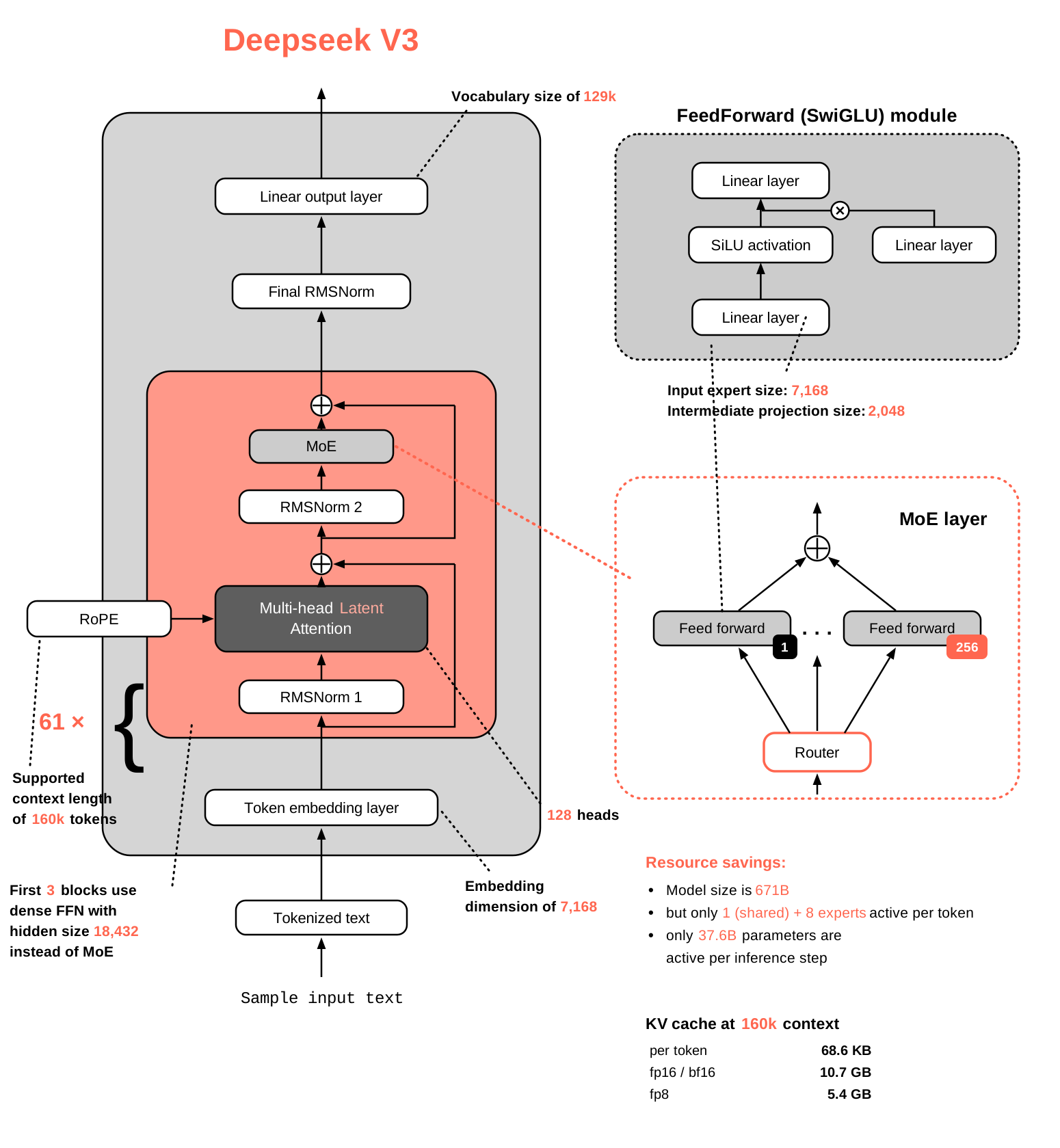
Hand-drawn galleries are wonderful and update episodically. llmviz generates the same figure in milliseconds, for any model, the day its config lands on the Hub — including architectures that didn't exist when this tool was written. The parser is generic-first (field-name synonyms, capability detection, graceful degradation), so hybrid Mamba mixers, linear attention, MLA, sandwich norms, and whatever ships next all render correctly or degrade honestly.
The numbers are the point: total and active parameters, KV-cache bytes per token, and VRAM footprints are reconstructed from per-layer math. The test suite pins them against published figures — Llama-3-8B at 8.03B, DeepSeek-V3 at 671B/37.5B, Qwen3-235B-A22B at 235B/22B — within 0.5–3%. When Kimi-Linear-48B-A3B (a model the code was never tuned for) parses to 48.9B total / 3.3B active, you know the math is doing the work.
pip install llmviz                # SVG figures
pip install "llmviz[png]"         # + PNG export (cairosvg)
pip install "llmviz[explain]"     # + LLM-written notes (LiteLLM: Ollama, llama.cpp, any provider)
pip install "llmviz[mcp]" # + MCP server for agentsllmviz render deepseek-ai/DeepSeek-V3 # the figure above → DeepSeek-V3.svg
llmviz render ollama:deepseek-r1 # a model installed in YOUR Ollama
llmviz inspect ./model-q4.gguf # any local or remote .gguf (header-only read)
llmviz fit Qwen/Qwen3-235B-A22B -c 131072 # can I run it? fp16/q8/q4 + your GPU verdict
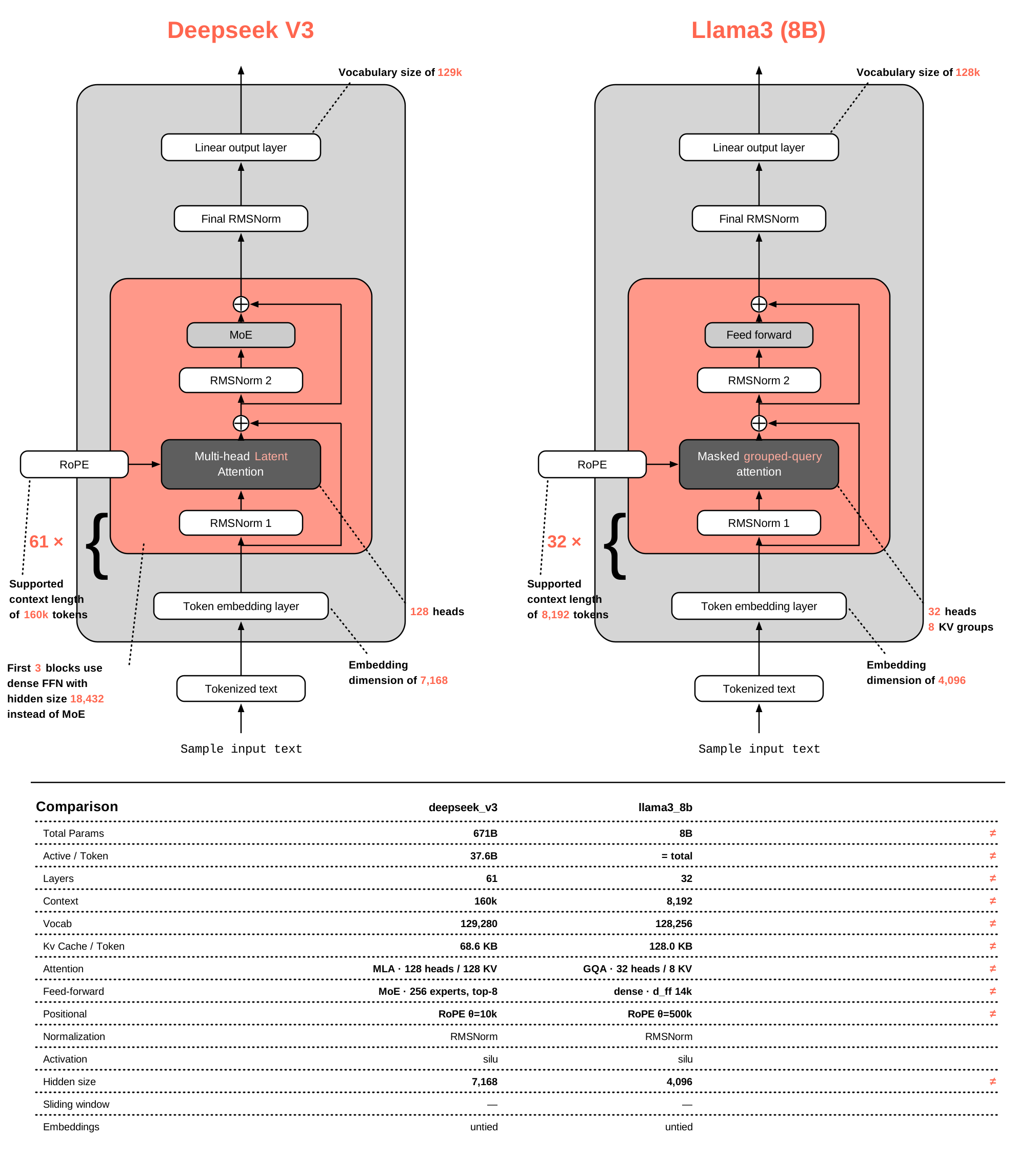
llmviz diff deepseek-ai/DeepSeek-V3 NousResearch/Meta-Llama-3-8B| Command | What it produces |
|---|---|
render <model> |
The architecture figure (SVG/PNG). --animate adds a staggered build-up. |
diff <a> <b> |
Two towers side by side + a comparison table with every difference flagged |
lineage <m1> <m2> … |
Family evolution strip with per-generation "what changed" deltas |
card <model> |
1200×630 social card — headline stats + the tower, share-ready |
poster models.yaml |
Print-ready grid of towers on one sheet (--cols, --title) |
gallery models.yaml |
Self-contained static HTML gallery with search/sort. --space user/name deploys it to a free HF Space |
watch |
Gallery of the Hub's trending models right now — pair with --space on a cron for a self-updating public gallery |
inspect <model> |
The normalized fact sheet as a terminal table |
fit <model> |
Quantization-aware memory needs (weights + KV cache) and which GPUs fit — detects your local GPU via nvidia-smi |
explain <model> |
Five LLM-written notes on what's architecturally notable — local-first via Ollama |
mcp |
MCP server (stdio): inspect_architecture, memory_to_run, render_architecture_figure, diff_architectures as agent tools |
Every command accepts a Hugging Face id (org/name), a local config.json path, a .gguf file or URL, or ollama:<name>. Gated repos (meta-llama, google) need --token or hf auth login.
| Signal | Source fields |
|---|---|
| MHA / GQA / MQA | num_key_value_heads vs num_attention_heads, multi_query |
| MLA (DeepSeek-style latent KV) | kv_lora_rank, q_lora_rank, decoupled-RoPE head dims |
| MoE | num_experts / n_routed_experts / num_local_experts, five spellings of top-k, shared experts, leading dense layers |
| Hybrid token mixers | layer_types, linear_attn_config, full_attn_idxs, attn_type_list, mamba_* — summarized as e.g. "20 linear-attention (KDA) : 7 full attention layers" |
| Norm placement | pre (default), post (OLMo-2), sandwich (Gemma) — drawn structurally |
| The rest | sliding windows and local:global ratios, QK-norm, RoPE θ / ALiBi / learned, tied embeddings, activation |
GGUF sources are read header-only (a few MB, never the weights), including vocab size recovered from the tokenizer array length — so llmviz render ollama:qwen2.5-coder:14b diagrams a 9 GB model in under a second. For remote GGUF URLs only the metadata bytes are fetched via ranged HTTP.
Counting convention: "active" means every parameter touched in a forward pass, including embeddings and the LM head — some vendors report actives excluding the unembedding, so their number may read slightly lower.
explain is local-first through LiteLLM:
llmviz explain zai-org/GLM-4.5-Air                                    # local Ollama (auto-picks an installed model)
llmviz explain <m> --llm openai/local --api-base http://localhost:8080/v1   # llama.cpp server
llmviz explain <m> --llm groq/llama-3.3-70b-versatile                 # any hosted LiteLLM provider
export LLMVIZ_LLM="ollama/deepseek-r1:latest"                         # set your default
Reasoning models (DeepSeek-R1, Qwen3) are handled — thinking is stripped, the answer is kept.
Give any agent architecture facts computed from configs instead of recalled from training data:
{"mcpServers": {"llmviz": {"command": "llmviz", "args": ["mcp"]}}}from llmviz.fetch import load_spec
from llmviz.render.block import render_model
spec = load_spec("Qwen/Qwen3-235B-A22B") # or "ollama:deepseek-r1", "./model.gguf"
spec.total_params, spec.active_params, spec.attention.kind, spec.hybrid_note
svg = render_model(spec)ArchSpec is a Pydantic model — spec.model_dump_json() gives you the normalized architecture for your own tooling.
git clone https://github.com/h9-tec/llmviz && cd llmviz
python -m venv .venv && .venv/bin/pip install -e ".[dev,png]"
.venv/bin/pytest                              # offline; fixtures are real Hub configs
.venv/bin/ruff check src tests
Tests treat published parameter counts as ground truth — if the per-layer math doesn't reproduce a model's documented size, the parser is wrong. CI runs on 3.11/3.12; a nightly workflow rebuilds the trending gallery and deploys it to a Hugging Face Space; tagging v* publishes to PyPI via trusted publishing.
The visual language is a faithful implementation of Sebastian Raschka's LLM Architecture Gallery figures (sebastianraschka.com/llm-architecture-gallery) — colors were sampled from his published figures with admiration. If you want the hand-crafted originals with his commentary, go read Ahead of AI.
Apache-2.0