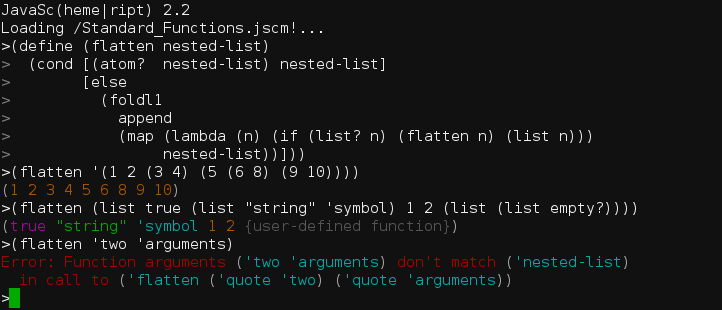
A minimal 400 line implementation of a simple Scheme dialect, built around existing Javascript types. Included are two REPL (read eval print loop) programs - one browser based and the other Node.js based.
[Try it out in your browser now][1].
Also included is a .tmlanguage definition of JavaSc(heme|ript), compatible with a variety of text editors including Sublime Text and Textmate.
[1]: http://rawgit.com/harpocrates/JavaSc-heme-ript-/master/JavaSc%28heme%7Cript%29_REPL.html "JavaSc(heme|ript)""
-
Tail call optimized: The following piece of code to find the nth fibonnacci number will never produce a stack overflow because the function that is doing all the work,
fib1, is in tail position.(define (fib n) (local [(define (fib1 n fn fm) (if (= n 0) fn (fib1 (- n 1) fm (+ fn fm))))] (fib1 n 0 1))) (fib 100) => 354224848179262000000
There is no stack overflow from calling a function (f false) defined (define (f x) (f x)). The REPL will just hang indefinitely.
-
Macros: This is borrowed from early LISP style, compared to the Scheme syntax rules. A macro is just a function that is evaluated before all other functions, doesn't evaluate its arguments, and returns an s-expression. For example, an
unlessmacro is defined in the standard functions file as(define-macro (unless condition body) `(if ,condition void ,body)) (unless true "Hello") (unless false "World") => "World"
The usual quote ', quasiquote `, unquote ,, and unquote-splicing ,@ apply.
-
Currying: An optional feature to permit partial application of functions (inspired from Haskell). For example, since
*is a function that accepts two arguments,(* 2)is equivalent to(lambda (n) (* 2 n)). This makes something like generating a list of powers of two a bit simpler:(map (expt 2) '(1 2 3 4 5 6 7 8 9 10)) => (2 4 8 16 32 64 128 256 512 1024)
Note that currying implies that for a function f of three arguments (((f a) b) c), ((f a b) c), ((f a) b c), and (f a b c) will evaluate to the same thing.
-
Error stack trace: The error message will hopefully be helpful, and the stack trace will tell you where the problem came from. In the following code, the function
mapexpects a function and a list as arguments. Instead of the function, it gets the literal9.(append (list 1 2 3 4) (map 9 (list 5 6 7 8)))
produces the error message
  Error: expected a function, not 9
          in call to ('f ('first 'l))
          in call to ('cons ('f ('first 'l)) ('map 'f ('rest 'l)))
          in call to ('append ('list 1 2 3 4) ('map 9 ('list 5 6 7 8)))
- s-expressions aren't really s-expressions - just arrays.
- variadic functions aren't supported (except for
listand fundamental forms). Otherwise, function-currying would be too complex for the user. - fundamental forms
define-syntax,let-syntax,letrec-syntax,syntax-rulesare not defined - they are replaced bydefine-macrosimilar to the LISPdefmacro - a couple forms like
doandcaseare implemented partially anddelayis not implemented. - the numerical tower is completely off. Numbers are just JavaScript numbers. Same goes for all other types - there are no vectors, characters, or pairs.
The fixed-point combinator (aka the Y combinator) for transforming recursive functions into non-recursive ones using first-class and anonymous functions.
; Y combinator
(define (Y f)
  ((lambda (x) (x x))
     (lambda (x) (f (lambda (y) ((x x) y))))))

; Not quite factorial, almost though
(define (almost_factorial f)
  (lambda (n)
    (if (equal? n 0)
        1
        (* n (f (- n 1))))))

; A full-fledged factorial function without any recursion/loops
(define factorial (Y almost_factorial))
Calling (factorial 21) gives 51090942171709440000. A screenshot of the Node.js REPL, run from the console, is included below.