🐛 Describe the bug
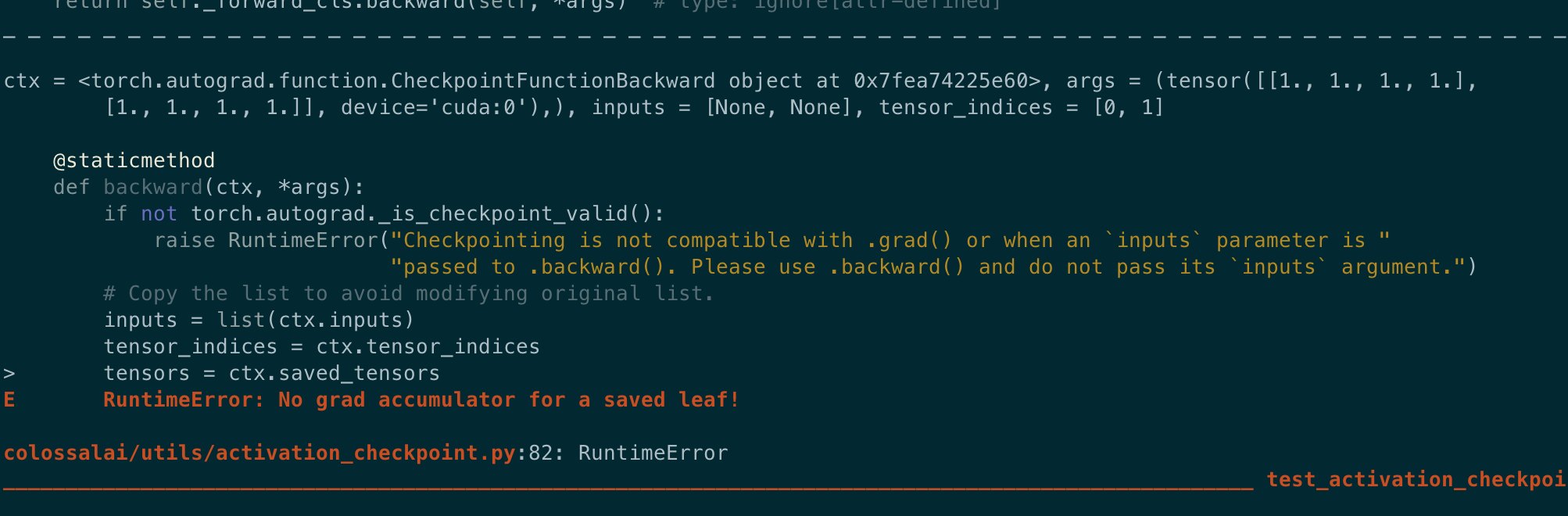
When running unit testing with PyTorch 1.9, the following exception occurs for tests/test_utils/test_activation_checkpointing.py.
Screenshot
Reasons
This bug occurs because of the invalid use of ctx.save_for_backward. In torch autograd function, we need to provide either inputs or intermediate values to ctx.save_for_backward. However, when activation_offload=True, the current implementation will copy the tensors to cpu, creating new tensors which are neither inputs or intermediate activations (i.e. does not have gradient accumulator objects associated with them).
for i, arg in enumerate(args):
      if torch.is_tensor(arg):
          if activation_offload:
              tensor_inputs.append(copy_to_device(arg, 'cpu'))
          else:
              tensor_inputs.append(arg)
          ctx.tensor_indices.append(i)
          ctx.inputs.append(None)
      else:
          ctx.inputs.append(arg)

  ctx.save_for_backward(*tensor_inputs)
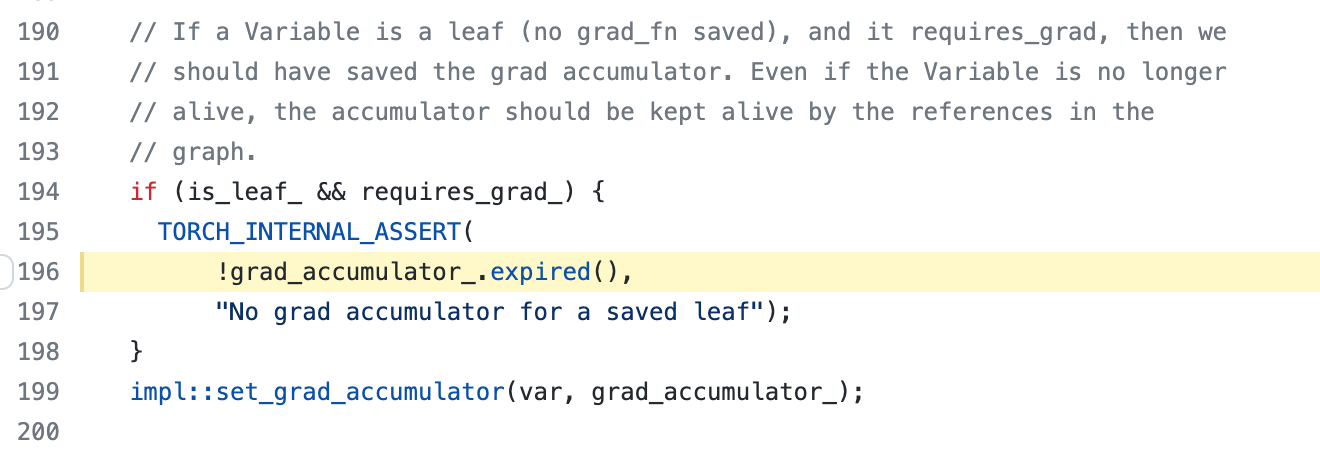
This will trigger the assertion statement as shown below.
Solution
Use cxt.tensor_inputs = tensor_inputs instead of ctx.save_for_backward(*tensor_inputs) if activation_offload=True.
Environment
CUDA: 11.1
PyTorch: 1.9.1

🐛 Describe the bug
When running unit testing with PyTorch 1.9, the following exception occurs for
tests/test_utils/test_activation_checkpointing.py.Screenshot
Reasons
This bug occurs because of the invalid use of
ctx.save_for_backward. In torch autograd function, we need to provide either inputs or intermediate values toctx.save_for_backward. However, whenactivation_offload=True, the current implementation will copy the tensors to cpu, creating new tensors which are neither inputs or intermediate activations (i.e. does not have gradient accumulator objects associated with them).This will trigger the assertion statement as shown below.
Solution
Use
cxt.tensor_inputs = tensor_inputsinstead ofctx.save_for_backward(*tensor_inputs)ifactivation_offload=True.Environment
CUDA: 11.1
PyTorch: 1.9.1