
ChenFliessSeries.jl is a Julia library to simulate the output of a control system by means of the Chen-Fliess series.
It provides:
- The list of iterated integrals indexed by words of a certain length or less
- The list of Lie derivatives indexed by words of a certain length or less
- The Chen-Fliess series of a nonlinear system
ChenFliessSeries.jl is a Julia library that contains the following functions:
| Function | Description |
|---|---|
| iter_int | A function for the numerical computation of a list of iterated integrals |
| iter_lie | A function for the analytical computation of a list of Lie derivatives |
| chen_fliess_output | A function for the analytical computation of a single Lie derivative |
ChenFliessSeries.jl is used for:
- Computation of iterated integrals
- Computation of Lie derivatives
- Simulation of the output of a control systems
- Reachability analysis of a control system
Currently, ChenFliessSeries.jl is guaranteed to run on releases of Julia 1.12.3 onwards.
To install the current release:
Using the Julia REPL's Pkg mode
julia> ]
pkg> add ChenFliessSeries
Or using the Pkg module in the standard REPL
julia> using Pkg
julia> Pkg.add(“ChenFliessSeries”)# Libraries
using Symbolics
using LinearAlgebra
using ChenFliessSeries
# ---------------------------------------------------------
# 1. Lie derivatives
# ---------------------------------------------------------
# Symbolic variable representing the state of the system
@variables x[1:6]
x_vec = x
# Truncation length of words
Ntrunc = 4
# Output of the system
h = x[1]
# Parameters of the nonlinear control-affine system
gg = 9.81 # Gravitational acceleration (m/s^2)
m = 0.18 # Mass (kg)
Ixx = 0.00025 # Mass moment of inertia (kg*m^2)
L = 0.086 # Arm length (m)
# Vector fields
g = hcat(
[x[4], x[5], x[6], 0, -gg, 0],
[0, 0, 0, 1/m*sin(x[3]), 1/m*cos(x[3]), -L/Ixx],
[0, 0, 0, 1/m*sin(x[3]), 1/m*cos(x[3]), L/Ixx]
)
# Initial value
x_val = [0.0, 0.0, 0.1, 0.0, 0.0, 0.0]
# initial evaluator
f_L = build_lie_evaluator(h, g, x_vec, Ntrunc)
# Lie derivatives or coefficients of the Chen-Fliess series
L_eval = f_L(x_val)
# ---------------------------------------------------------
# 2. Iterated integrals
# ---------------------------------------------------------
# Time step
dt = 0.001
# Time interval
t = 0:dt:0.1
# Inputs
u0 = one.(t)
u1 = sin.(t)
u2 = cos.(t)
# Stack of the inputs
utemp = vcat(u0', u1', u2')
# Iterated integrals
E = iter_int(utemp, dt, Ntrunc)
# ---------------------------------------------------------
# 3. Chen–Fliess series
# ---------------------------------------------------------
y_cf = x_val[1] .+ vec(L_eval' * E) # output h = x1We can compare this result with a numerical ODE solver
# Libraries
using DifferentialEquations
using Plots

# ---------------------------------------------------------
# 4. ODE solution using DifferentialEquations.jl
# ---------------------------------------------------------

function twodquad!(dx, x, p, t)
    # Inputs
    u1 = sin(t)
    u2 = cos(t)

    # Numeric dynamics
    dx[1] = x[4]
    dx[2] = x[5]
    dx[3] = x[6]
    dx[4] = 1/m*sin(x[3])*(u1+u2)
    dx[5] = -gg + (1/m*cos(x[3]))*(u1+u2)
    dx[6] = (L/Ixx)*(u2-u1)
end

x0 = x_val
tspan = (0.0, 0.1)

prob = ODEProblem(twodquad!, x0, tspan)
sol = solve(prob, Tsit5(), saveat = t)

x1_ode = sol[1, :]   # extract x1(t), since h = x1


# ---------------------------------------------------------
# 4. Plot both curves
# ---------------------------------------------------------
plot(t, x1_ode,
     label="ODE solution x₁(t)",
     linewidth=3,
     color=:blue)

plot!(t, y_cf,
      label="Chen–Fliess (Ntrunc = 3)",
      linewidth=3,
      linestyle=:dash,
      color=:red)

xlabel!("Time")
ylabel!("Value")
title!("ODE vs Chen–Fliess Approximation")
plot!(grid = true)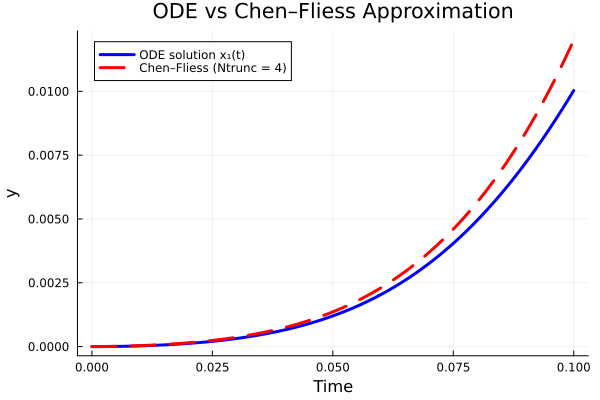
For more examples, see the ChenFliessFliess.jl demos
All feedback is welcome.
Please reach out if you have any questions:
ChenFliessSeries.jl is open-source and released under the MIT License.
Feel free to cite my work:
@article{iperezave,
  title={ChenFliessSeries.jl},
  author={Perez Avellaneda, Ivan},
  journal={GitHub. Note: https://github.com/iperezav/ChenFliessSeries.jl},
  volume={1},
  year={2026}
}