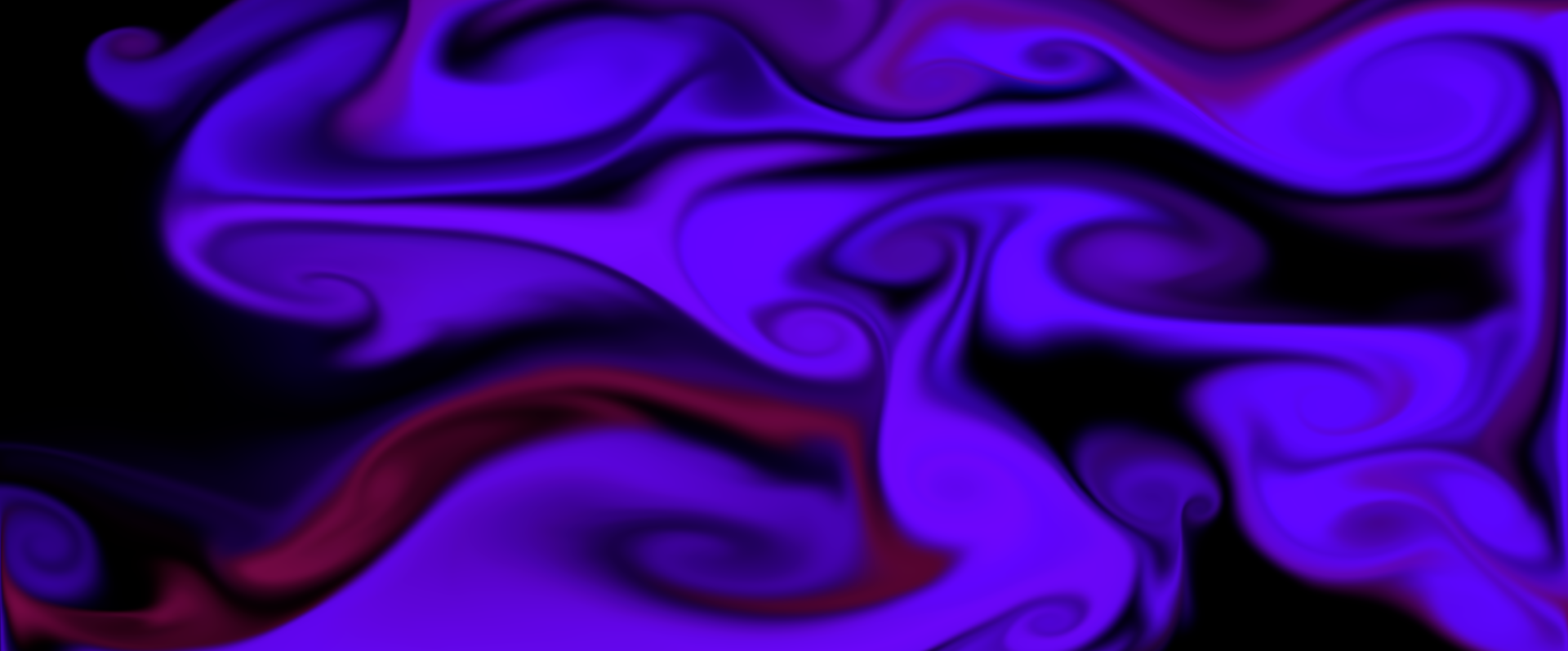
Navier Stokes - Incompressible Fluid Simulation |
Ryutai - Japanese word for "fluid"
Fluids are everywhere, water, honey, air, well anything that flows falls in that category. The goal was to implement a 2D Fluid Simulation using C++ and Vulkan, and later expand it into 3D Fluid Simulation all based on Jos Stam Real-Time Fluid Dynamics Technique, which itself uses Navier Stokes Incompressible Fluid Equations.
The equations look very complicated at a first glance, but - Fluid Dynamics NVIDIA does a great job at breaking the equations down to chewable bites. Well, I said chewable not digestable haha, it helped me atleast understand what's happening within the simulation overall.
The idea is quite simple: Fluids flow, what do they flow?
- They flow things that are present in them
- More importantly - they flow themselves too.
At the highest level, this simulation is made up of two things:
- Velocity Field: A field that tells you where the fluid is flowing.
- Dye Field: A field that tells you if the fluid flows something in it, this is like dropping paint drops in a bucket of water, it gives us the ability to visualize the flow properly.
The rest of the algorithm works to make sure the velocity field is computed according to the equations, hence keeping it true to Physics.
A general flow of the program can be thought as follows:
- We start with a zero velocity field and a zero dye field ( no flow & no color)
- We introduce a few "splats" that disturb these fields:
- A splat is made up of radius, color and location, we send this information to the velocity field and dye field, they accordingly make a note of this splat
- Velocity field reads the color component as force
- Dye Field, reads the color and stores it
- A splat is made up of radius, color and location, we send this information to the velocity field and dye field, they accordingly make a note of this splat
- This "disturbing" of fluid due to splats, causes the velocity field to have some "bad areas", areas that compress or expand and that wouldn't respect physics.
- We try to find these "bad areas" using something called as "divergence".
- Next, we need to compute a pressure field that would counteract these "bad areas", which makes the simulation "incompressible".
- The velocity field is fixed using the pressure field, the result is a stable velocity field.
- The most important thing a fluid does is, and that's the reason for it's mere existance: it flows. We now use our stable velocity to do two things: flow velocity itself and whatever is present in the fluid ( dye )
- We also ensure to dampen the flow, so eventually as the simulation keeps running, the flow looses energy and comes to standstill ( at that point we just kill the dye ). If we don't do this, the flow will never stop and will keep the energy constant.
The above algorithm is the soul of the simulation, and that's what gives us the beautiful renders of fluids.
Here is a video of how the simulation would proceed from an initial state to a few seconds into the simulation