Your coding agent already writes the code. Rungs makes it accountable for the launch.
Local-first, agent-native launch tracking for solo products. One goal, the rungs between you and it, evidence-only metrics over time, and stall detection that forces a strategy conversation — as a git-tracked folder and a single HTML page. Nothing deploys, nothing is a service, nothing phones home.
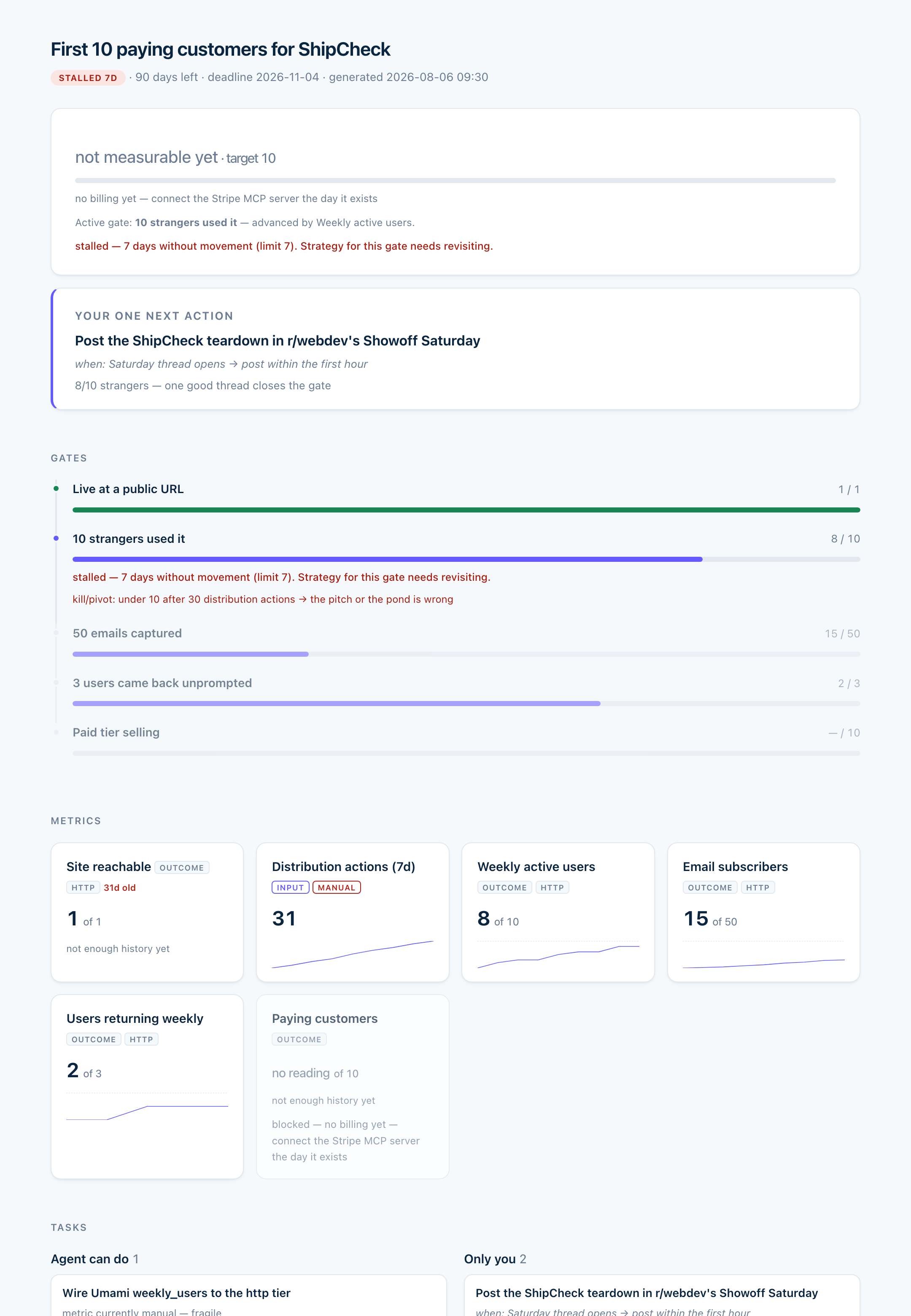
The board answers three questions in the first screenful, in order: am I on track, what's in the way, and what is my one next action. Everything else — gates, metrics, tasks, timeline — is supporting detail below it.
npx create-rungs
That drops a single bundled file (rungs/cli.mjs, no dependencies added to
your repo), a starter mission.json, the method docs, and the /rungs
agent skill. Then:
npm run rungs— see the board immediately; it works before anything is wired (unmeasured metrics render as null with a reason, never zero).- In your agent:
/rungs init— it scans the repo for bindable sources (Supabase, Stripe, Umami/Plausible, your own API routes), asks you three questions, and writesmission.jsonfor you. You never hand-edit JSON unless you want to. - Say yes when it offers the SessionStart hook — every coding session then opens with the three-line verdict (goal, active gate, stall). The system that only speaks when invoked is governed by the same avoidance it exists to fight; the hook makes looking at progress the default, not a decision.
Not using Claude Code? The skill is plain markdown — point any agent
(Cursor, AGENTS.md-style setups) at .claude/skills/rungs/SKILL.md; the
CLI and files are agent-agnostic.
npm run rungs                  # collect → append snapshot → render → open
npm run rungs -- --brief       # print 3-line verdict; skips collection if the
                                 # last snapshot is <12h old (safe as a hook)
npm run rungs -- --receipt     # draft the weekly build-in-public receipt
npm run rungs -- --render-only # rebuild the page from stored data (offline)
npm run rungs -- --dry         # show what collectors return, write nothing
npm run rungs -- --discover    # scan the host project for bindable sources
npm run rungs -- --set x_followers=41 --tier browser
The page is rungs/out/index.html; the receipt lands in
rungs/out/receipt.md — inputs done, outcomes moved (misses included),
what changed, one next action. Post it where your audience is: recording +
public reporting is the strongest form of progress monitoring, and it doubles
as build-in-public content.
Solo products mostly die the same few deaths, and each part of this tool is aimed at one of them:
- No external forcing function → gates carry hard
deadlines. Projects with nobody expecting anything ship never. - Zombie mode — too dead to grow, too alive to kill → gates carry a
killcriterion written in advance (a state and a date), when you're still able to reason about it. - Lateral motion — refactoring that feels like progress → metrics are
marked
input(work you control: posts, outreach) oroutcome(users, revenue). A flat outcome with flat inputs means you stopped trying, not that the strategy failed. Code shipped is not an input metric; strangers reached is. - Intending ≠ doing — the intention–behavior gap is one of the most
replicated findings in goal psychology; if-then plans ("implementation
intentions") close it with a medium-to-large effect (d ≈ .65, Gollwitzer &
Sheeran meta-analysis). Tasks carry a
whenfield: not "post on Reddit" but "when the Thursday thread opens → post the receipt". - Progress you don't look at — monitoring progress measurably improves
attainment, and the effect is larger when progress is recorded and
reported (Harkin et al. 2016, 138 studies, N≈20k). Hence append-only
data/*.jsonl, the rendered page, and the agent's weekly receipt (below). - Plausible numbers — nothing is ever estimated. A metric that can't be
read records
nullplus the reason, and the page renders the reason. A guessed number is a lie that compounds across the whole timeline.
Every metric declares sources in order; the collector takes the first that works and records which tier produced the value.
| tier | channel | who runs it |
|---|---|---|
http |
own APIs, public JSON | the script |
shell |
npm scripts, git, CLI | the script |
mcp |
connected MCP servers | the agent |
browser |
logged-in surfaces via Chrome | the agent |
manual |
ask the human | the agent |
A node process cannot drive an MCP server or a logged-in browser, so tiers 3–5
are collected by the agent (the /rungs skill) and written back with
--set. Metrics stuck on tiers 4–5 should have a task to move them up.
{
  "id": "subscribers",
  "label": "Email subscribers",
  "kind": "outcome",
  "target": 50,
  "direction": "up",
  "sources": [
    { "tier": "http", "url": "${SUPABASE_URL}/rest/v1/subscribers?select=email",
      "headers": { "apikey": "${SUPABASE_SERVICE_ROLE_KEY}" }, "expr": "d.length" },
    { "tier": "browser", "note": "where to look if the API dies" }
  ]
}
${VAR} expands from process.env and the host project's .env. expr is a
JS expression over d — parsed JSON for http, stdout text for shell — and
must produce a number. It's evaluated with new Function, so treat
mission.json as code: it's yours, don't paste expressions into it from
anywhere else.
{
  "id": "users",
  "label": "10 strangers used it",
  "metric": "weekly_users",
  "target": 10,
  "stallDays": 7,
  "deadline": "2026-09-15",
  "kill": "under 10 after 30 distribution actions → the pitch or the pond is wrong"
}
Gates are the rungs of the ladder: sequential, and the first unmet one is
active. stallDays of no
movement declares the gate stalled — the signal that the strategy needs
revisiting, not that you need to try harder. The starter mission.json ships
a generic solo-product ladder (ship → strangers → audience → retention →
revenue); rewrite it for your product.
| file | what it is |
|---|---|
rungs/mission.json |
goal, gates, metric declarations, stall rules — yours |
rungs/data/metrics.jsonl |
one append-only snapshot per run |
rungs/data/tasks.jsonl |
task ledger, each with owner: agent | human and an if-then when |
rungs/data/strategy.jsonl |
strategy revisions with the evidence that forced them |
rungs/capabilities.json |
generated by --discover; mcp/browser refreshed by the agent |
docs/journal.md |
dated-bullet journal; feeds the page's timeline |
docs/method.md |
the operating method and the research behind it |
data/*.jsonl is append-only by convention, not enforcement. Hand-edit
freely; git log gives you a second timeline for free.
The TypeScript source is rungs/cli.ts + rungs/core/; npm run build
bundles it to dist/cli.mjs (what the installer ships). npm run rungs
here runs the source via tsx; npm test runs the vitest suite. Requires
Node 20+.
The extraction test: nothing under rungs/core/ may import from a host
project. If a metric needs project code, expose it as an npm script or an
HTTP route and declare a shell/http source instead.