Chrome App
##Introduction
The best introduction to Chrome Apps is provided by Google. A developer guide can be downloaded from http://commondatastorage.googleapis.com/io-2013/presentations/4017%20-%20IO13-ChromeAppscodelab.pdf
Most Kendo UI controls rely on templates which use the eval function which chrome apps forbid unless sandboxing. This is further explained by Telerik.
##Building the Chrome App
Building the Chrome app with sandboxing requires the addition of 4 files:
- manifest.json, the manifest with name, description, icons and permissions;
- chrome_launcher.js, the laucher;
- chrome_wrapper.html, the container for the sandboxed application.
- chrome_wrapper.js, the script for the sandboxed application.
##Loading and testing the Chrome App
In Chrome, call menu tools -> extensions or type chrome://extensions in the address bar and click the Developer mode checkbox.
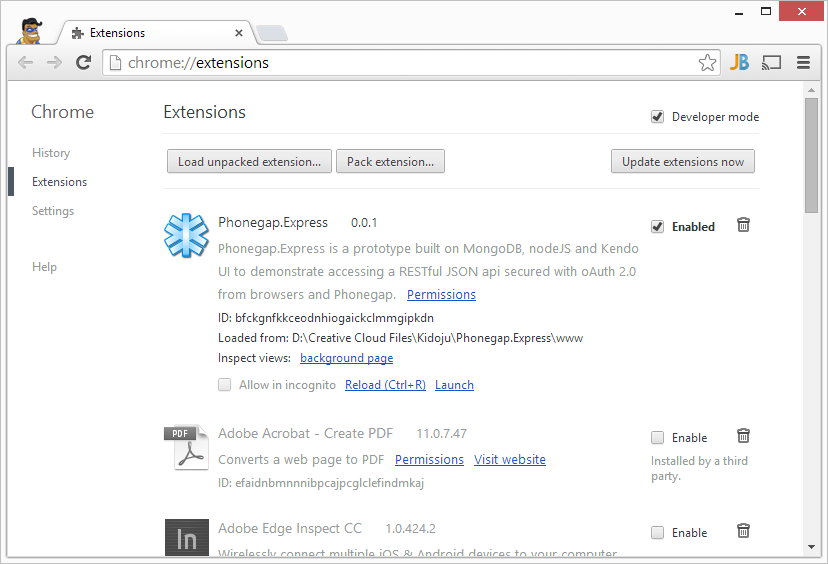
This displays a button to Load unpacked extension from a directory. Click the button and select the www directory on your computer, which should contain manifest.json.
Then the chrome app is displayed in the list of extensions with a Launch link that you can click to run it.
##Limitations
In the current state of the chrome app some features do not work. Some Javascript functions have been disabled in Chrome apps. The ones which affect Phonegap.Express are:
- localStorage is easily taken care of in api.js (DONE);
- window.alert can easily be circumvented (TODO);
- window.location is more difficult to work around although we should be able to assign the src attribute of the containing iFrame of chrome.html (TODO).