Introduction
Let's assume you want to share a pie with N people and the size of slices should be randomly drawn while making sure that nobody gets favoured. The size of slices can be interpreted as weights. Each weight need to be between 0 and 1 while all the N weights need to sum up to 1 because we have unfortunately only one cake.
We are looking for a way to sample weights randomly with all N weights being identically distributed. Means we want the distribution of cake slices to be the same for each of the N people who decided to share the cake.
Mathematically speaking, we look for a linear combination of N alternatives. If we have two options A1 and A2, we are looking for two weights w1 and w2 to obtain:
A = w_1 * A_1 + w_2 * A_2
where w1 is uniformly sampled between 0 and 1 and w2 is set to (1-w1).
With more options it is more complicated. As an example, we want to sample soil textures. We therefore have the three options (A1) sand content, (A2) silt, and (A3) clay content. The weight for each option is w1, w2, and w3, respectively. The weights need to sum up to 1. The soil texture is then:
texture = w_1 * A_1 + w_2 * A_2 + w_3 * A_3
The order of weights should not matter, i.e. a high sand content should be as likely as a high clay or silt content. This means we want to uniformly sample from the sand-silt-clay classification diagram.
One strategy could be to sample the first weight w1 ~ U[0,1]. Then sample the next weight in the remaining range w2 ~ U[0,1-w1]. The last weight is then set as the remainder w3 = 1-w1-w2 to obtain a sum of 1. This naïve approach can be extended to any number N of alternatives and weights:
      w_1 ~ U[0,1]
      w_2 ~ U[0,1-w_1]
      w_3 ~ U[0,1-w_1-w_2]
      w_4 ~ U[0,1-w_1-w_2-w_3]
      ...
      w_N = 1-w_1-w_2-...-w_(N-1)
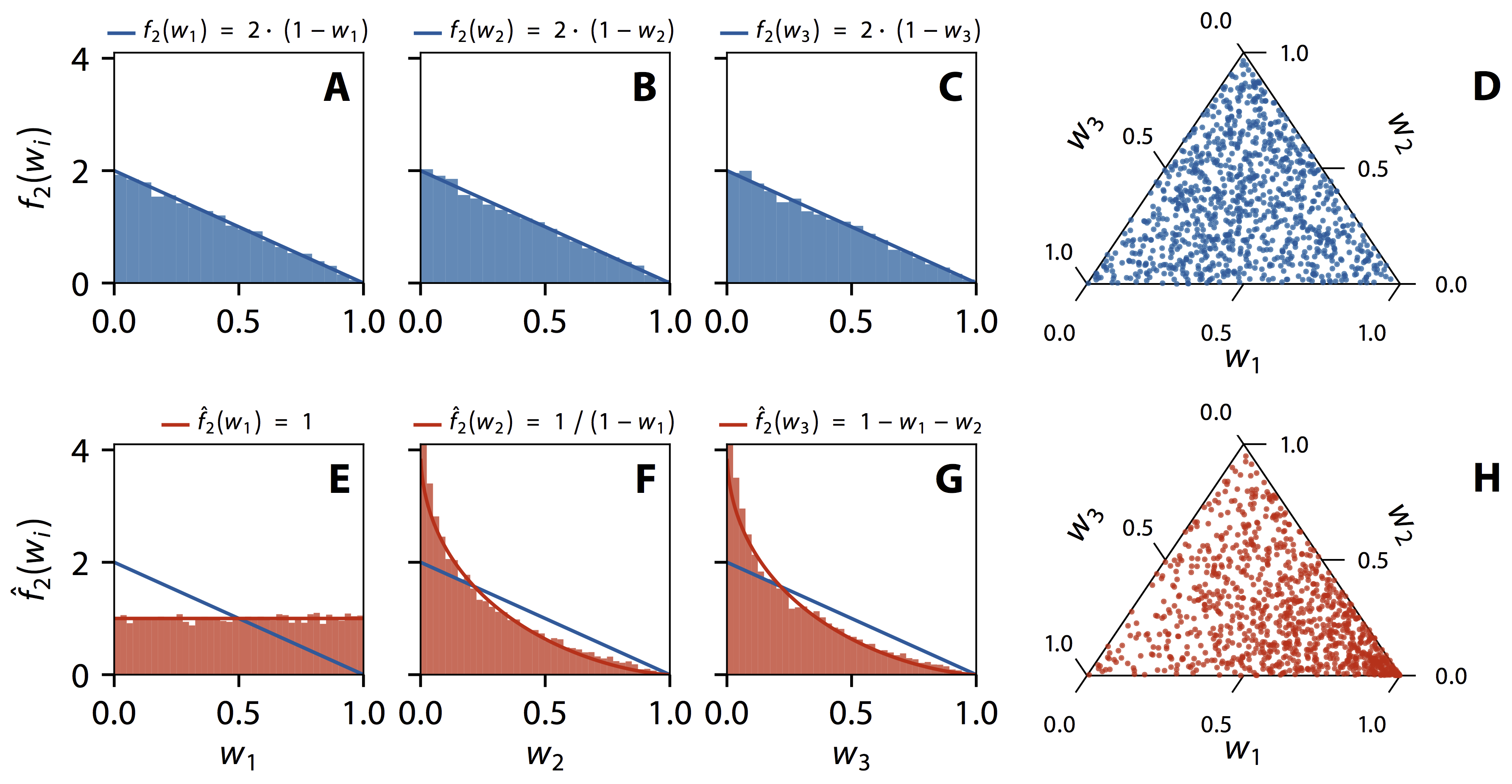
The problem is that the distribution functions of the weights are not identical, leading to the fact that the order of the alternatives matters (large values of the first alternative/weight are always more likely than large weights of the last alternative). This can be seen in the histograms when three weights are sampled following this approach (Figure 1 Panels A-C). This in turn means for the soil texture example that the sand-silt-clay classification diagram is not sampled uniformly (Figure 1 Panel D).
We hence propose the revised sampling strategy from the Pie Share Distribution to obtain N weights for N alternatives that are all identically distributed (see Figure 1 Panels E-G) leading to a uniform sampling of the full domain (See Figure 1 Panel H). The proposed transformation of (N-1) uniformly sampled random numbers ri ~ U[0,1], i=1,..,(N-1) is as follows:
      w_1 ~ (1)            *(1-(1-r_1)**(1/(N-1)))
      w_2 ~ (1-w_1)        *(1-(1-r_2)**(1/(N-2)))
      w_3 ~ (1-w_1-w_2)    *(1-(1-r_3)**(1/(N-3)))
      w_4 ~ (1-w_1-w_2-w_3)*(1-(1-r_4)**(1/(N-4)))
      ...
      w_N = 1-w_1-w_2-...-w_(N-1)$
The N weights are identically distributed with the probability density function:
f(x) = N * (1-x)**(N-1)



© 2019-2021 - PieShareDistribution - juliane.mai@uwaterloo.ca
Funded under IMPC project of Global Water Futures program.
Table of contents