Most AI commit tools are git diff | ask GPT. They produce fix: update stuff and call it a day.
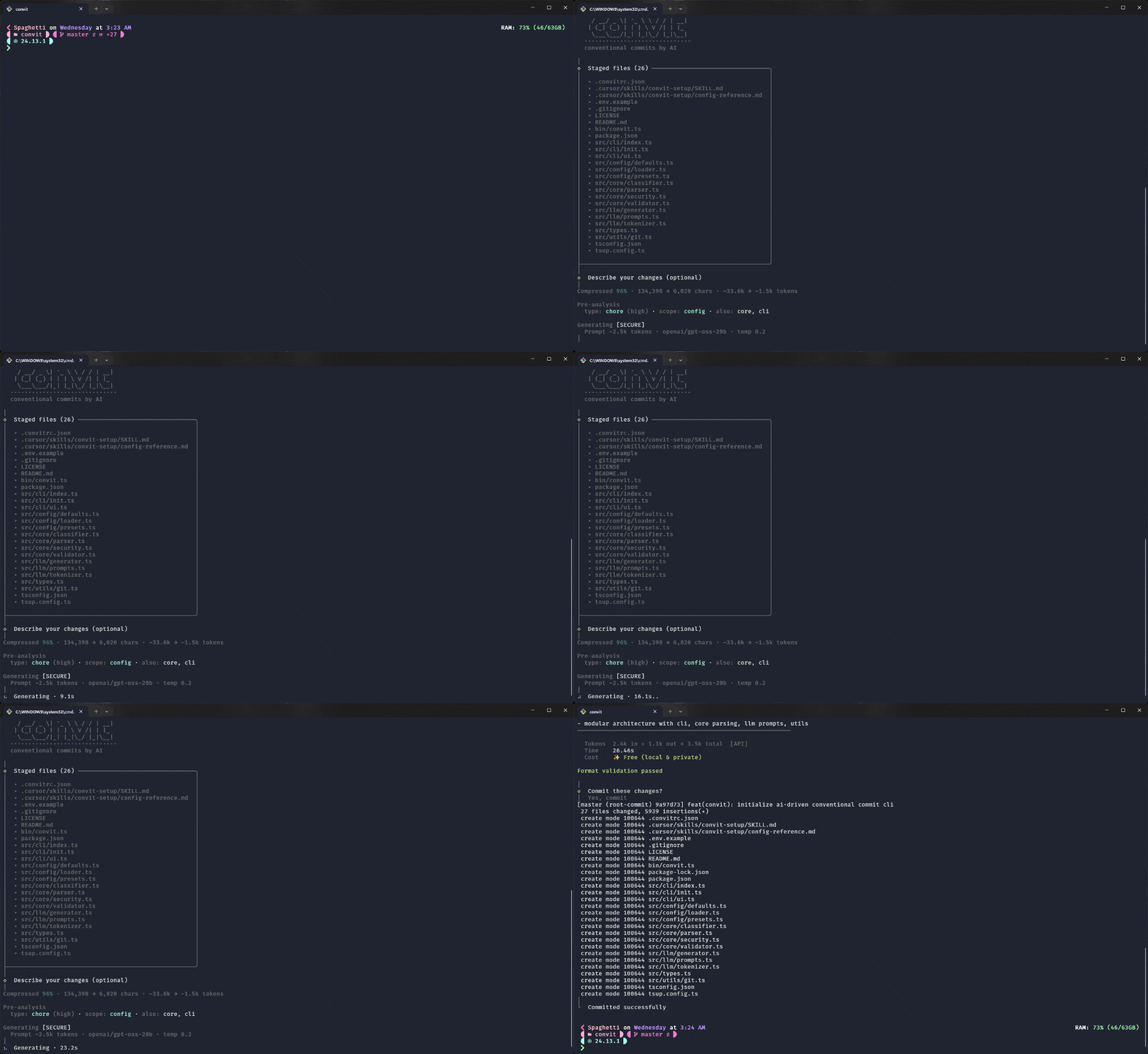
convit is different by design. Before a single token reaches the model, the codebase runs a complete pre-analysis pass. It votes on the commit type. It scores every file by importance. It scans for secrets. It compresses the diff down to pure signal. The model receives context that is already half-analyzed. That is why the output is different.
- Quick Setup
- Why
- [SECURE] Mode
- The Weighted Voting Engine
- Surgical Compression
- The Audit Trail
- The Correction Loop
- The First Commit
- Installation
- Setup
- Convit Setup Skill (Cursor)
- Commands
- Configuration Reference
- What This Is Really About
- Contributing
-
Install (project-local):
npm install -D @kareem-aez/convit
-
Add script to
package.json:"scripts": { "commit": "convit" }
-
Start a model — LM Studio (default): open LM Studio, load a model. Or Ollama:
ollama run <model>. Or set.envfor cloud APIs (see Setup). -
Run:
npm run commit
Or:
npx @kareem-aez/convit -
Optional — config:
npx @kareem-aez/convit init(CLI wizard) or use the Convit Setup Skill in Cursor — ask "Set up convit for this project" to generate.convitrc.jsonfrom your codebase.
Generic GPT wrappers hand the model a raw diff and a template. The model has no idea what matters. It guesses. It produces output that is technically formatted but semantically empty.
The Pre-Analysis Intelligence Layer runs first. It classifies every file by category, computes importance scores, casts weighted votes on type and scope, and strips generated noise before the prompt is even assembled. The model does not guess. It gets a hint derived from the actual structure of your change.
The model should reason about your intent, not your lockfile.
convit is local-first by default.
Out of the box, it talks to http://localhost:1234/v1. No configuration. No API key. No account. Open LM Studio, load a model, run npx @kareem-aez/convit. Your diff never leaves the machine.
When convit detects localhost or 127.0.0.1, the [SECURE] badge appears in the terminal on every generation. The cost line reads Free (local & private). That is not a fallback state. It is the intended default.
# start LM Studio, load a model, then:
npx @kareem-aez/convit
This works identically with Ollama:
CONVIT_URL="http://localhost:11434/v1"Before any generation runs, the raw diff is scanned against eight sensitive data patterns on your local machine. The scan happens before the prompt is built, before any network call, regardless of which provider you use.
Sensitive data patterns:
| Pattern | What it catches |
|---|---|
ghp_[A-Za-z0-9]{36} |
GitHub personal access tokens |
sk-[A-Za-z0-9]{48} |
OpenAI API keys |
AKIA[0-9A-Z]{16} |
AWS access keys |
-----BEGIN ... PRIVATE KEY----- |
RSA / OPENSSH private keys |
api_key = "..." (20+ chars) |
Generic API key assignments |
password = "..." (8+ chars) |
Password assignments |
secret = "..." (20+ chars) |
Secret assignments |
token = "..." (20+ chars) |
Token assignments |
Matched values are masked to first4****last4 in the display. The confirmation prompt defaults to cancel. Secrets do not leave silently.
Using --accept for CI automation? Any sensitive match is a hard block. The run stops.
Every file independently casts votes based on what it is and what happened to it. The type with the highest accumulated score wins.
Type votes:
| Signal | Vote |
|---|---|
| Test file touched | +5 test |
| Docs file touched | +5 docs |
| Config file touched | +4 chore |
| File renamed | +3 refactor |
Diff contains useMemo / cache / optimize |
+3 perf |
| New source file added | +2 feat |
| Existing source file modified | +2 fix |
Diff contains catch / error / try |
+2 fix |
This is additive, not a decision tree. Touch three test files and two source files: test accumulates 15 points to fix's 4. Test wins. Modify a source file that also introduces error handling: fix gets 4 combined points. It is right. Multiple weak signals compound into a confident classification.
Confidence is reported next to the type: high (score >= 10), medium (>= 5), low (< 5). You know how certain the analysis is before the model starts.
Scope candidates compete by accumulated weight across all staged files. Highest weight wins.
Built-in defaults:
| Pattern | Scope | Weight |
|---|---|---|
packages/([^/]+)/.* |
package name | 10 |
src/([^/]+)/.* |
directory name | 8 |
components/.* |
ui | 5 |
User patterns in .convitrc run before the defaults. Configure src/features/([^/]+)/.* at weight 10 and feature-sliced scopes beat generic directory names. Touch five files across three layers and the deepest, most specific scope takes the commit. No tiebreaker ambiguity.
$1 in the scope string injects the first capture group. The scope is derived, not hardcoded.
Raw diffs are noisy. A 300-line feature can arrive padded with 2,000 lines of context, whitespace, and boilerplate. Feeding that to the model wastes the context window on content that carries no signal.
Below 10,000 characters, the diff passes through unchanged. The model gets full context for small changesets.
Above 10,000 characters, compression activates. The parser runs a structured extraction:
- Files are grouped by semantic category: source first, generated last.
- Within each file, key changes are extracted using AST-lite pattern matching. Function declarations, class definitions, exported constants, type definitions, TODO and FIXME annotations are kept. Import statements are explicitly skipped. They carry no semantic signal.
- The output is a compact structured summary with category headers, file paths, change stats, and up to five key-change bullets per file.
A 45,000-character diff becomes 4,000 characters. The model still sees what matters.
The CLI shows the math every time:
Compressed 89% · 45,321 → 4,891 chars · ~11.3k → ~1.2k tokens
Hard ceiling at 100,000 characters on the final prompt input. --no-compress bypasses everything for when you need the raw view.
convit --debugEvery decision is visible. No black boxes.
The debug output exposes the full system prompt and user prompt before they reach the model. The complete DiffSummary with per-file category, importance score, additions, and deletions. The classification scorecard showing every vote, which rules fired, which files triggered them, and the winner. Compression stats. Config details including URL, model, dry-run state, and estimated input tokens.
The scorecard format:
  • test     (15): +5 from auth.test.ts, +5 from profile.test.ts, +5 from session.test.ts  ←
  • fix      (4):  +2 from api/auth.ts, +2 from diff: error/catch
  • chore    (3):  +3 from 1 config files
  Winner: test (15/22 total votes)
  Primary scope: auth (via src/features/auth/handler.ts)
You can see exactly why the analysis landed where it did. If it is wrong, you know which rule to tune. The voting is transparent by design.
When a generated message fails validation and you hit Regenerate, convit does not retry with the same prompt. That is how you get the same wrong answer twice.
Instead, it builds a structured CorrectionHint[] array. Each hint has a severity (must_fix or should_fix), a description of exactly what broke, and a concrete suggestion for fixing it.
must_fix hints go into the next prompt immediately. should_fix hints escalate after the first failed attempt. Temperature increases with each retry: 0.2, then 0.3, then 0.4. The model's search space expands without losing structure.
The model receives a targeted correction block. Not "please try again." Exactly which rule it violated. Exactly what the fix looks like.
After three attempts, Regenerate is removed from the menu. If the model cannot land a valid commit in three rounds with explicit correction hints, you get Accept, Edit, or Cancel. No infinite loops. No pretending a broken retry is useful.
Most tools break on a repo with no commits. convit detects it and handles it correctly.
isInitialCommit() runs git rev-list --count HEAD. On a fresh repo, git throws a fatal error. convit catches it, returns true, and switches the entire prompt into initial-commit mode. The tool does not crash. It does not warn you about the git errors printed to stdout. It just works.
In initial-commit mode, the prompt changes completely:
- The file-level type and scope votes are explicitly suppressed. The model is told to ignore them.
- Instead of "these are incremental changes to X," the model is instructed to describe what the project is and what it does.
- The type is constrained to
featorchore.fixis blocked. Nothing is being fixed on a first commit.
Surgical compression still fires on the full staged set. A 26-file initial commit with 134,398 characters of diff compresses to 6,020 characters. That is 96% reduction, ~33.6k tokens down to ~1.5k, before the model sees anything.
The result:
feat(convit): initialize ai-driven conventional commit cli

- provide ai-driven conventional commit generation from staged diffs
- support config via .convitrc.json with presets and cost settings
- include security checks for sensitive data in diffs
- calculate token usage and cost for transparency
- modular architecture with cli, core parsing, llm prompts, utils
Tokens  2.4k in + 1.1k out = 3.5k total
Time    26.46s
Cost    ✨ Free (local & private)

Format validation passed
That is not a file list. That is a project description. The model understood what it was looking at because the prompt told it the right question to answer.
The model was openai/gpt-oss-20b. Running locally in LM Studio with reasoning set to medium. $0.00. The message it was compared against was generated by Cursor's cloud-backed AI:
Initialize convit project with essential configuration files, including .convitrc.json, .env.example,
.gitignore, LICENSE, package.json, and README.md. Set up TypeScript configuration and build process
with tsup. Implement interactive CLI for commit generation and configuration setup. Add type definitions
and core functionality for commit analysis and generation.
No conventional commits format. No scope. File names as content. Three sentences of prose where a subject line should be.
The local model won. Not because it is smarter. Because it had the right context and was asked the right question.
# zero install, run once
npx @kareem-aez/convit

# project-local (recommended)
npm install -D @kareem-aez/convit
Add to package.json:
{
  "scripts": {
    "commit": "convit"
  }
}LM Studio (default): Open LM Studio, load a model, run npx @kareem-aez/convit. Zero config. Auto-detects the loaded model from /v1/models with a 1-second timeout. Code never leaves the machine. [SECURE] mode is active automatically.
Cloud APIs: Copy .env.example to .env:
CONVIT_URL="https://api.openai.com/v1"
CONVIT_KEY="sk-..."
CONVIT_MODEL="gpt-4o"
Works with OpenAI, Google Gemini, Anthropic, OpenRouter, AI Gateway, Groq, or any OpenAI-compatible endpoint. Only three things change: the URL, the API key, and the model name. Same tool. Same prompts. For Gemini, the URL must end with /openai. Secrets stay in .env. Config files are safe to commit.
Ollama: CONVIT_URL="http://localhost:11434/v1". [SECURE] mode. No API key required.
Project config: npx @kareem-aez/convit init runs a setup wizard and writes a .convitrc.json tuned to your project structure. Scope patterns, file exclusions, and format rules are all configurable.
Config precedence: --model flag > env vars > .convitrc > built-in defaults.
The convit repo includes a Cursor Agent Skill that generates .convitrc.json from first principles. It scans your codebase, applies the Hierarchy Principle (Surgical Core, Functional Layers, Auxiliary Support), and proposes scope patterns, exclude paths, and rules. Total coverage: the config captures the entire repo, not just application code.
Location: .cursor/skills/convit-setup/ (in this repo)
How to use:
- Copy the skill into your agent's skills path (see table below).
- Open your project in the agent and start a chat.
- Ask the AI to set up convit. Example prompts:
- "Set up convit for this project"
- "Configure .convitrc with scope patterns for my codebase"
- "Run convit setup"
- "Generate .convitrc.json from my project structure"
The skill runs a Full-Scan Protocol (every top-level directory), Gitignore Intelligence (respects .gitignore, proposes exclude candidates for build output), and groups proposed patterns into Primary Boundary, Transversal Layers, and Auxiliary Support. You confirm or adjust each proposal before it writes the config.
Optionally, the skill can run ensure-convit-env.mjs to append missing CONVIT_* vars to .env (placeholder values only, no secrets).
Using with any agent
Skills are agent-specific. Each agent system reads from its own skills directory. Copy the convit-setup folder into the correct path for your agent:
| Agent | Skills path |
|---|---|
| Cursor | .cursor/skills/convit-setup/ (in project root) |
| Codex | $CODEX_HOME/skills/convit-setup/ |
Other (e.g. .agents) |
.agents/skills/convit-setup/ (at workspace root) |
The skill triggers on: convit setup, .convitrc, commit scopes, convit init. Use Chat, Composer, or Agent mode. The agent loads the skill when your prompt matches those triggers and the skill is in the project's (or workspace's) skills path.
convit                  interactive commit workflow
convit init             setup wizard, writes .convitrc.json
convit --accept         auto-accept first valid message (CI / automation)
convit --debug          print prompt, DiffSummary, classification, full scorecard
convit --dry-run        generate without committing
convit --model <id>     override model for this run
convit --no-compress    send raw diff, bypass summarization
Interactive loop: accept, regenerate, edit, or cancel.
Secrets go in .env only: CONVIT_URL, CONVIT_KEY, CONVIT_MODEL. Optional: CONVIT_TIMEOUT (ms), CONVIT_INPUT_COST, CONVIT_OUTPUT_COST for cost tracking.
{
  "rules": {
    "maxSubjectLength": 50,
    "maxBulletLength": 72,
    "minBullets": 1,
    "temperature": 0.2,
    "timeout": 60000
  },
  "scopePatterns": [
    { "pattern": "src/features/([^/]+)/.*", "scope": "$1", "weight": 10 },
    { "pattern": "packages/([^/]+)/.*", "scope": "$1", "weight": 10 },
    { "pattern": "src/([^/]+)/.*", "scope": "$1", "weight": 8 }
  ],
  "exclude": ["src/generated/prisma"]
}
scopePatterns are regex strings. $1 injects the first capture group. User patterns always run before built-in defaults. Higher weight wins when multiple patterns compete over the same changeset.
A commit message is not a description of what changed. Git already has that.
A commit message is the reason. The design decision. The constraint you hit. The tradeoff you made. It is the last act of code review, written for the engineer who reads git blame six months from now.
Tools that generate fix: update stuff are not saving you time. They are producing noise that looks like signal and training your team to ignore the log entirely.
convit is built on the assumption that you care enough to commit the why. The whole pipeline exists to get the model close enough that you only need to accept or tweak, not rewrite from scratch.
Your commits are part of the codebase. Treat them like it.
Issues and PRs welcome. GitHub
MIT - Kareem Ahmed