Training and Evaluation
The dataset is only useful if it makes the real-world model better. That claim is tested by a kill switch: synthetic data must measurably lift the production model, or the approach is reconsidered rather than shipped on faith. Training lives in the sister repo vehicle-keypoints; this page explains how the two connect.
vehicle-keypoints v1 is an ultralytics YOLO-pose model trained on the real CarFusion dataset (14 keypoints). Its held-out baseline is OKS-mAP ≈ 0.2199 on the 12,761-frame CarFusion test set. That number is the bar to beat.
Synthetic pre-training must lift the v1 model's OKS-mAP by at least +2 percentage points on the CarFusion test set.
| Outcome | Condition |
|---|---|
| PASS | arm A OKS-mAP >= v1 + 2pp (0.2399) |
| MARGINAL | arm A in [v1, v1 + 2pp) |
| FAIL | arm A < v1 (0.2199) |
The comparison is isolated with a control:
- arm A - v1 checkpoint fine-tuned on a mixed dataset (synthetic v4 frames + the 100 real CarFusion frames, real oversampled x8).
- arm B (control) - v1 checkpoint fine-tuned on the same 100 real frames, no synthetic. Reused from a prior run (0.2204).
The synthetic contribution is arm A - arm B. Both arms start from the v1 checkpoint and validate on the real CarFusion val split, so model selection always tracks the real domain.
From the vehicle-keypoints repo, point the trainer at the exported dataset and run:
cd vehicle-keypoints
export VK_SYNTH_PHASE0V4_DIR="<repo>/ue5-vehicle-synth/captures/phase0_v4"
uv run python scripts/phase0_train_v4.py > logs/phase0_v4.log 2>&1
Run it persistently (a detached/background process), not chained behind a shell that exits - a long training run will be killed if its launching wrapper dies. On an RTX 3080 the full run (25-epoch mixed fine-tune + eval on 12,761 frames) is ~45-60 minutes.
What the script does, in order:
- Convert the synthetic COCO (
phase0_v4/annotations/coco.json) to YOLO-pose format. - Oversample the 100 real frames x8 (so the real domain is not drowned by the synthetic frames in each epoch).
- Build one mixed YOLO dataset (synthetic + real x8), validate on real CarFusion val.
- Fine-tune the v1 checkpoint for 25 epochs (imgsz 480, batch 16, lr 2e-4).
- Evaluate on the full CarFusion test set with the same eval module that produced the v1 baseline.
- Write
docs/phase0/kill_switch_report_v4.mdand the metrics JSONs, and print the verdict.
The report tabulates v1, arm B, and arm A with OKS-mAP, OKS-mAP@50, PCK@0.05, and the delta vs v1, plus the synthetic contribution and the verdict line. Watch the log for === v4 arm A …, the eval line, and the final VERDICT v4: ….
The first Phase 0 slices did not clear the gate, with a clear, honest diagnosis rather than a mystery:
- A single venue, single vehicle, single lighting slice (~800 frames) dominated training and dragged the model into one synthetic scene; the original hypothesis assumed Phase-1-style variety.
- Sequential pre-train -> fine-tune caused catastrophic forgetting of the real-domain detector.
- A keypoint-tight bounding box ended at the wheel centers, not the tire bottoms, mismatching real annotations.
v4 addresses each directly: multi-venue (4) x multi-lighting (3) x multi-vehicle (4) capture across the real road network (~1440 frames), mixed training instead of sequential, a mesh-bounds bounding box that reaches the tire bottoms, and real-oversampling x8 so the real domain is not outvoted. Whatever the verdict, it is reported honestly here - a negative result with a mechanistic explanation is a legitimate outcome of the kill switch.
The kill switch grades against CarFusion's own annotations, so a fair reading needs two extra facts.
First, a model trained only on the synthetic frames (all 24 points, no real data) reaches 0.86 box mAP@50 on held-out synthetic frames - the labels are clean and learnable in-domain. The poor CarFusion number is therefore a transfer problem, not a label-quality one.
Second, our labels are measurably cleaner than the reference they are graded against:
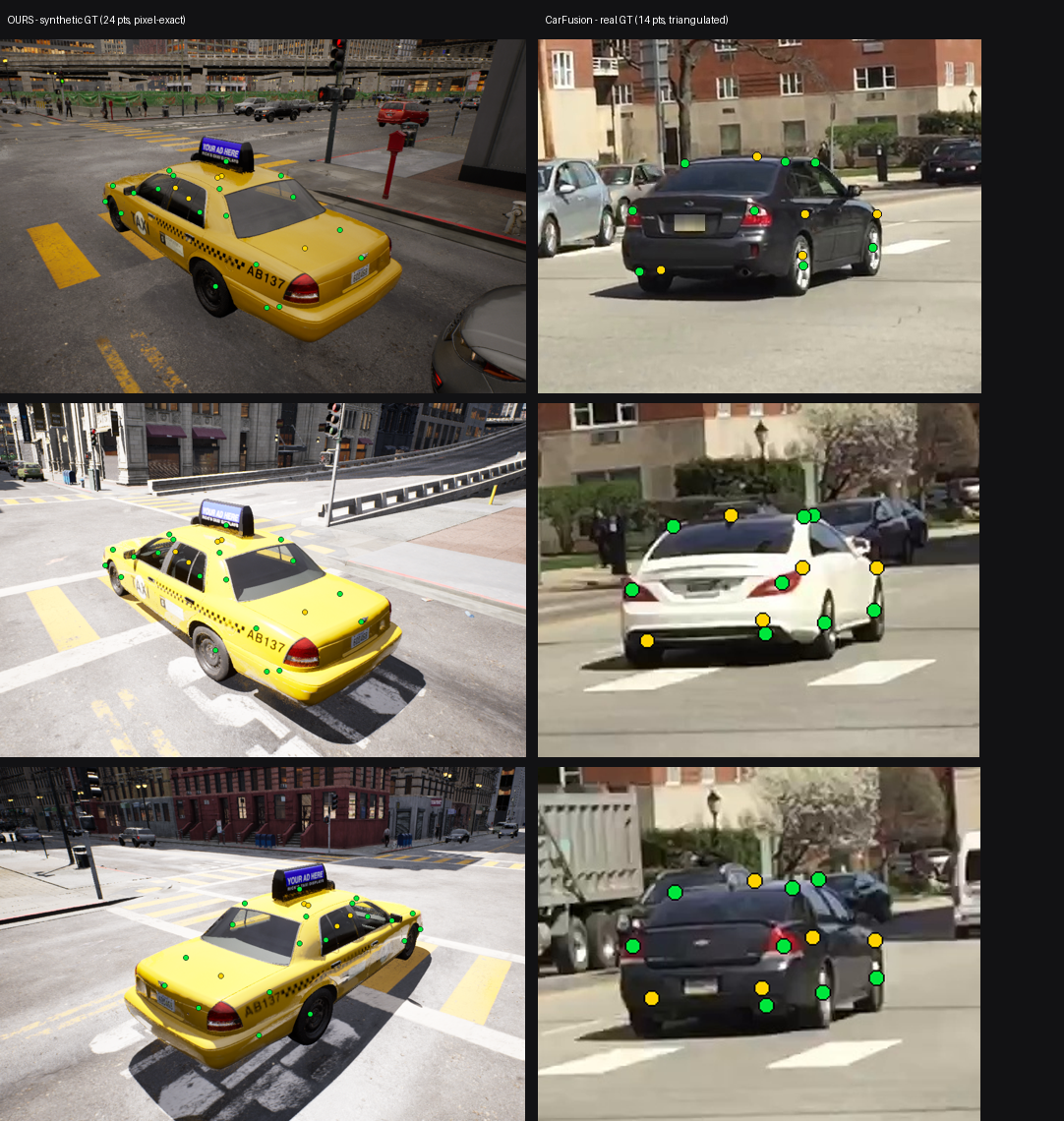
Our synthetic ground truth (left) is dense and pixel-exact by construction - the 24 points are projected from the 3D mesh, so they land on the wheel centres, light corners, mirrors, and roof corners with ~zero error. CarFusion's real ground truth (right), even on its best-labelled cars, is sparser (14 points) and visibly scattered, with gaps from occlusion and multi-view triangulation noise.
The implication: synthetic pre-training shifts the model toward this cleaner convention, and measured against CarFusion's noisier one that scores lower - so the negative transfer number conflates label-convention mismatch with true transfer quality. A fairer evaluation would use a real test set labelled in the same convention. This is reported openly rather than buried.
If the gate passes, the synthetic pipeline graduates from a vertical slice to a Phase 1 full build (more venues, vehicles, conditions; the full 24-point release of vehicle-keypoints). If it fails, the diagnosis points the next iteration - the pipeline, the C++ plugin, and an honest write-up are the portfolio deliverable regardless.