Repository navigation
Flocking
Início / Home · Fundamentos / Foundations
O bando surge de três decisões locais: manter espaço, alinhar velocidade e ficar perto. Flocking combina essas regras por pesos. Todos devem enxergar o mesmo quadro antigo antes de substituir a população inteira.
English. Flocks emerge from separation, alignment and cohesion. Weighted local decisions must read the same old frame; replace the whole population only after calculating all new snapshots.
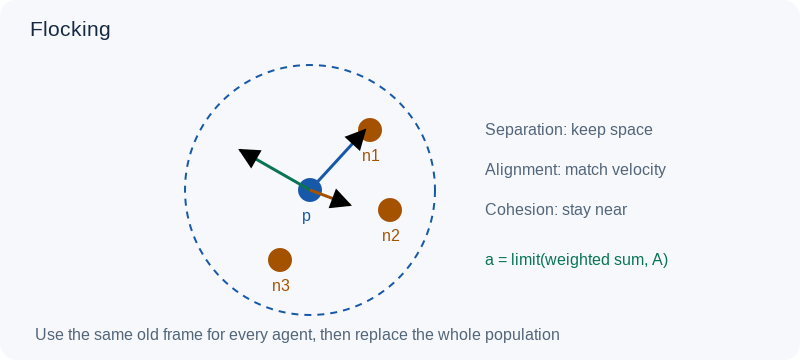
Diagrama esquemático, sem escala. Azul: agente/velocidade; laranja: alvo/geometria; verde: decisão desejada. Setas representam grandezas distintas, não uma trajetória calculada. Schematic, not to scale. Blue: agent/velocity; orange: target/geometry; green: desired decision. Arrows represent different quantities, not a simulated trajectory.
Notação e funções auxiliares: Fundamentos. O resultado a é
aceleração; apenas o engine integra a posição. This is implementation-oriented
pseudocode, with helpers defined in Foundations; the engine integrates the result.
observed = AgentNeighborhood(oldAgents)  # once per frame
rule = WeightedBlend([
    (Separation(observed, separationRadius), separationWeight),
    (Alignment(observed, neighborRadius, T), alignmentWeight),
    (Cohesion(observed, neighborRadius), cohesionWeight)
])
nextAgents = [engine.step(agent, rule, dt) for agent in oldAgents]
agents = nextAgents
| Entrada / Input | Efeito e ajuste / Effect and tuning |
|---|---|
separationRadius = 25, neighborRadius = 80
|
Separação próxima e observação mais ampla / near repulsion and broader interaction. |
separationWeight = 1.5 |
Ganho da repulsão / repulsion gain. |
alignmentWeight = 1, cohesionWeight = 1
|
Ganhos sem normalização / unnormalized gains. |
responseTime = 0.25 |
Tempo de resposta de Alignment / alignment response time. |
Abra esta cena no laboratório / Open this lab scene
Pause, avance um passo e compare os vetores com o diagrama acima. Pause, single-step and compare the vectors with the diagram above.
Importe package:steering_engine/steering_engine.dart. Os trechos abaixo mostram
a configuração; agent, dt, agents e targetSnapshot, quando usados, são
snapshots do quadro atual. Veja o loop completo.
Import the public package; these are configuration snippets in the complete loop
from Foundations, using current-frame snapshots where applicable.
final observed = AgentNeighborhood.spatial(agents, cellSize: 80);
final behavior = Flocking(observed,
    separationWeight: 1.5, alignmentWeight: 1, cohesionWeight: 0.7);
final next = [
  for (final agent in agents)
    const SteeringEngine().step(agent, behavior, 1 / 60),
];
// Substitua agents por next apenas após o cálculo completo. / Replace after the batch.Comece com apenas Separation e ative as outras regras uma a uma. Se virar uma bola compacta, reduza cohesionWeight ou aumente separação. / Enable rules individually; reduce cohesion or increase separation if the group collapses.
Os pesos não são probabilidades e não somam obrigatoriamente 1. Não há destino global nem garantia de colisão evitada. Consultas lineares custam O(n²) no grupo; a grade ajuda em cenas esparsas, sem garantia no pior caso. / No global goal, collision guarantee or universal grid speedup.
As fórmulas descrevem esta biblioteca, que adapta os conceitos de Reynolds. These formulas describe this implementation; conceptual references are listed on Home.