Repository navigation
Path Following
Início / Home · Fundamentos / Foundations
Uma rota é uma lista ordenada de destinos. O seguidor guarda qual é o atual, avança quando entra no raio de captura e usa Arrive para se aproximar de cada ponto. Na rota aberta mantém o destino final; na fechada volta ao início.
English. A route is an ordered waypoint list. The follower retains its current index, advances inside the capture radius, and uses Arrive at each local destination. Open routes retain the last point; loops wrap to the first.
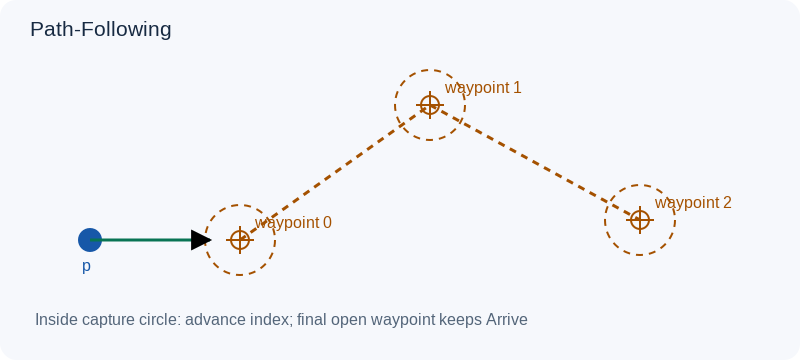
Diagrama esquemático, sem escala. Azul: agente/velocidade; laranja: alvo/geometria; verde: decisão desejada. Setas representam grandezas distintas, não uma trajetória calculada. Schematic, not to scale. Blue: agent/velocity; orange: target/geometry; green: desired decision. Arrows represent different quantities, not a simulated trajectory.
Notação e funções auxiliares: Fundamentos. O resultado a é
aceleração; apenas o engine integra a posição. This is implementation-oriented
pseudocode, with helpers defined in Foundations; the engine integrates the result.
if dt > 0:
    repeat at most numberOfWaypoints - 1 times:
        if distance(p, currentWaypoint) > waypointRadius: break
        if index is last and not path.loop: break
        index = (index + 1) modulo numberOfWaypoints
return Arrive(currentWaypoint, slowingRadius, stopRadius, T).calculate(agent, dt)
| Entrada / Input | Efeito e ajuste / Effect and tuning |
|---|---|
path |
SteeringPath não vazio, loop=false por padrão / nonempty immutable route. |
waypointRadius = 10 |
Captura do próximo destino / next-point capture threshold; > stopRadius. |
slowingRadius = 50, stopRadius = 1
|
Frenagem em cada ponto / arrival at every point; slowing > stop >= 0. |
responseTime = 0.25 |
T de Arrive / arrival response time. |
Abra esta cena no laboratório / Open this lab scene
Pause, avance um passo e compare os vetores com o diagrama acima. Pause, single-step and compare the vectors with the diagram above.
Importe package:steering_engine/steering_engine.dart. Os trechos abaixo mostram
a configuração; agent, dt, agents e targetSnapshot, quando usados, são
snapshots do quadro atual. Veja o loop completo.
Import the public package; these are configuration snippets in the complete loop
from Foundations, using current-frame snapshots where applicable.
final route = SteeringPath([Vec2(80, 0), Vec2(80, 80), Vec2(160, 80)]);
final behavior = FollowPath(route, waypointRadius: 5, slowingRadius: 35);
// Preserve behavior entre passos. / Retain behavior across steps.Observe waypointIndex ao entrar no círculo de captura. Aumente waypointRadius e veja a troca ocorrer mais cedo. Use reset() para retornar ao ponto zero. / Watch earlier transitions with a larger capture radius; reset rewinds traversal.
Para seguir segmentos com projeção e antecipação por distância, use FollowPolyline, disponível na fonte 0.2.0. O contrato de FollowPath continua inalterado. / For continuous segment guidance see FollowPolyline; the waypoint-capture contract remains unchanged.
Uma instância por agente. Não projeta no segmento, não encontra a rota mais curta nem suaviza curvas. dt grande pode pular o círculo e deixar o agente voltando. No máximo n-1 trocas por avaliação evita laço infinito em pontos duplicados. / Capture-radius following, not continuous segment projection or pathfinding.
As fórmulas descrevem esta biblioteca, que adapta os conceitos de Reynolds. These formulas describe this implementation; conceptual references are listed on Home.