Repository navigation
Wall Following
Início / Home · Fundamentos / Foundations
Projete uma sonda à frente no segmento de parede mais próximo. Oriente a tangente para acompanhar o movimento e escolha um alvo um pouco adiante, deslocado pela normal. Seek leva o agente a esse alvo local.
English. Project a forward probe onto the nearest finite wall segment. Orient the tangent along travel and seek a target ahead of the projection, offset along the selected normal.
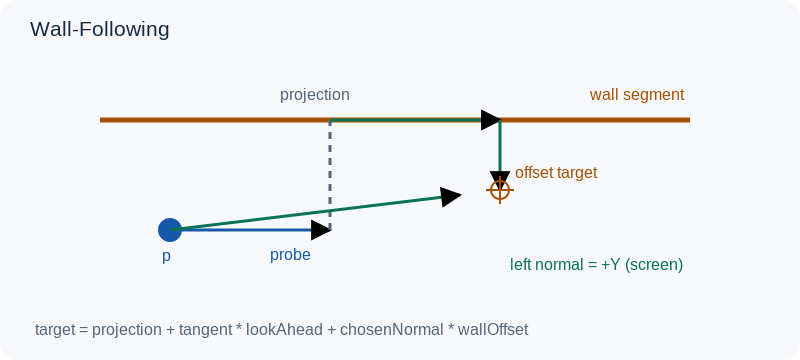
Diagrama esquemático, sem escala. Azul: agente/velocidade; laranja: alvo/geometria; verde: decisão desejada. Setas representam grandezas distintas, não uma trajetória calculada. Schematic, not to scale. Blue: agent/velocity; orange: target/geometry; green: desired decision. Arrows represent different quantities, not a simulated trajectory.
Notação e funções auxiliares: Fundamentos. O resultado a é
aceleração; apenas o engine integra a posição. This is implementation-oriented
pseudocode, with helpers defined in Foundations; the engine integrates the result.
h = normalize(v) if moving else normalize(fallbackDirection)
probe = p + h*lookAhead
wall, projected = nearest finite segment projection to probe
if no wall within maxDistance: return zero
t = normalize(wall.end - wall.start)
if dot(t,h) < 0: t = -t
normal = (-t.y,t.x) * (+1 if side==left else -1)
target = projected + t*lookAhead + normal*wallOffset
return Seek(target, responseTime=T).calculate(agent, dt)
| Entrada / Input | Efeito e ajuste / Effect and tuning |
|---|---|
wallOffset = 20 |
Distância à parede, >= 0 / nonnegative offset. |
lookAhead = 30 |
Avanço da sonda e do alvo / probe and tangent target advance. |
maxDistance = 100 |
Alcance de aquisição medido da sonda / acquisition radius from probe. |
side = WallSide.left |
Normal (-ty,tx); em canvas +Y aponta para baixo / algebraic side, screen Y may point down. |
fallbackDirection = (1,0), responseTime = 0.25
|
Direção parado e resposta / stationary heading and response. |
Abra esta cena no laboratório / Open this lab scene
Pause, avance um passo e compare os vetores com o diagrama acima. Pause, single-step and compare the vectors with the diagram above.
Importe package:steering_engine/steering_engine.dart. Os trechos abaixo mostram
a configuração; agent, dt, agents e targetSnapshot, quando usados, são
snapshots do quadro atual. Veja o loop completo.
Import the public package; these are configuration snippets in the complete loop
from Foundations, using current-frame snapshots where applicable.
final behavior = WallFollowing([
  WallSegment(Vec2(0, 0), Vec2(200, 0)),
], wallOffset: 20, lookAhead: 30, side: WallSide.left);Parede de (0,0) a (200,0), p=(20,20), h=(1,0), lookAhead=30 e offset=20: sonda=(50,20), projeção=(50,0), alvo=(80,20). / The target remains 20 units off the wall.
A projeção é limitada às extremidades do segmento; o alvo tangencial pode ficar além delas. Cantos podem oscilar. Não é wall avoidance nem resolvedor de contato. Listas vazias e paredes fora de alcance retornam zero. / Local following only; corners can oscillate and no collision resolution is implied.
As fórmulas descrevem esta biblioteca, que adapta os conceitos de Reynolds. These formulas describe this implementation; conceptual references are listed on Home.