Relay is an interactive llm.rb application built with HTMX, Roda, Falcon, and WebSockets. It serves as both a demo of llm.rb and an example of a Ruby-first architecture that keeps JavaScript light while still supporting background workers and a database-backed app.
Relay serves as a reference implementation for building real-time, tool-enabled LLM applications with llm.rb in a production-style environment.
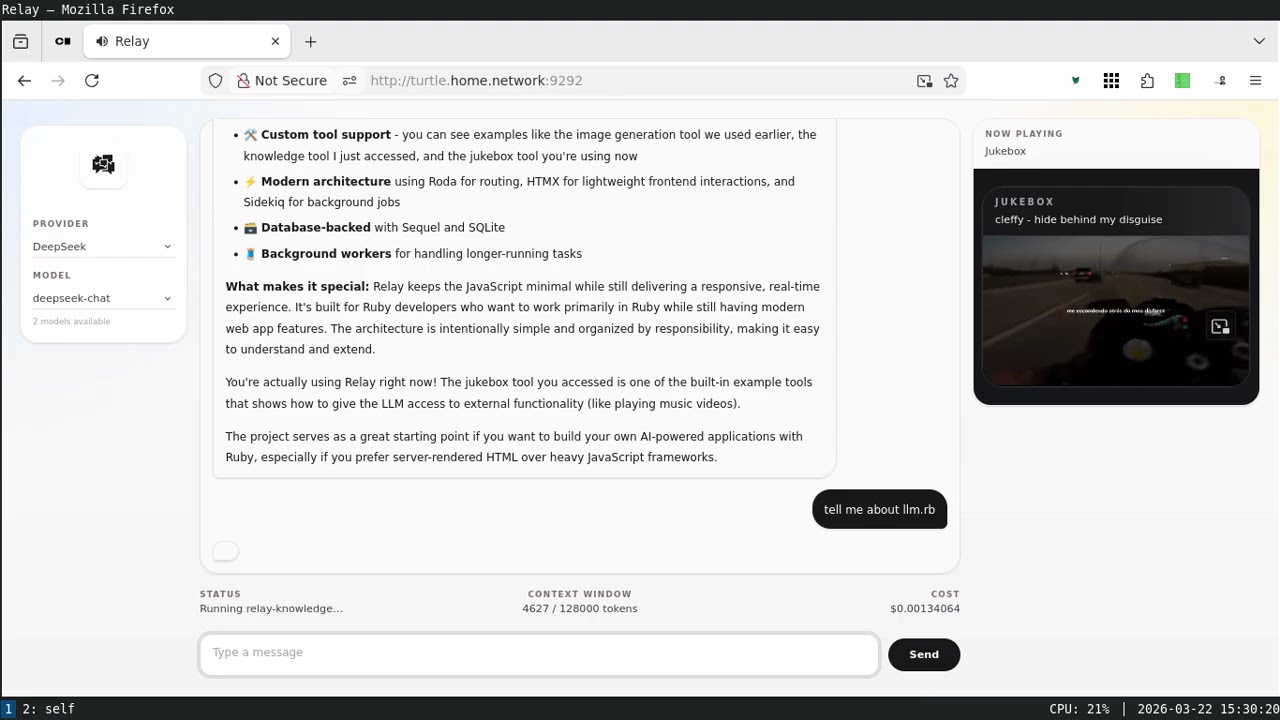
- 🌊 Streaming chat over WebSockets
- 🛠️ Custom tool support via app/tools/
- 🖼️ Sample image-generation tool in create_image.rb
- 📚 Sample knowledge tool in relay_knowledge.rb
- 🎵 Sample jukebox tool in juke_box.rb
The example tools show two useful patterns: delegating work to external providers, and exposing documentation-backed knowledge to the model through a tool.
The jukebox tool gives the LLM a small built-in playlist. It can use
juke_box.rb to pick a track and show a playable embed in the chat UI.
- ⚙️ Rack application built with Falcon, Roda, and async-websocket
- 🗃️ Sequel with built-in migrations
- 🧵 Sidekiq workers for background jobs
- 🧰 Built-in task monitor that supervises the full dev environment: web, workers, assets
- 🗂️ Session support through Roda's session plugin
- ⚡ In-memory cache support via
Relay.cache - 🔐 Automatic
.envloading during app boot
Setup
Redis is required for Sidekiq support. SQLite is required for database support.
bundle install
bundle exec rake db:migrate
bundle exec rake dev:start
Secrets
Set your secrets in .env:
OPENAI_SECRET=...
GOOGLE_SECRET=...
ANTHROPIC_SECRET=...
DEEPSEEK_SECRET=...
XAI_SECRET=...
SESSION_SECRET=
REDIS_URL=Overview
The architecture is intentionally simple. HTMX keeps the client light, while server-rendered HTML keeps the application comfortable for Ruby-focused developers. Background work is handled with Sidekiq, and development processes are coordinated by Relay's task monitor.
Some important notes:
- The app boots from
app/init.rb, which sets up the database, autoloading, and application initialization. .envis loaded automatically during boot when present.- HTTP routing is handled by Roda, with templates rendered from
app/viewsand static assets served frompublic/. - Webpack builds the JavaScript and CSS assets from
app/assets.
The codebase is organized by responsibility:
app/initcontains boot and framework setupapp/toolscontains toolsapp/promptscontains system promptapp/modelscontains Sequel modelsapp/routescontains route classes and WebSocket handlersapp/viewscontains HTML templates and partialsapp/workerscontains Sidekiq workersdb/contains database configuration and migrationstasks/contains rake tasks for development, assets, and database worklib/relaycontains support code like the task monitor
Route
A route is a class that inherits from Relay::Routes::Base and
implements call. Base delegates missing methods to the current
Roda instance, so route classes can use helpers like view, partial,
request, response, session, and params:
# app/routes/some_route.rb
module Relay::Routes
  class SomeRoute < Base
    def call
      "hello world"
    end
  end
end

# app/init/router.rb
r.on "some-route" do
  r.is do
    SomeRoute.new(self).call
  end
end
State
Relay includes session support through Roda's session plugin. This is useful for lightweight per-user state such as the current provider and model, which can be rendered directly in views and updated through normal route handlers.
For shared in-process state, Relay exposes Relay.cache, which is
backed by Relay::Cache::InMemoryCache. This is useful for small,
ephemeral caches such as model lists that can be reused across routes
without treating them as persistent data.