
A task-level database of scientific research — a comprehensive map of what researchers actually do, broken down by domain, field, subfield, and topic. SciNet enables rigorous, task-level analysis of scientific work by mapping the granular activity structure of science across 5 domains, 30 fields, 302 subfields, and 4,516 topics, with 26,371 released task statements.
Website: anatomyofscience.com · Repository: github.com/lukasalthoff/scinet
SciNet organizes research work into a hierarchy aligned with OpenAlex (domains, fields, subfields, and topics). For each level, we use large language models to generate O*NET-style task statements describing what researchers in that area regularly do.
The files in data/ are released for replication and downstream research.
All files are UTF-8. CSVs use comma separators. See data/README.md for a standalone description.
| File | Description |
|---|---|
data/tasks.csv |
Every task in the hierarchy (universal, domain, and subfield levels) with category labels |
data/openalex_topic_subfield_mapping.csv |
Maps each OpenAlex topic to its SciNet display domain, field, and subfield |
tasks.csv
| Column | Description |
|---|---|
task |
Task statement text |
category |
Task category (e.g. "Ideation & Hypothesis Generation", "Data Gathering") |
level |
One of universal, domain, or subfield |
domain |
Domain name, e.g. "Social Sciences" (empty for universal tasks) |
field |
Display field name, e.g. "Economics" (empty for universal/domain tasks) |
subfield |
Display subfield name, e.g. "Labor Economics" (empty for universal/domain tasks) |
openalex_topic_subfield_mapping.csv
| Column | Description |
|---|---|
topic_id |
OpenAlex topic identifier |
topic_name |
Topic display name |
domain |
SciNet display domain |
field |
SciNet display field |
subfield |
SciNet display subfield |
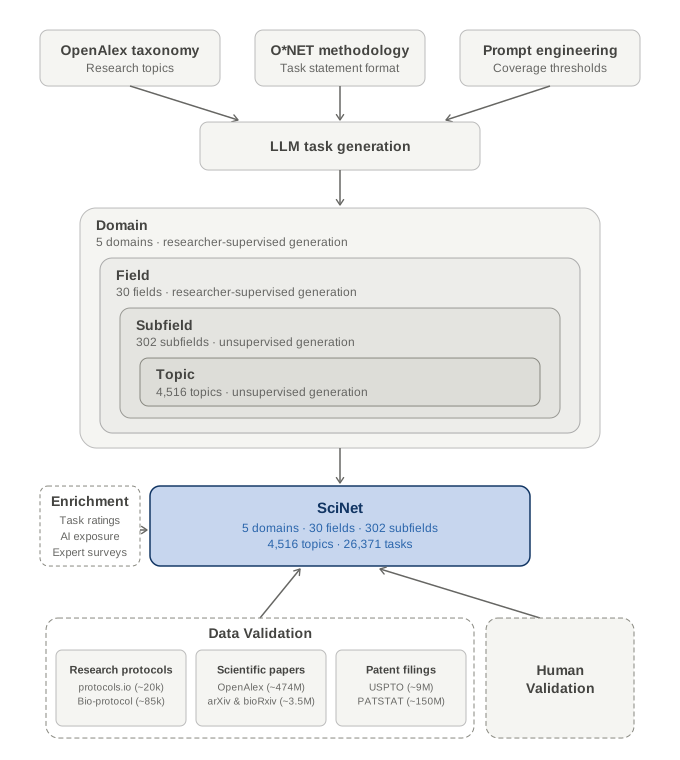
- Hierarchy: OpenAlex domains, fields, subfields, and topics define the taxonomy.
- Task generation: Large language models produce O*NET-style task statements at field, subfield, and topic levels using a top-down hierarchical approach.
For a complete description of every pipeline step — including prompt design, coverage thresholds, O*NET calibration results, and protocols.io validation — see METHODOLOGY.md.
For visual summaries of the data — task distributions, verifiability rankings, AI adoption — see DATA_OVERVIEW.md.
For the research paper when available and project updates, see the Stanford project page.
If you use this dataset, please cite the SciNet project and this repository, for example:
@misc{scinet_data,
  title        = {SciNet: The Anatomy of Science},
  author       = {Althoff, Lukas},
  year         = {2026},
  howpublished = {\url{https://github.com/lukasalthoff/scinet}},
}Data and documentation in this repository are licensed under CC BY 4.0 — see LICENSE.
- Replaced
generated_tasks.csv,openalex_topics.csv, andcatalog.jsonwith two simpler files:tasks.csv: flat task file with category, level, domain, field, and subfield columns.openalex_topic_subfield_mapping.csv: maps OpenAlex topics to SciNet display domains, fields, and subfields.
- Added
METHODOLOGY.md: full pipeline documentation covering taxonomy construction, hierarchical task generation, O*NET-style rating and filtering, AI exposure scoring, O*NET calibration, and protocols.io validation.