







from livekit.agents import AgentSession
from livekit.plugins import deepgram, openai, cartesia
import voicegateway

session = AgentSession(
    stt=deepgram.STT(model="nova-3"),
    llm=openai.LLM(model="gpt-4o-mini"),
    tts=cartesia.TTS(model="sonic-3"),
)
voicegateway.attach(session)   # one line. profile every call.
# logged per call: provider, model, tokens, $cost, latency, session_id
The open-source profiler for voice agents. Add one line and every STT, LLM, and TTS call is priced and timed: cost to the cent, latency p50/p95, and conversation quality. attach() takes a LiveKit AgentSession or a Pipecat PipelineTask, and import voicegateway pulls neither framework until you use it. Prices come from voice-prices and reconcile against your real provider invoices with one command. Self-hosted, your keys, no data leaves your infra.
Using Pipecat? Same one line.
from pipecat.pipeline.task import PipelineTask
import voicegateway

task = PipelineTask(pipeline)
voicegateway.attach(task) # profile every call, Pipecat# Local SQLite + the dashboard at http://localhost:8080
pip install "voicegateway[dashboard]"
voicegw init && voicegw serveAdd the voicegateway.attach(session) line above to your agent and every call is tracked. Provider plugins install with your framework: pip install "voicegateway[livekit,deepgram,openai,cartesia]" or "voicegateway[pipecat]".
Python 3.11+. The full extras matrix, the zero-install uvx path, and the OS daemon installer are in the get-started docs.
Voice AI vendors hide three numbers: whether it works, what it costs, and how to make it cheaper. VoiceGateway exposes all three, per call.
| Capability | What it gives you |
|---|---|
| Framework-neutral | One attach() for LiveKit or Pipecat. Your keys, your plugins, no lock-in |
| Voice-conversation metrics | Per-minute cost, latency p50/p95, interruptions, dead air, talk-over |
| Cost to the cent | STT by audio seconds, LLM by tokens, TTS by characters, broken down per call and per model |
| Reconciliation | voicegw reconcile checks recorded cost against your real provider invoices |
| Spend control | guard(): daily budget cap, fallback on error, rate limit, per project |
| Conversation replay | Scrub any past call: STT chunks, LLM tokens, TTS frames, with timing and cost |
| Multi-tenant attribution | Per-tenant cost, scoped API keys per team, agency-ready |
| Fleet collector | One-line installer. N agents push to one collector. Slice by agent, project, tenant |
Building a text-only LLM app with no voice? LiteLLM is the better fit. See the decision table. Release history: CHANGELOG.md.
Self-hosted at http://localhost:8080. Bundled, no SaaS account, no data leaves your stack.
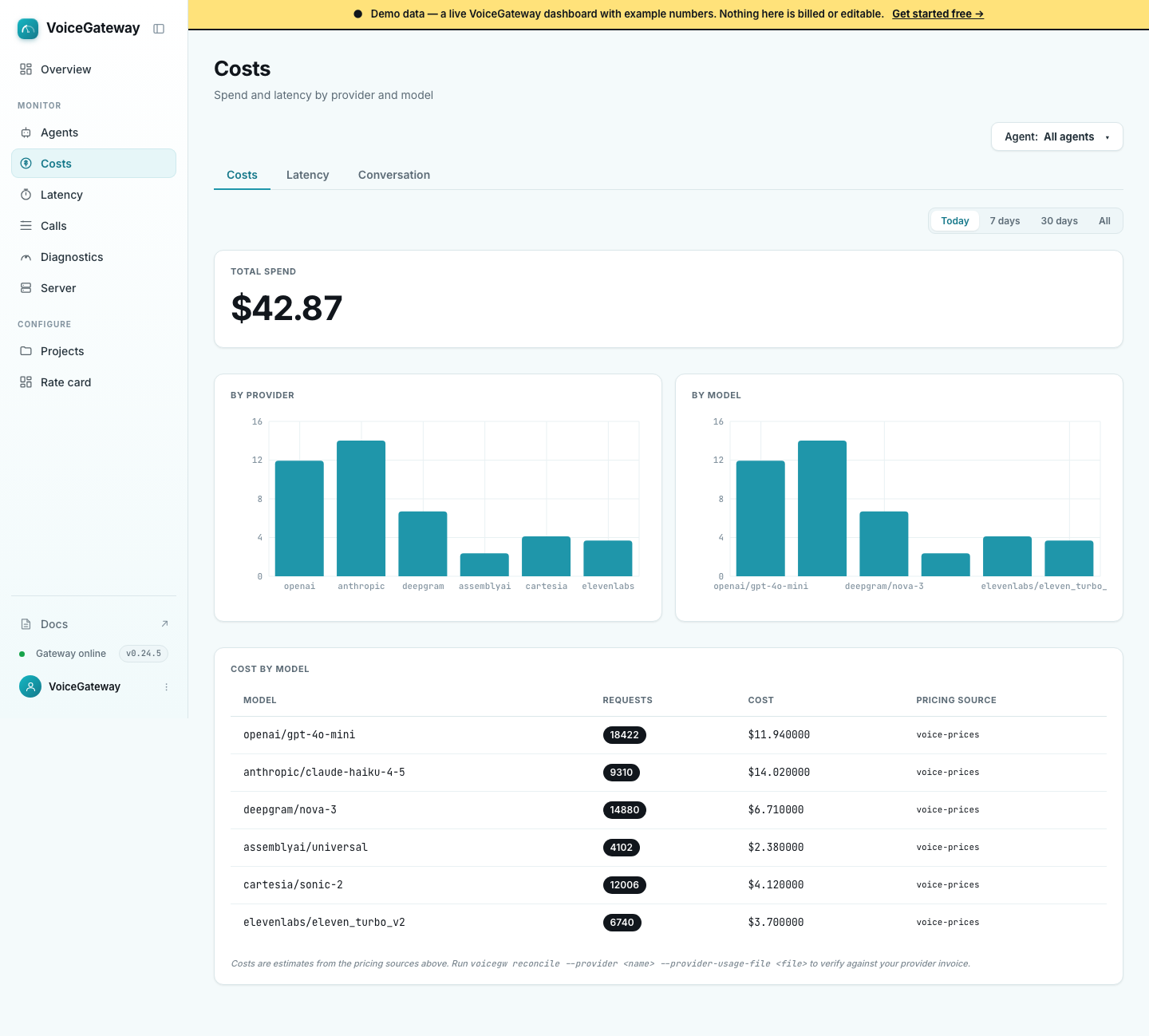
Overview (7-day spend and request trend), Agents (per-agent cost, model stack, worker memory), Costs (per provider, model, project, tenant, plus latency p50/p95), Calls (replay any conversation), Latency, Server (your LiveKit rooms, SIP, egress, cost-annotated), and Diagnostics (probe your LiveKit deployment).
White-label it per project: upload a logo, set an accent color and product name, and the whole UI re-skins. One-key light/dark.
attach() watches. guard() acts. Wrap one provider to cap spend, fall back on errors, and rate-limit. It returns a drop-in of the same type, so it slots into your session unchanged.
llm = voicegateway.guard(
    openai.LLM(model="gpt-4o-mini"),
    fallback=[openai.LLM(model="gpt-4o")],   # on a primary error
    budget="$5.00/day",                       # hard stop past the cap
    rate_limit="60/min",
)
guard() writes no metrics and attach() never double-counts, so use both together.
Run one shared collector on your VPS. Every agent pushes to it: one dashboard, one cost view, across all of them.
curl -fsSL https://voicegateway.dev/collector.sh | bashThe script installs Docker if needed, generates and persists secrets, pins the image version, and health-checks the container before returning. Point your agents at it:
export VOICEGW_COLLECTOR_URL="https://collector.example.com"
export VOICEGW_API_KEY="<your-ingest-key>"
export VOICEGW_PROJECT="my-agent"
attach() reads those and batches every call to the collector instead of local SQLite. SQLite and Postgres backends, Docker Compose, and HTTPS via Caddy: deployment docs.
VoiceGateway ships a Model Context Protocol server, so Claude Code, Cursor, Codex, and Cline can create projects, check costs, and inspect calls in natural language.
pipx inject voicegateway "voicegateway[dashboard]"
claude mcp add voicegateway --command "voicegw mcp --transport stdio"
Destructive ops (delete_*) require an explicit confirm=True after a preview. Remote HTTP/SSE transport and the full tool list: MCP reference.
Any provider voice-prices covers. You bring your own native plugins; VoiceGateway meters and prices them.
| Modality | Cloud | Local |
|---|---|---|
| STT | Deepgram, OpenAI Whisper, AssemblyAI, Groq | faster-whisper |
| LLM | OpenAI, Anthropic, Groq | Ollama (any compatible) |
| TTS | Cartesia, ElevenLabs, Deepgram Aura-2, OpenAI | Kokoro, Piper |
A price it does not recognize records at zero and flags for a rate-card entry, so nothing is silently dropped. Per-model IDs: configuration/providers.
git clone https://github.com/mahimailabs/voicegateway
cd voicegateway
pip install -e ".[dev]"
pytest
Read CONTRIBUTING.md and CODE_OF_CONDUCT.md before opening a PR. Security issues go through SECURITY.md, not a public issue. Questions and ideas are welcome in Discord.
MIT. Fork it, ship it.
Built in public by Mahimai Raja, founder of Mahimai AI, a voice AI company. Standing on LiveKit Agents, Pipecat, FastAPI, Pydantic, and voice-prices.