Adding Process analysis#1641
Conversation


|
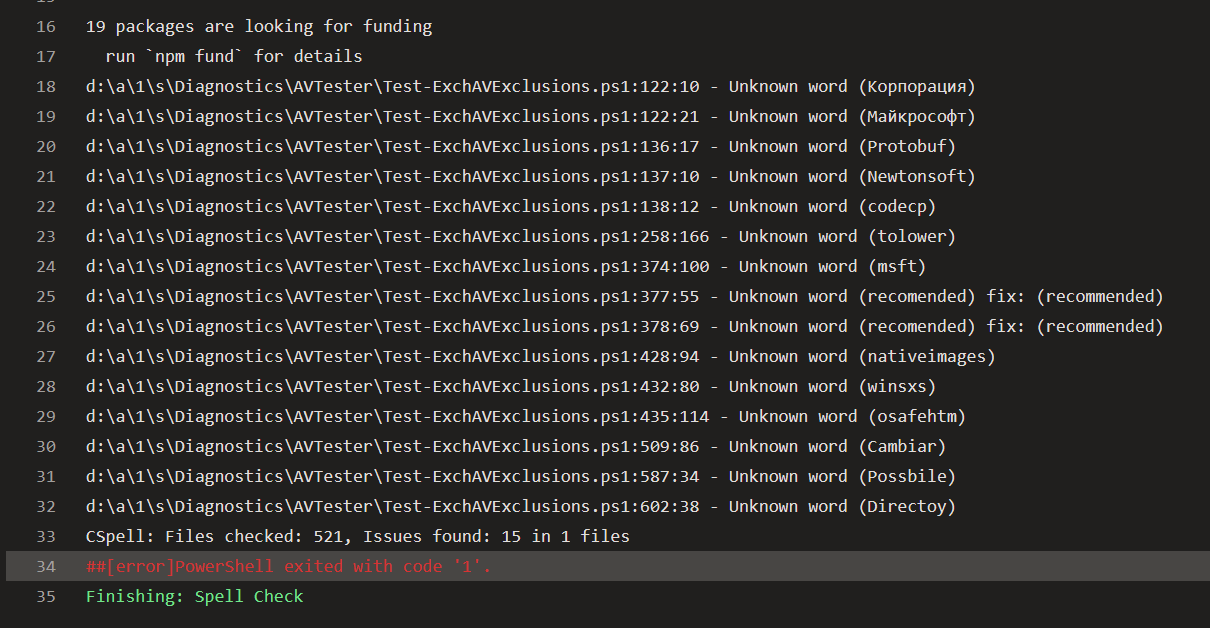
@iserrano76 spell check failed: |


…/CSS-Exchange into Test-ExchAVExclusions

| $response = $null | ||
| $response = Invoke-WebRequest http://crl.microsoft.com/pki/crl/products/CodeSigPCA.crl | ||
| if ($null -ne $response) { | ||
| if ( $response.StatusCode -eq 200 ) { | ||
| $Offline = $false | ||
| } else { | ||
| $Offline = $true | ||
| } | ||
| } else { | ||
| $Offline = $true | ||
| } | ||
| # If -recurse then we need to find all SubFolders and Add them to the list to be tested | ||
| if ($Recurse) { | ||
|
|
||
| # Add the root folder | ||
| $FolderList.Add($path.ToLower()) | ||
| } catch { | ||
| $Offline = $true | ||
| } |

There was a problem hiding this comment.
We can make this simpler:
try {
$response = $null
$Offline = $true
$response = Invoke-WebRequest http://crl.microsoft.com/pki/crl/products/CodeSigPCA.crl
$Offline = $null -eq $response -or $response.StatusCode -ne 200
} catch {
Write-verbose "Failed web request with inner error: $_"
}
| if ( ($module.FileName.ToLower().StartsWith(('c:\windows\assembly\NativeImages_').ToLower()) -and ( | ||
| $module.FileName.ToLower().EndsWith('.ni.dll') -or $module.FileName.ToLower().EndsWith('.ni.exe') -or | ||
| $module.FileName.ToLower().EndsWith('.wrapper.dll') ) ) -or | ||
| ($module.FileName.ToLower().StartsWith('c:\windows\system32\') -and [environment]::OSVersion.Version.Major -le 6 ) -or | ||
| ($module.FileName.ToLower().StartsWith(('c:\windows\WinSxS\').ToLower()) -and [environment]::OSVersion.Version.Major -le 6 ) -or | ||
| ($module.FileName.ToLower().StartsWith('c:\windows\assembly\') -and [environment]::OSVersion.Version.Major -le 6 ) -or | ||
| ($module.FileName.ToLower().StartsWith('c:\windows\microsoft.net\assembly\gac_64\') -and [environment]::OSVersion.Version.Major -le 6 ) -or | ||
| ($module.FileName.ToLower() -eq (Join-Path ($env:ExchangeInstallPath).ToLower() 'bin\osafehtm.dll') -and ([byte]$serverExchangeInstallDirectory.MsiProductMinor) -gt 0 ) ) { |
There was a problem hiding this comment.
Add comment for what we are trying to do here. This is extremely complicated and need more context here. But I believe this is testing for things that aren't signed for known modules that are on Windows 2012 R2 or below.
We should just do a list of known unsigned files if it isn't long. As this would be better for security reasons.
| $BadProcessList["$($Instance.Id) - $($module.FileName)"] = "$($Instance.Id), $($module.FileName), $($module.Company), $($module.Description), $($module.Product), $($Instance.Path), $CommandLine" | ||
| Write-SimpleLogFile -String ("[FAIL] - We could not get root certificate on Module: $($module.FileName) `n`tCompany: $($module.Company) `n`tDescription: $($module.Description) `n`tProduct: $($module.Product) `n`tProcess ID: $($Instance.Id) `n`tCommand Line: $CommandLine") -name $LogFile -OutHost | ||
| } else { | ||
| $FIPSPath = Join-Path $env:ExchangeInstallPath 'FIP-FS\Bin\TE' |
There was a problem hiding this comment.
Variable set and never changed inside of a loop. Best practice is to not do this.
| $BadProcessList["$($Instance.Id) - $($module.FileName)"] = "$($Instance.Id), $($module.FileName), $($module.Company), $($module.Description), $($module.Product), $($Instance.Path), $CommandLine" | ||
| Write-SimpleLogFile -String ("[FAIL] - We could not get root certificate on Module: $($module.FileName) `n`tCompany: $($module.Company) `n`tDescription: $($module.Description) `n`tProduct: $($module.Product) `n`tProcess ID: $($Instance.Id) `n`tCommand Line: $CommandLine") -name $LogFile -OutHost | ||
| } else { | ||
| $FIPSPath = Join-Path $env:ExchangeInstallPath 'FIP-FS\Bin\TE' |
There was a problem hiding this comment.
Using $env:ExchangeInstallPath but not a guarantee that it is there. We already define the value in $ExchangePath we should be using that.
| if ( -not (CheckIfISAcceptedRootCA -CAString $rootCertificate -isFIPFS -Offline) ) { | ||
| $BadProcessList["$($Instance.Id) - $($module.FileName)"] = "$($Instance.Id), $($module.FileName), $($module.Company), $($module.Description), $($module.Product), $($Instance.Path), $CommandLine" | ||
| Write-SimpleLogFile -String ("[FAIL] - root do not expected (FIP-FS) on Module: $($module.FileName) `n`tCompany: $($module.Company) `n`tDescription: $($module.Description) `n`tProduct: $($module.Product) `n`tRoot CA $rootCertificate `n`tProcess ID: $($Instance.Id) `n`tCommand Line: $CommandLine") -name $LogFile -OutHost | ||
| } |
There was a problem hiding this comment.
Why are we checking to see if the module is signed correctly in this script?
This script is to check for AV Exclusions the easiest way possible. If there is a threat concern that we are trying to validate here. That would need to be done in a different script, not in an AV Exclusions script.
There was a problem hiding this comment.
We are checking that the modules are signed correctly by well-know CAs.
CN=Microsoft Corporate Root CA, O=Microsoft Corporation
CN=Microsoft Root Authority, OU=Microsoft Corporation, OU=Copyright (c) 1997 Microsoft Corp.
CN=Microsoft Root Certificate Authority, DC=microsoft, DC=com
CN=Microsoft Root Certificate Authority 2010, O=Microsoft Corporation, L=Redmond, S=Washington, C=US
CN=Microsoft Root Certificate Authority 2011, O=Microsoft Corporation, L=Redmond, S=Washington, C=US
In case or FIPS files Verisign is valid as well.
CN=VeriSign Class 3 Public Primary Certification Authority - G5, OU="(c) 2006 VeriSign, Inc. - For authorized use only", OU=VeriSign Trust Network, O="VeriSign, Inc.", C=US
I think it is better to use the signature than the company name in the file.
In this way, we can verify that the module is not from a different company and that our modules were not modified.


|
Closing PR, as this has already been updated. |
4 participants


Issue:
Included a Test for Exchange processes looking for 3rd party DLLs
Reason:
Include processes test in the script.
It is based in the #1130 PR but Including signature validation of the files.
Fix:
Check the files running are signed by a know issuer (Microsoft or VeriSign in case of FIPS files)
If the file is not signed, it will verify the company or the module name is well-known.
Validation:
Test it in lab.