The major contributors of this repository include Yuqing Zhu, Shuhao Fu, Xizhou Zhu.
Flow-Guided Feature Aggregation is initially described in a ICCV 2017 paper. It provides an accurate and end-to-end learning framework for video object detection. It is worth noting that:
- Flow-Guided Feature Aggregation improves the per-frame features by aggregation of nearby features along the motion paths, thus significantly improves the video object detection accuracy.
- Flow-Guided Feature Aggregation considers temporal information at the feature level instead of the final box level. The entire system is end-to-end trained for the task of video recognition, which is vital for improving the recognition accuracy.
- Flow-Guided Feature Aggregation significantly improves upon strong single-frame baselines in ImageNet VID, especially for more challenging fast moving objects
Click image to watch our demo video
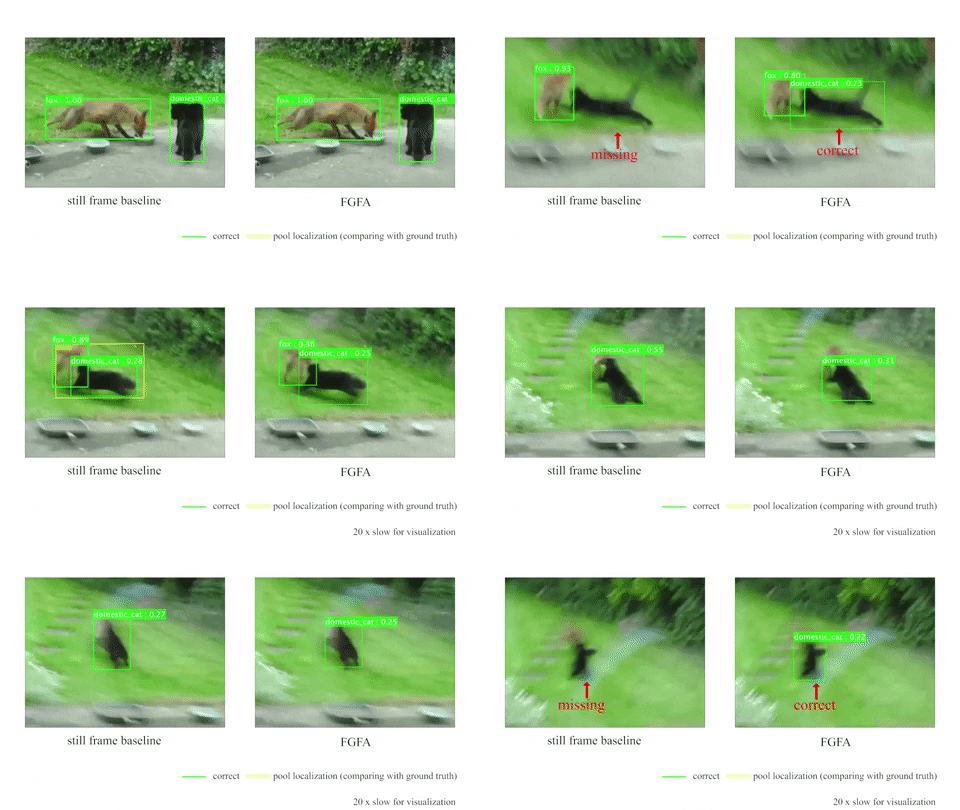
This is an official implementation for Flow-Guided Feature Aggregation for Video Recognition (FGFA) based on MXNet. It is worth noticing that:
- The original implementation is based on our internal Caffe version on Windows. There are slight differences in the final accuracy and running time due to the plenty details in platform switch.
- This repository performs one-phase training on the mixture dataset of ImageNet DET+VID, instead of two-phase training (first trained on ImageNet DET, then trained on ImageNet VID) which is performed in the original paper.
- The code is tested on official MXNet@(v0.10.0) with the extra operators for Flow-guided Feature Aggregation.
- We trained our model based on the ImageNet pre-trained ResNet-v1-101 model and Flying Chairs pre-trained FlowNet model using a model converter. The converted ResNet-v1-101 model produces slightly lower accuracy (Top-1 Error on ImageNet val: 24.0% v.s. 23.6%).
- This repository used code from MXNet rcnn example and mx-rfcn.
© Microsoft, 2017. Licensed under an Apache-2.0 license.
If you find Flow-Guided Feature Aggregation useful in your research, please consider citing:
@inproceedings{zhu17fgfa,
    Author = {Xizhou Zhu, Yujie Wang, Jifeng Dai, Lu Yuan, Yichen Wei},
    Title = {Flow-Guided Feature Aggregation for Video Object Detection},
    Conference = {ICCV},
    Year = {2017}
}

@inproceedings{dai16rfcn,
    Author = {Jifeng Dai, Yi Li, Kaiming He, Jian Sun},
    Title = {{R-FCN}: Object Detection via Region-based Fully Convolutional Networks},
    Conference = {NIPS},
    Year = {2016}
}
| training data | testing data | mAP(%) | mAP(%)(slow) | mAP(%)(medium) | mAP(%)(fast) | |
|---|---|---|---|---|---|---|
| Single-frame baseline (R-FCN, ResNet-v1-101) |
ImageNet DET train + VID train | ImageNet VID validation | 74.1 | 83.6 | 71.6 | 51.2 |
| FGFA (R-FCN, ResNet-v1-101, FlowNet) |
ImageNet DET train + VID train | ImageNet VID validation | 77.1 | 85.9 | 75.7 | 56.1 |
| FGFA + SeqNMS (R-FCN, ResNet-v1-101, FlowNet) |
ImageNet DET train + VID train | ImageNet VID validation | 78.9 | 86.8 | 77.9 | 57.9 |
Detection accuracy of slow (motion iou > 0.9), medium (0.7 ≤ motion iou ≤ 0.9), and fast (motion iou < 0.7) moving object instances.
Single-frame baseline model is from Deep-Feature-Flow.
-
MXNet from the offical repository. We tested our code on MXNet@(v0.10.0). Due to the rapid development of MXNet, it is recommended to checkout this version if you encounter any issues. We may maintain this repository periodically if MXNet adds important feature in future release.
-
Python packages might missing: cython, opencv-python >= 3.2.0, easydict. If
pipis set up on your system, those packages should be able to be fetched and installed by runningpip install Cython pip install opencv-python==3.2.0.6 pip install easydict==1.6 -
For Windows users, Visual Studio 2015 is needed to compile cython module.
Any NVIDIA GPUs with at least 8GB memory should be OK
- Clone the Flow-Guided Feature Aggregation repository, and we'll call the directory that you cloned Flow-Guided-Feature-Aggregation as ${FGFA_ROOT}.
git clone https://github.com/msracver/Flow-Guided-Feature-Aggregation.git
-
For Windows users, run
cmd .\init.bat. For Linux user, runsh ./init.sh. The scripts will build cython module automatically and create some folders. -
Install MXNet:
3.1 Clone MXNet and checkout to MXNet@(v0.10.0) by
git clone --recursive https://github.com/apache/incubator-mxnet.git
cd incubator-mxnet
git checkout v0.10.0
git submodule update
3.2 Copy operators in
$(FGFA_ROOT)/fgfa_rfcn/operator_cxxto$(YOUR_MXNET_FOLDER)/src/operator/contribbycp -r $(FGFA_ROOT)/fgfa_rfcn/operator_cxx/* $(MXNET_ROOT)/src/operator/contrib/3.3 Compile MXNet
cd ${MXNET_ROOT}
make -j4
3.4 Install the MXNet Python binding by
Note: If you will actively switch between different versions of MXNet, please follow 3.5 instead of 3.4
cd python
sudo python setup.py install
3.5 For advanced users, you may put your Python packge into
./external/mxnet/$(YOUR_MXNET_PACKAGE), and modifyMXNET_VERSIONin./experiments/fgfa_rfcn/cfgs/*.yamlto$(YOUR_MXNET_PACKAGE). Thus you can switch among different versions of MXNet quickly.
-
To run the demo with our trained model (on ImageNet DET + VID train), please download the model manually from OneDrive, and put it under folder
model/.Make sure it looks like this:
./model/rfcn_fgfa_flownet_vid-0000.params -
Run
python ./fgfa_rfcn/demo.py
-
Please download ILSVRC2015 DET and ILSVRC2015 VID dataset, and make sure it looks like this:
./data/ILSVRC2015/ ./data/ILSVRC2015/Annotations/DET ./data/ILSVRC2015/Annotations/VID ./data/ILSVRC2015/Data/DET ./data/ILSVRC2015/Data/VID ./data/ILSVRC2015/ImageSets -
Please download ImageNet pre-trained ResNet-v1-101 model and Flying-Chairs pre-trained FlowNet model manually from OneDrive, and put it under folder
./model. Make sure it looks like this:./model/pretrained_model/resnet_v1_101-0000.params ./model/pretrained_model/flownet-0000.params
-
All of our experiment settings (GPU #, dataset, etc.) are kept in yaml config files at folder
./experiments/fgfa_rfcn/cfgs. -
Two config files have been provided so far, namely, Frame baseline with R-FCN and Flow-Guided-Feature-Aggregation with R-FCN for ImageNet VID. We use 4 GPUs to train models on ImageNet VID.
-
To perform experiments, run the python script with the corresponding config file as input. For example, to train and test Flow-Guided Feature Aggregation with R-FCN, use the following command
python experiments/fgfa_rfcn/fgfa_rfcn_end2end_train_test.py --cfg experiments/fgfa_rfcn/cfgs/resnet_v1_101_flownet_imagenet_vid_rfcn_end2end_ohem.yamlA cache folder would be created automatically to save the model and the log under
output/fgfa_rfcn/imagenet_vid/. -
Please find more details in config files and in our code.
Code has been tested under:
- Windows Server 2012 R2 with 4 K40 GPUs and Intel Xeon CPU E5-2650 v2 @ 2.60GHz
- Windows Server 2012 R2 with 2 Pascal Titan X GPUs and Intel Xeon CPU E5-2670 v2 @ 2.50GHz
Q: I encounter segment fault at the beginning.
A: A compatibility issue has been identified between MXNet and opencv-python 3.0+. We suggest that you always import cv2 first before import mxnet in the entry script.
Q: I find the training speed becomes slower when training for a long time.
A: It has been identified that MXNet on Windows has this problem. So we recommend to run this program on Linux. You could also stop it and resume the training process to regain the training speed if you encounter this problem.
Q: Can you share your caffe implementation?
A: Due to several reasons (code is based on a old, internal Caffe, port to public Caffe needs extra work, time limit, etc.). We do not plan to release our Caffe code. Since a warping layer is easy to implement, anyone who wish to do it is welcome to make a pull request.