Text Reading: Extraction Types
Currently, we extract the following types of mentions:
Entities:
- Identifier
- Location
- Date
- Model
- ModelComponent
- Parameter
- Measurements (Value, Unit)
- Filename
- Repository
- String (#todo: not listed below. Need to add? @Sarah)
- Command (#todo: not listed below. Need to add? @Sarah)
- CommLineParameter (#todo: not listed below. Need to add? @Sarah)
Events:
- Description
- Parameter Setting
- UnitRelations
- Function
- Model Description
- Context
- DateEvent
- CommandSequence
- CommandLineParamValuePair (# not included below, needs to add? @Sarah)
- MD_Context (# not included below, needs to add? @Sarah)
In the following sections, we will explain each mention type with example sentences. To learn more about the overall workflow of Text Reading pipeline, see the associated github Wiki and the user manual. To see the rules used to extract these mention types, follow the link here.
We extract various types of entities that are used as building blocks in event mention extractions. See below table for the examples.
| Entity Label | Example | Extraction Example |
|---|---|---|
| Identifier | E0, Kcd, ETpm |  |
| Location | Burundi, Central African Republic, CAR |  |
| Date | 1 December 2013, 29 February 2016 |  |
| Model | The Soil and Water Assessment Tool (SWAT) model |  |
| ModelComponent | test_sensitivity |  |
| Parameter | movechance |  |
| Measurements (Value, Unit) | 7-10, days |  |
| Filename | run_TWIST.py |  |
| Repository | https://gitlab.pik-potsdam.de/twist/twist-global-model.git |  |
Description mentions capture the descriptions on the variables used in models. They are extracted by dependency or token rules using trigger words or patterns. See below for the examples.
ex1) β (variable) can be interpreted (trigger) as the effective contact rate (description).
| Relation Label | Arguments | Example |
|---|---|---|
| Description | variable description |
 |
- Description mention structure

There are cases where variables and/or descriptions are given with a conjunction ("and"). In these cases, a post-process action is applied to entangle the conjunction and map the variable with the correct description. See below for the example.
ex2)s1 and s2 (variables with a conjunction) are parameters of a logistic curve (description)
| Relation Label | Arguments | Example |
|---|---|---|
| ConjDescription | variable description |
 |
- ConjDescription mention structure


Parameter setting mentions extract a variable and its parameter value set by the model. It is extracted by either dependency or token rules with trigger words or patterns denoting parameter setting. See below for the example.
ex1) EORATIO for maize simulations was hard-coded to 1.0 within DSSAT-CSM.
| Relation Label | Arguments | Example |
|---|---|---|
| ParameterSetting | variable value |
 |
- ParameterSetting mention structure

Parameter value can be an interval rather than a single number. There are separate rules for parameter setting with value intervals. When a parameter value is an interval, the interval might include or exclude the thresholds. This information is post-processed through an action and stored as an attachment to each mention. See below for the example.
| Relation Label | Arguments | Example |
|---|---|---|
| IntervalParameterSetting | variable valueLeast valueMost |
 |
- ParameterSetting mention structure

UnitRelations Mentions are for connecting variables with their units. See below for the example.
| Relation Label | Arguments | Example |
|---|---|---|
| UnitRelation | variable unit |
 |
- UnitRelation mention structure

Other mention types, such as ParameterSetting mentions or Description mentions, can be connected with Units given in the same sentence. If there is a mention type where a unit can be connected to, a post-processing action is applied to connect those two mentions through creating a new mention type ("ParamAndUnit" type). See below for the example.
| Relation Label | Arguments | Example |
|---|---|---|
| ParamAndUnit | variable unit description+ |
 |
- ParamAndUnit mention structure

+ This third argument is not a fixed one. It can be either description or value, depending on the mention type that the unit is connected to.
Function mentions capture the functional relations (including causations or correlations) between inputs and outputs. They are extracted by dependency rules that are written based on the syntactic patterns commonly found among functional relations and trigger words. See below for the example.
ex1) E0 (output) is calculated as the product (trigger) of Kcd and ETpm (inputs).
| Relation Label | Arguments | Example |
|---|---|---|
| Function | input output |
 |
- Function mention structure

In the example 1, all the function arguments (output and inputs) are given within the same sentence. However, there are cases where function arguments (input or output) are given in separate sentences. In these cases, they are extracted as function fragments in each sentence, and then combined into a single mention by a post-processing action. See below for the example.
ex2) Rn (output) depends on RS, but also on T and RH (inputs). The only additional parameter appearing in the suggested formula is the extraterrestrial radiation (another input), RA.
- Combined function mention structure

Example 2 shows a case where additional input (extraterrestrial radiation here) is given in a separate sentence. In cases like this, function fragments are combined with the function mention found within the closest vicinity (i.e. mention from the first sentence in the example 2) to form a complete function mention.
Model description mentions (labelled as "ModelDescr") are extracted to capture the descriptions of the models (i.e., purpose, capability, characteristic, and etc.). They are extracted by dependency or token rules with trigger words associated with model descriptions. When the mentions are describing the limitations of the model, they are separately labelled as "ModelLimitation" to show their distinct nature. Show below for the example.
ex1) The Soil and Water Assessment Tool (SWAT) model (modelName) is (trigger) a robust watershed modeling tool (modelDescr).
ex2) The major limitation (trigger) of MWSWAT (modelName) was its reduced capability in larger water-sheds (modelDescr).
| Relation Label | Arguments | Example |
|---|---|---|
| Model Description | modelName modelDescr |
 |
| Model Limitation | modelName modelDescr |
 |
- Model Description mention structure

There are cases where models are referred by anaphoric phrases (i.e., it, they, the model, and etc.) instead of their names. In cases like these, anaphoric phrases are resolved to the preceding model names by a post-processing action. See below for the example.
ex3) The Soil and Water Assessment Tool (SWAT) model (modelName) is a robust watershed modeling tool. This (anaphor to be resolved) allows for (trigger) more realistic simulation of the soil water profile (modelDescr) and application of excess irrigation for leaching salts (modelDescr).
- Structure of Model Description mention with Coreference Resolution

Context mentions capture various contextual information. They are usually adverbial clauses or relative clauses containing temporal information, locational information, or conditional information. See below for the example.
ex1) After the latent period ends (context), the individual enters the class I.
| Relation Label | Arguments | Example |
|---|---|---|
| Context | context |  |
- Context mention structure

Some event mentions (i.e., function mentions, parameter setting mentions) can be contextualized with the context mentions. Context mentions are associated with other event mentions either through rules (in "contextualizedEvents.yml") or through token interval overlap. They are turned into attachments by post-processing actions and attached to the event mentions that they are associated with. See below for the examples.
ex2) If E and T data are unavailable (context), values of SKc from 0.5 to 0.7 (parameter setting) are recommended.
- Structure of contextualized event mention

We extract a limited number of Date/Event mentions, where we indicate what events occurred on a given date. The argument indicating the event that occurred is labeled "subj" (as in grammatical subject) and the predicate argument is indicated with the label "verb".
| Relation Label | Arguments | Example |
|---|---|---|
| DateEvent | subj, verb (the date is the trigger) |  |
Text of the event can be assembled by combining the text of the two relevant arguments, e.g. like here:
m.arguments("subj").head.text + " " + m.arguments("verb").head.text
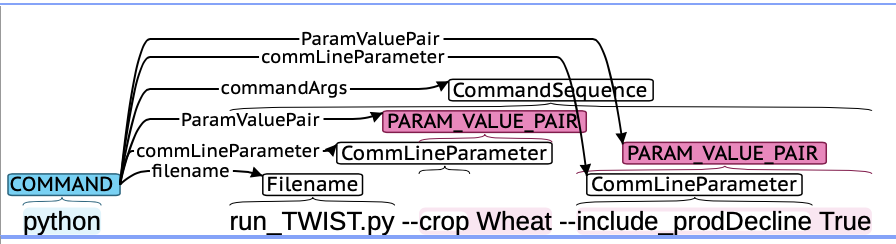
CommandSequences are extracted as events with two components: commands and command arguments. The command arguments are also made up of two linked components - parameters and values. CommandSequence events are enriched with these extractions based on overlapping mention spans in post-processing. See an example of this below: the trigger word denoting a command, in this example: "python", is used to identify the line as a command sequence and is linked to the following arguments to the command, such as the parameter-value pairs, the filename to be run, etc. The rules are identifying "crop" as a parameter and "Wheat" as the argument to that parameter, for example.
| Relation Label | Arguments | Example |
|---|---|---|
| Command | ParamValuePair commLineParamter commandArgs filename |
 |