A machine learning project implementing regression algorithms from the ground up using only Python and NumPy — no high-level ML libraries such as scikit-learn. Developed as a demonstration of foundational understanding of statistical learning theory and numerical optimisation.
- Project Overview
- Key Features
- Mathematical Foundation
- Model Architecture
- Performance Metrics
- Project Structure
- Installation & Setup
- How to Run
- Results & Visualisations
- Sample Output
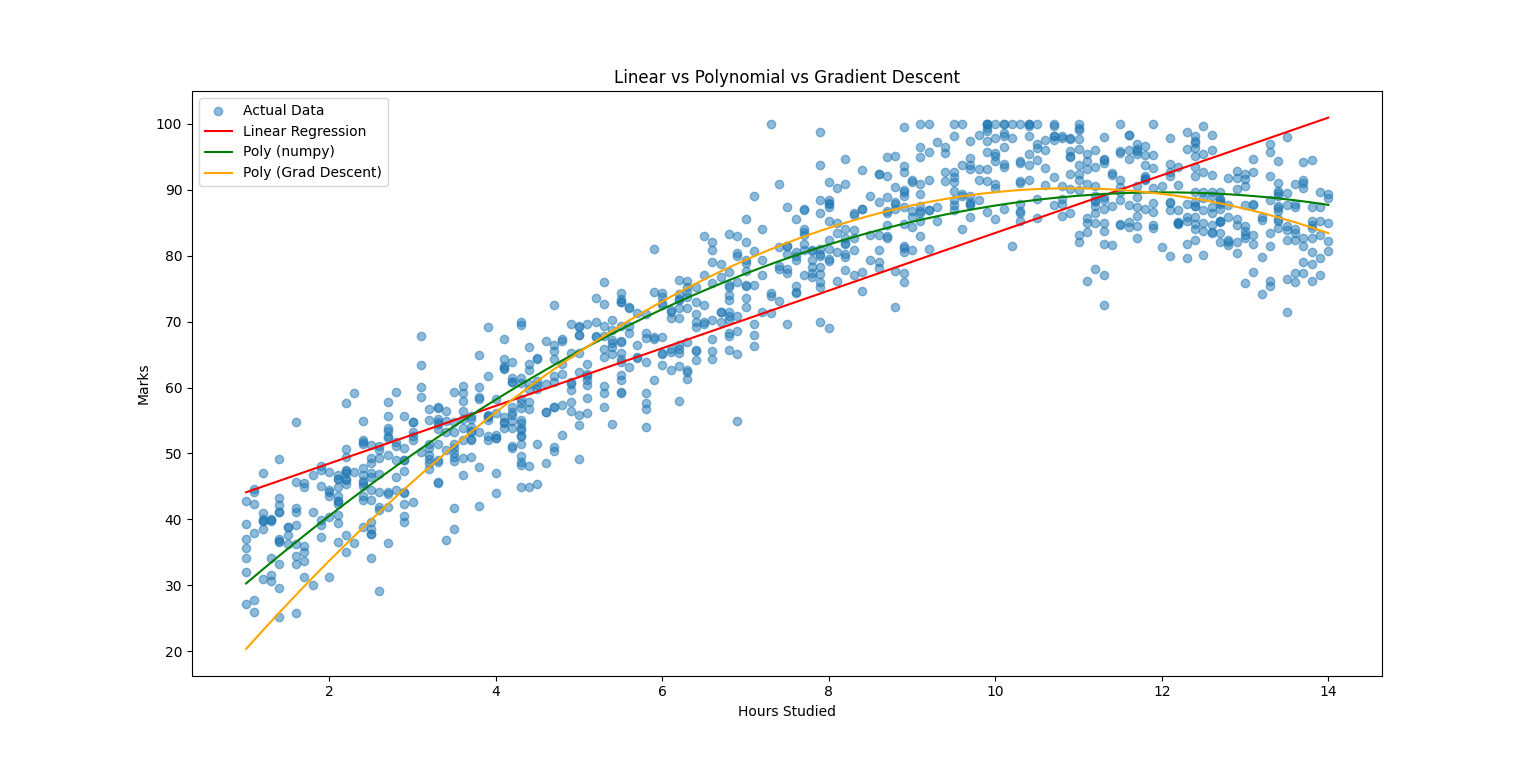
This project predicts student exam marks based on hours studied by training and comparing three regression models side-by-side:
| Model | Method |
|---|---|
| Linear Regression | Closed-form analytical solution (Normal Equation) |
| Polynomial Regression (NumPy) | NumPy polyfit as a reference baseline |
| Polynomial Regression (Gradient Descent) | Iterative optimisation implemented entirely from scratch |
The dataset contains 1,000+ student records spanning 1.0–14.0 study hours. An 80/20 train-test split is applied after random shuffling to ensure unbiased evaluation.
- Three models in one script — direct side-by-side comparison of Linear Regression, NumPy Polynomial, and from-scratch Gradient Descent Polynomial
- Zero high-level ML dependencies — every algorithm is implemented manually; no scikit-learn or similar libraries
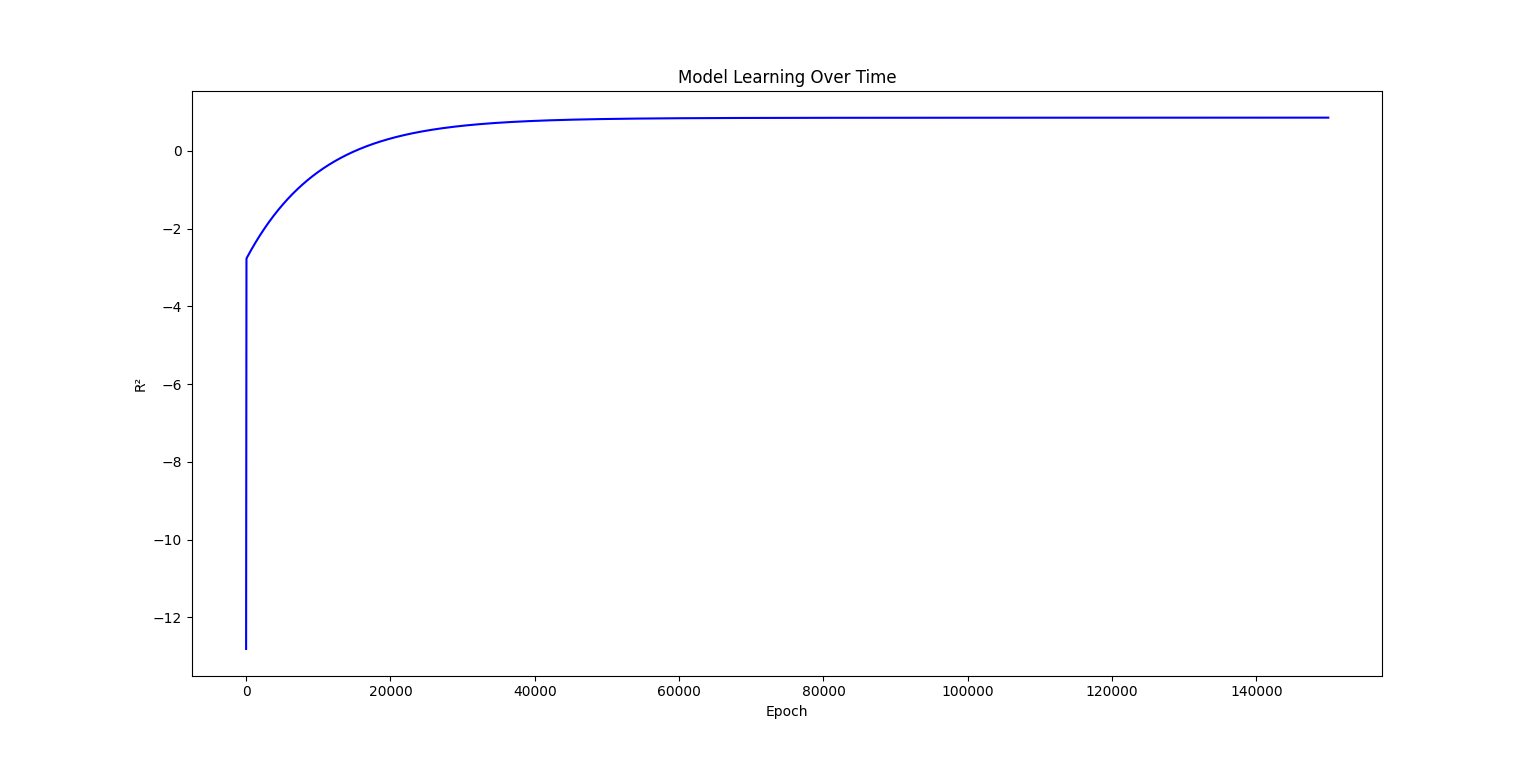
- Live training feedback — R² score is logged to the console every 10,000 epochs during gradient descent
- Interactive prediction — after training, the user can enter any value (1.0–13.9 hours) and receive predictions from all three models simultaneously
- Overfitting diagnostics — explicit train vs. test R² comparison printed after training
- Learning curve plot — R² score tracked against epoch count to visualise model convergence
All mathematical operations are implemented from scratch without relying on library abstractions.
Mean
Median — computed via manual sorting and index selection for both even and odd-length arrays.
Variance & Standard Deviation
Slope (m)
Intercept (c)
Prediction
Coefficients A, B, C are initialised to zero and updated iteratively by minimising the Mean Squared Error loss:
Partial gradients:
Update rule:
| Hyperparameter | Value |
|---|---|
| Learning Rate (α) | 1e-5 |
| Epochs | 150,000 |
R² (Coefficient of Determination)
Average Absolute Error (AAE)
Average Percentage Error (APE)
Input: Hours Studied (float, range 1.0 – 14.0)
        │
        ├─── Linear Regression ──────────── ŷ = mx + c
        │      └── Analytical closed-form solution
        │
        ├─── Polynomial Regression (NumPy)── ŷ = ax² + bx + c
        │      └── numpy.polyfit baseline
        │
        └─── Polynomial Regression (GD) ─── ŷ = Ax² + Bx + C
               └── Manual gradient descent (150,000 epochs)
                        │
                Output: Predicted Mark (0 – 100)
ML-Grade-Predictor/
│
├── ml_grade_predictor.py     # Main script — all models and visualisations
└── README.md                 # Project documentation
Ensure Python 3.x is installed, then install the two required libraries:
python -m pip install numpy==1.26.4 matplotlib==3.8.4Windows users — if the above command does not work, try:
py -m pip install numpy==1.26.4 matplotlib==3.8.4
Dependencies summary:
| Library | Version | Purpose |
|---|---|---|
numpy |
1.26.4 | Array operations & polyfit baseline |
matplotlib |
3.8.4 | Regression and learning curve plots |
No other external dependencies are required.
Navigate to the project directory and execute:
python ml_grade_predictor.pyWindows alternative:
py ml_grade_predictor.py
What happens at runtime:
- The dataset is shuffled and split 80/20 into training and test sets
- All three models are trained; gradient descent logs progress every 10,000 epochs
- Final R² scores and overfitting diagnostics are printed to the console
- Two plots are displayed — regression curves and the learning curve
- The user is prompted to enter hours studied and receives predictions from all three models
- Average absolute error and average percentage error on the test set are printed
Displays the raw scatter data alongside all three fitted curves, enabling direct visual comparison of how each model captures the underlying trend.
Tracks R² score against epoch number across 150,000 training iterations, illustrating the convergence behaviour of the gradient descent optimiser.
Epoch      0 | A:0.001 B:0.003 C:0.002 | Test R²:0.1234
Epoch  10000 | A:0.412 B:3.821 C:22.10 | Test R²:0.8901
Epoch 150000 | A:0.387 B:4.105 C:21.47 | Test R²:0.9312

--- Final R² Scores (full dataset) ---
Linear regression    : 0.9187
Poly (numpy)         : 0.9324
Poly (grad descent)  : 0.9312

--- Train vs Test R² (overfitting check) ---
Train R²: 0.9338
Test  R²: 0.9312

Enter Hours Studied: 7.5
Linear Prediction             : 68.43
Numpy Polynomial Prediction   : 69.81
Gradient Polynomial Prediction: 69.74

Avg abs error on test set : 4.21 marks
Avg % error on test set   : 5.38%
Note: Actual R² values and predictions will vary slightly between runs due to random shuffling of the dataset before the train-test split.