- Python Printing Techniques
- Python assertions
- Python 3-Pilars Functions [map/filter/reduce]
- Python Anonymous/Lambda Functions
- Python Dictionary Comprehension
Lambda functions in python are functions that are defined withought a name. Lambda functions are also called
anonymousfunctions. Regular functions are defined using thedefkeyword lambda functions are defined using thelambdakeyword Lambda functions can have any number of arguments,but can only have one expression.
lambda arguments : expression#Example 1
power = lambda number,p : number**p
print(power(10,2))
# >> 100
#Example 2
from datetime import date
#Get current Year
current_year = date.today().year
age = lambda birth_year : current_year - birth_year
print(age(1994),'years')
# Written in 2020
# >> 26 years
#Example 3
#BMI returns an anonymous function that calculates the Body Mass Index
def BMI():
return lambda height,weight : round(weight / (height * height), 2)
height = 1.75 # Height in meters
weight = 80 #Weight in kilograms
print("Your Body Mass Index:",BMI()(height,weight))
# >> Your Body Mass Index: 26.12
#Example
fruits_basket = {'🍉':True,'🍇':False,'🍎':True,'🍌':True}
#Check for existing fruits in basket.
def existing_fruits(fruits,callback):
for fruit,exists in fruits.items():
if(callback(exists)):
print(fruit,end=' ')
existing_fruits(fruits_basket,lambda itm:itm)
#Note: Lambda functions are mostly used as callbacks as an argument to a higher-order function (a function that takes in other functions as arguments). such as built-in map() or filter()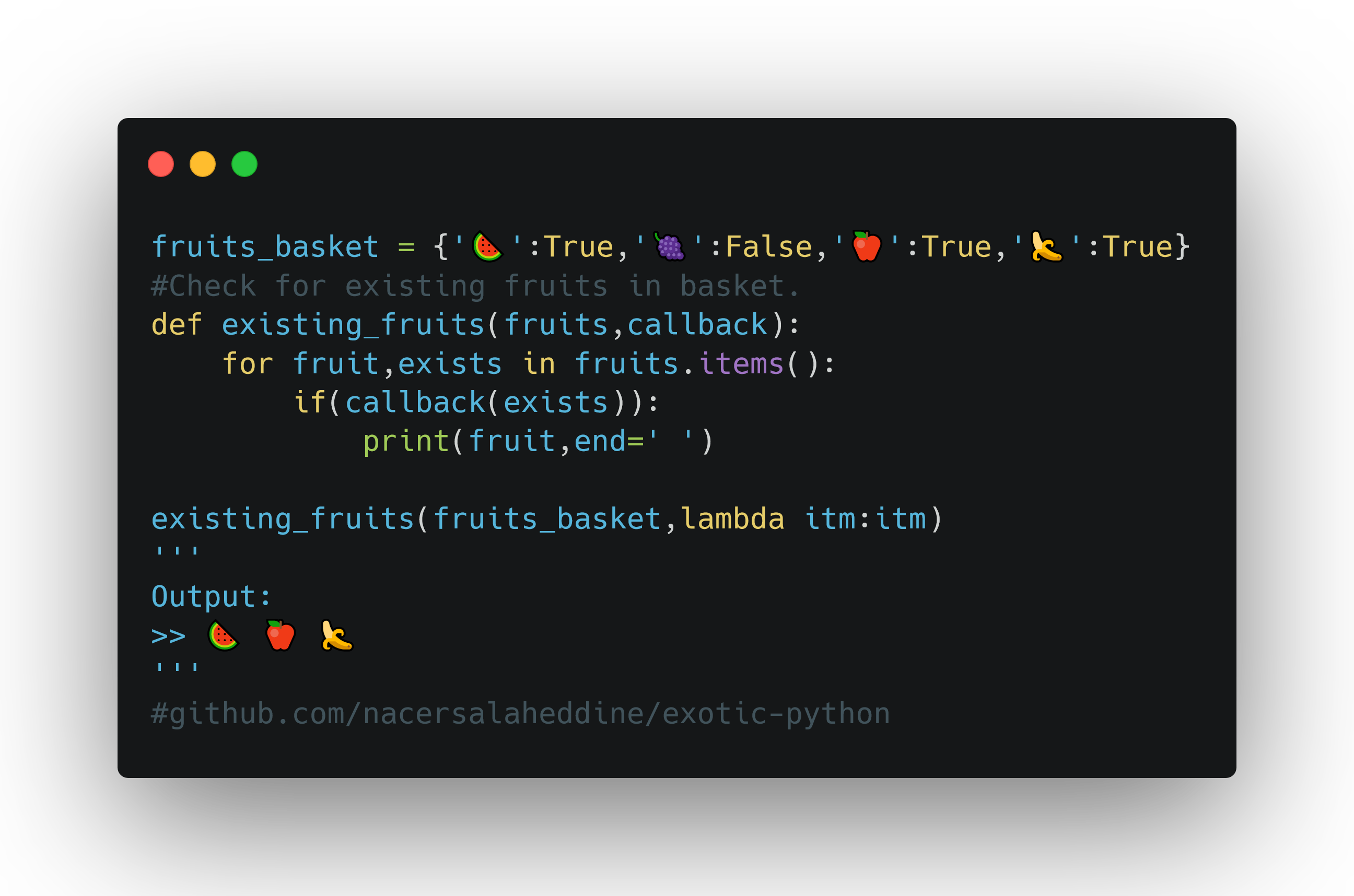
Dictionary comprehension is an elegant and concise way to create dictionaries.
{key: value for vars in iterable}#Example 1
dictionary = {x:x*x for x in range(10)}
# >> {0: 0, 1: 1, 2: 4, 3: 9, 4: 16, 5: 25, 6: 36, 7: 49, 8: 64, 9: 81}
#Example 2, People IQ dictionary, if Conditional Dictionary Comprehension
people_iq_dict = {'Salah eddine Nacer': 140, 'Mostafa Maryo': 100, 'Albert Einstein': 160, 'Donald Trump': 20}
people_low_iq_dict = {person:iq for (person,iq) in people_iq_dict.items() if iq < 100}
# >> {'Donald Trump': 20}
#Example 3, Programming languages birth year, if-else Conditional Dictionary Comprehension
programming_languages_year_dict = {'python': 1990, 'pascal': 1970, 'c': 1972, 'c++': 1980, 'java': 1995, 'javascript': 1995, 'dart': 2011, 'julia': 2012, 'c#': 2000, 'matlab': 1978, 'go': 2009, 'objective-c': 1983, 'swift': 2014, 'kotlin': 2011, 'php': 1995, 'ruby': 1993}
programming_languages_youth_dict = {lang: ('old' if year < 2000 else 'young') for (lang, year) in programming_languages_year_dict.items()}
# >> {'python': 'old', 'pascal': 'old', 'c': 'old', 'c++': 'old', 'java': 'old', 'javascript': 'old', 'dart': 'young', 'julia': 'young', 'c#': 'young', 'matlab': 'old', 'go': 'young', 'objective-c': 'old', 'swift': 'young', 'kotlin': 'young', 'php': 'old', 'ruby': 'old'}
#Example
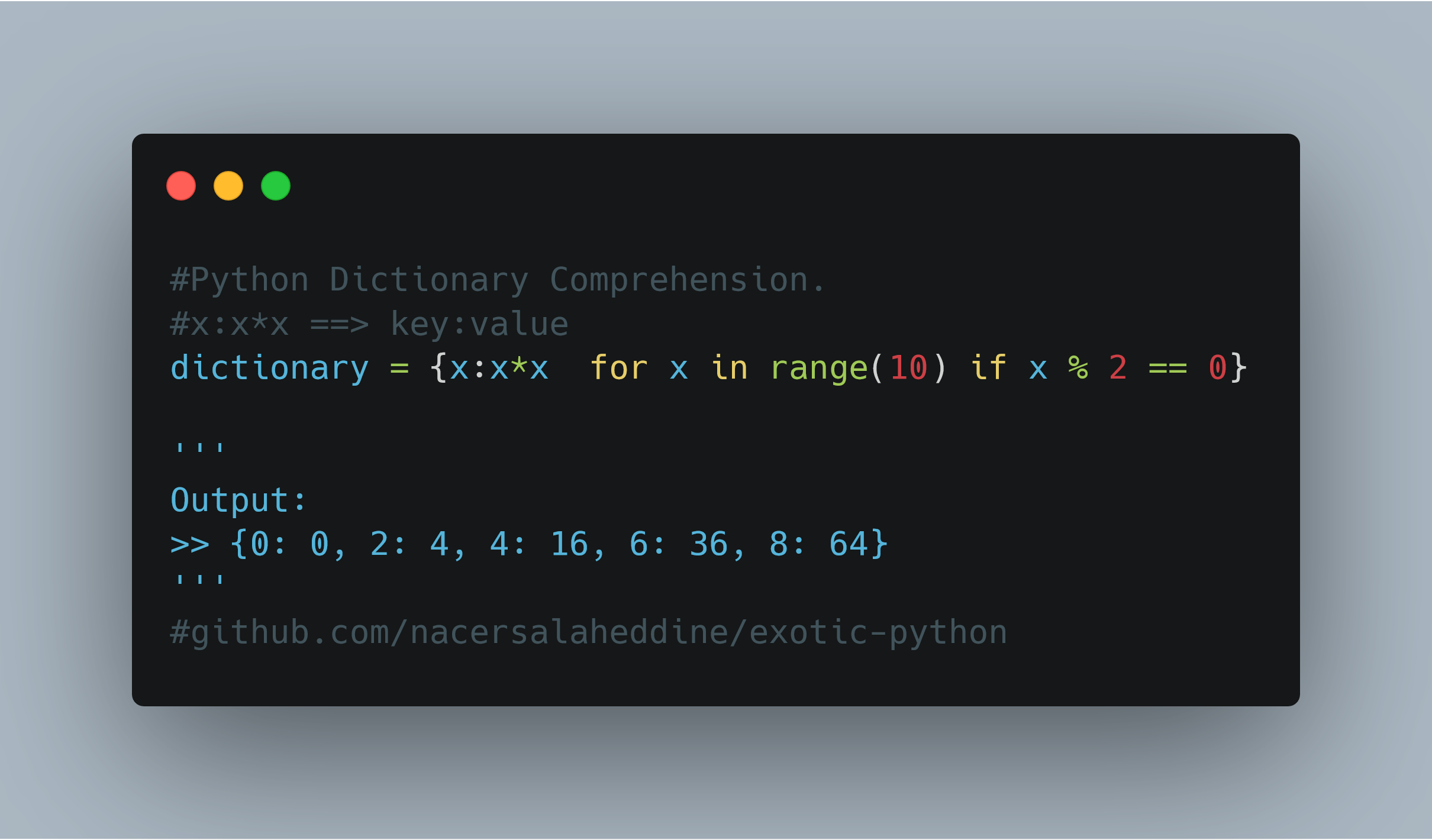
dictionary = {x:x*x for x in range(10) if x % 2 == 0}
#Equivalent code
dictionary = {}
for x in range(10):
if(x % 2 == 0):
dictionary[x] = x*x