
Strife is a modern full-stack web application built with Node.js, Express, MongoDB, and React.
Its primary focus is on secure, user-friendly authentication and profile management.
The project is a work in progress and currently showcases:
- A robust authentication system with JWT tokens, two-factor authentication (2FA), and Google Sign-In.
- User profile features, including registration, login, and customizable avatars stored via MinIO.
- A clean, responsive frontend UI, designed in Figma and built with React + Material UI.
- Modular backend APIs and a scalable project structure suitable for production environments.
Strife is both a learning project and a production-style prototype, simulating the workflows and best practices of real-world applications.
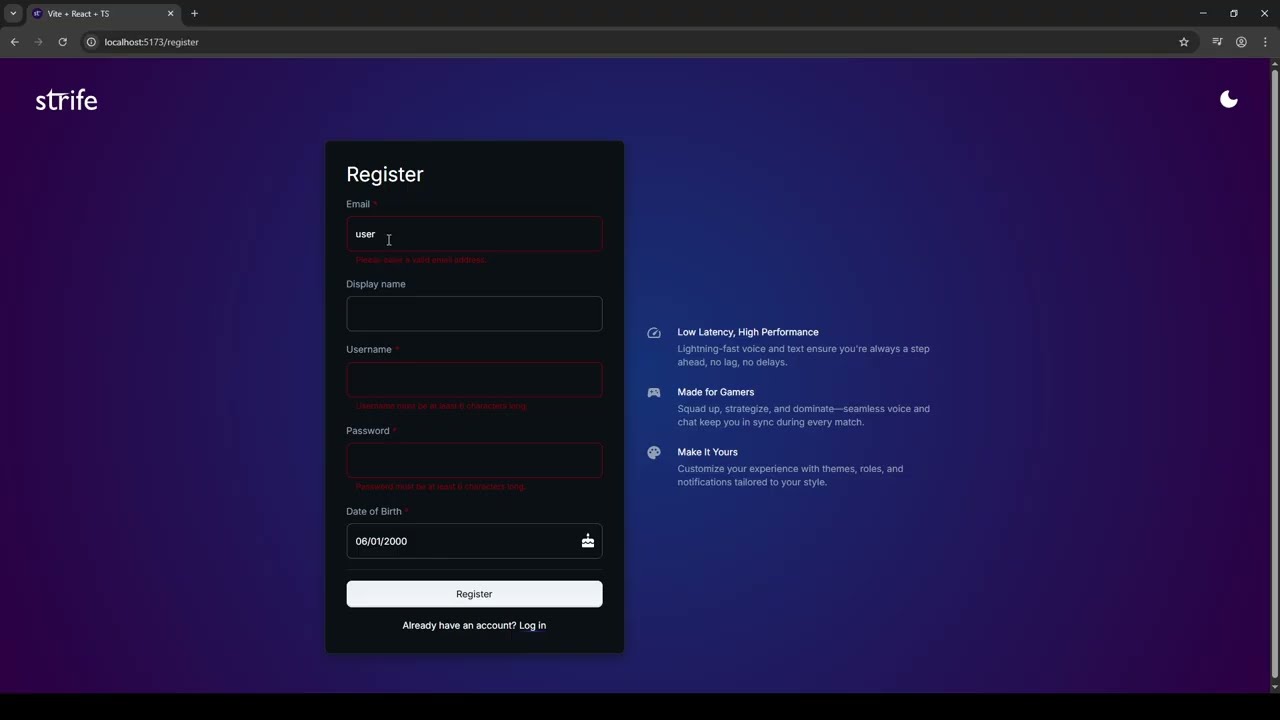
Strife is currently focused on secure authentication and user profiles, but its long-term vision is to grow into a community-driven platform with rich communication and administration features.
- Implement a guild (server) system where each guild can contain multiple channels.
- Support role-based permissions with fine-grained access control per guild and channel.
- Provide administration tools for guild owners and moderators to define custom rulesets and automate management.
- Goal: an easy-to-use platform that balances simplicity with powerful administration.
- Schema design in MongoDB for hierarchical guild/channel/role structures.
- Efficient permission resolution logic (guild-level vs channel-level overrides).
- Real-time updates using WebSockets (e.g., Socket.IO) to propagate changes instantly.
- Real-time text messaging in channels and direct messages.
- Focus on low latency and reliable delivery.
- Message persistence so history is stored and synchronized across devices.
- WebSockets or WebRTC Data Channels for real-time communication.
- Message queueing for scaling across multiple servers.
- Database optimization for storing messages (sharding, indexing, pagination).
- Potential end-to-end encryption for private messaging.
- One-on-one and group voice/video calls.
- Channel-based voice rooms (similar to Discord).
- Reliable media streaming with low latency.
- WebRTC as the underlying technology for peer-to-peer audio/video.
- Bandwidth adaptation and codec handling for a smoother user experience.
- Personalized discovery page for users, similar to "For You Pages".
- Content recommendations based on user activity and interests (initial focus on gaming).
- Surfacing articles, videos, and posts from around the web.
- A lightweight machine learning model for interest tracking and recommendation.
- Backend pipeline for collecting and filtering content.
- Ranking algorithm balancing relevance, freshness, and diversity.
- Possible integration with external APIs for curated content sources.
This roadmap aims to position Strife as a quickly rising platform that combines real-time communication, rich administration features, and personalized discovery into a single, cohesive experience.
- JWT-based authentication for secure sessions.
- Two-factor authentication (2FA) with QR codes and verification codes.
- Google Sign-In integration via Google Identity Services (GIS).
- Email validation step in 2FA reset flow.
- Password hashing and secure credential storage.
- User registration & login with Joi-based input validation.
- Profile view & editing.
- Avatar uploads with MinIO (S3-compatible, publicly accessible).
- Image upload validation (size limits, collision avoidance).
- Modern, responsive UI built with React + Vite.
- Material UI components with custom theming.
- Minimalist artwork backgrounds inspired by Discord’s style.
- Form validation with live error messages.
- Modular Express routes for clean API design.
- MongoDB + Mongoose for data persistence.
- Environment variable–based configuration.
- Ready for Postman testing & API exploration.
- Clear separation between frontend and backend.
- Backend and frontend can be developed & run independently.
- Scalable design for future features.
- React (Vite) — fast build tooling and modern React features
- Material UI (MUI) — UI components with custom theming
- Inter font — clean, modern typography
- Axios — for API requests
- Figma — design and prototyping
- Node.js + Express — REST API and server logic
- MongoDB + Mongoose — NoSQL database and schema modeling
- JWT (JSON Web Tokens) — authentication & session management
- Joi — schema-based input validation
- MinIO — S3-compatible object storage for avatars
- Google Identity Services (GIS) — client-side sign-in with Google
- Two-Factor Authentication (2FA) — QR-based secret + verification codes
- Password hashing and secure credential storage
- Postman — API testing
- IntelliJ IDEA — primary development environment
- Git & GitHub — version control and collaboration