

A local-first Claude Code skill (/explainer) that turns a topic or a source document into a visually dynamic HTML explainer deck and a narrated, captioned MP4 — end to end, on your own machine, using only local/free tools plus a Claude subscription. No paid SaaS anywhere in the generation path.
It runs on Apple Silicon (an M3/16 GB Mac), renders a 20–30 s short in roughly a minute, and stops at a clean, labeled output directory + a versioned manifest.json ready for a downstream poster. It does not post to social platforms — generation only.
Status: v1.0.0 — built, working, and polished enough that the tool generated its own explainer video about itself. Built as a Claude Code skill.
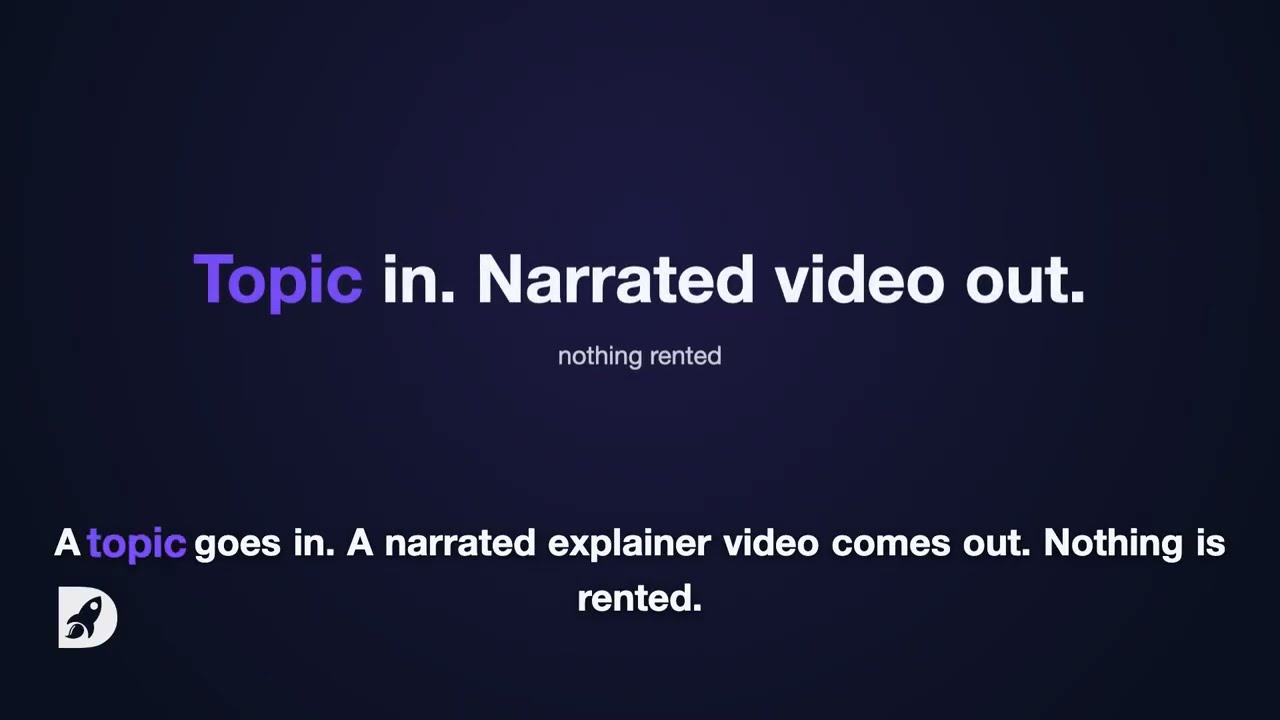
▶ Watch on YouTube — the explainer system, explained by an explainer it generated about itself.
This started from a simple itch.
There's a great open-source project, prajwal-y/video_explainer, that turns technical documents into explainer videos. The architecture is excellent — and I borrowed its single best idea (generate the audio first, then sync visuals to word-level timestamps). But its default path leans on ElevenLabs for narration and Remotion/React for rendering: a metered voice subscription and a source-available framework with a paid company license.
And that's the pattern everywhere you look. To make one short video the "normal" way, you end up renting four or five different cloud services — a voice subscription here, a stock-footage subscription there, an avatar plan, a render credit meter — each one a recurring bill, each one uploading your work to someone else's servers.
I just wasn't interested in that. I have a perfectly capable computer sitting right here. There's a tiny, excellent text-to-speech model (Kokoro-82M) that runs locally and sounds great. There's a forced aligner in torchaudio. There's a headless browser and ffmpeg. Why rent what I can run?
Yes, doing it locally might take a few minutes longer per video. So what? That's the whole point — this much capability, free, on the machine in front of me, with nothing leaving my desk. That's the beauty of where the technology is right now. This project is that conviction, built out: inspired by video_explainer, with every paid dependency stripped out and replaced with something local.
Give it a topic (or point it at a PDF/URL) and it will:
- Research & script — Claude researches the topic, captures sourced facts to a small local wiki, and writes a voice-over script and a structured deck.
- Narrate locally — Kokoro-82M synthesizes the narration (≈5× faster than real time on an M3), loudness-normalized to broadcast level.
- Align —
torchaudioMMS_FA forced alignment produces word-level timestamps (the Apple-Silicon-native replacement for WhisperX), driving word-synced kinetic captions and SRT/VTT. - Build a deck — a fixed-theme, data-driven HTML deck (hook · statement · diagram · figure · payoff slide types) with a template family of themes, varied transitions, a subtle ambient motion layer, and an optional source figure framed from an ingested PDF/URL.
- Render — a deterministic JS animation engine captured frame-by-frame via Playwright headless Chrome, encoded with
ffmpeg(VideoToolbox). One project renders multiple aspect ratios at once (9:16 / 16:9 / 4:5 / 1:1) with per-platform safe zones. - Brand & CTA — an optional brand library stamps a watermark on every slide and auto-appends a spoken + visual call-to-action end slide (logo, product image, link).
- Package — writes a labeled output dir, a standalone reusable HTML deck, captions, per-aspect MP4s, and a versioned
manifest.jsoncarrying AI-disclosure metadata and per-platform captions for a downstream poster. Then it stops.
A motion/pacing QA pass (ffmpeg freezedetect × the word timeline) flags visual dead air and weak pacing.
- Local & free stack: Kokoro-82M (TTS) · torchaudio MMS_FA (alignment) · plain HTML + a seeded JS animation driver · Playwright frame capture · ffmpeg/VideoToolbox. The only "AI service" is the operator's existing Claude subscription — no metered API key.
- Generation / media split: Claude is confined to the generation stages; the media path (narrate → align → render → mux) is pure Python with zero LLM calls, so renders run unattended.
- Deterministic by construction: seeded RNG + CDP virtual time; raw CSS animation is forbidden on captured elements, so the same project renders the same frames every time.
- Apple-Silicon-native: no CUDA; memory-heavy stages are serialized for a 16 GB unified-memory budget.
- Generation only: the boundary ends at the output dir + manifest. A separate tool (e.g. a Blotato adapter) can post; this one never does.
See PRD.md for the full architecture, phase-by-phase build log, risks, and the multi-perspective council review that shaped it, and the /explainer skill for usage.
explainer scaffold "what is a vector database" --brand ACME
# Claude authors script.json + deck.json (research, hook, slides)…
explainer media outputs/<date>_what-is-a-vector-database
#  → deck/index.html, video/explainer_9x16.mp4, captions/, manifest.json
explainer handoff outputs/<date>_… # per-platform, blotato-ready post specs (still never posts)This is a deliberately narrow, opinionated tool. There is a large and good market of alternatives; for many people one of them is the better choice. Here's an honest map, with references.
The biggest category. Type a script or prompt, get a finished video on the vendor's servers.
- Faceless / stock-montage: Pictory, InVideo AI, Fliki, Revid.ai, AutoShorts.ai
- Avatars & premium voice: Synthesia, HeyGen, Colossyan, D-ID, ElevenLabs (the exact voice service this project replaced with local Kokoro)
How they differ: all are cloud subscriptions ($6–$199+/mo), metered by minutes/credits, and your script and source material are uploaded to their servers. They offer things we simply don't: photoreal talking-head avatars and voice cloning, 100+ languages with one-click translation/dubbing, millions of licensed stock clips (Pictory) and frontier generative video (InVideo's Sora 2 / VEO), polished web editors, and — notably — auto-posting/scheduling straight to TikTok/YouTube (AutoShorts.ai, Revid.ai).
What we do differently: 100% local and offline-capable (nothing leaves your Mac), no per-video metering, a designed animated deck rather than a stock montage or a talking head, real source-figure ingestion, and multi-aspect output from one project.
- Gamma (best-in-class PDF/PPTX → designed deck), Google Vids, Canva Magic Studio, Beautiful.ai. (Tome has pivoted away from this space.)
How they differ: these are superb at decks and live in the cloud with real-time collaboration, hosting, share links, huge template/stock libraries, and broad export — strengths we don't chase. Most are deck-first; only some emit a true narrated MP4. We span both (a reusable HTML deck and a narrated video) but as a single-user, local, file-based tool.
The render-engine layer.
- Remotion (React; mature, but a paid company license above 3 employees), Revideo (MIT, license-clean), Motion Canvas (MIT, editor-centric), HyperFrames (Apache-2.0; architecturally the closest to our HTML + virtual-clock capture path).
How they differ: these are libraries you build a pipeline around, not finished tools. They give far more raw animation power (React/canvas, Three.js, GSAP, Lottie) and, for Remotion/Revideo, cloud-render scaling to thousands of videos. We deliberately trade that flexibility for an end-to-end skill with batteries included (TTS, alignment, scripting, captions, branding) and no React/licensing dependency — closest in spirit to HyperFrames, but as a whole pipeline.
The closest cousins.
- Topic→video pipelines:
video_explainer(our inspiration), MoneyPrinterTurbo, ShortGPT - Paper / doc → explainer: Paper2Video (full academic talk + talking head, but assumes a 48 GB CUDA GPU), Manimator (3Blue1Brown-style Manim math animation), NotebookLM Video Overviews (zero-setup, cloud, polished), repo-explainer
How they differ: these are the genuine end-to-end alternatives — and several are excellent. But almost all of them call a metered LLM API (GPT-4.1/Gemini) and many default to paid TTS, stock footage, or a CUDA GPU. MoneyPrinterTurbo/ShortGPT build stock-clip montages and can auto-publish; the Manim tools do true equation/proof animation we can't match; Paper2Video produces a far more complete academic artifact (talking head, cursor grounding, a published benchmark). We're the one tuned to run entirely on a consumer Apple-Silicon Mac with no metered API — reusing your Claude subscription instead of a per-token key — and aimed at short, social-format video with hook + kinetic captions + branding.
These are choices, not gaps — and for some users they're dealbreakers, which is fine:
- No posting. We write a labeled dir + manifest and stop. (Tools like AutoShorts.ai/Revid.ai auto-publish; pair us with a separate poster instead.)
- No avatars or voice cloning. No talking head, no cloned voice — a single local Kokoro voice.
- No stock footage or generative B-roll. The visual is a designed animated deck, not photoreal video.
- No big multilingual catalog. Effectively single-language per the local voice; no one-click translation/dubbing.
- No cloud editor, hosting, collaboration, or template marketplace. Single-user, local, file-based.
- No turnkey cross-platform packaging. Apple-Silicon-first; not a Windows/Docker/cloud product (today).
- You want zero setup and a polished result in a browser, today → NotebookLM, Gamma, or Pictory.
- You need a human presenter, voice cloning, or 100+ languages → Synthesia, HeyGen, ElevenLabs.
- You want a set-and-forget faceless channel that posts itself → AutoShorts.ai, Revid.ai.
- You're a developer who wants maximum animation control or cloud-scale rendering → Remotion, Revideo, HyperFrames.
- You're animating math/theorems or academic talks → Manimator, Paper2Video.
You, if you: own a capable machine and would rather run things on it than rent them; care that your source material and scripts never leave your desk; want zero marginal cost per video beyond a Claude subscription you already pay for; like a designed, deterministic, reproducible deck aesthetic over stock montages or avatars; and are happy to own the (small) setup in exchange for a free, private, end-to-end pipeline.
A few minutes longer per render, run locally and free, with nothing leaving your machine. That trade is the entire point.
This is free and open source (MIT), and it isn't a business. If it's useful to you, a ⭐ on the repo genuinely helps other people find it.
Found a bug, or want a feature? Open an issue — I'm actively collecting feature ideas, and PRs are welcome.
Built as a Claude Code skill. Design & build log: PRD.md. Conventions: CLAUDE.md. Generation-only — this tool never posts to social platforms. Licensed under MIT.