
Open-source platform for building accounting-centric business applications and industry solutions.
Built on .NET and PostgreSQL, designed for modular business systems, production-grade accounting, metadata-driven UI, and vertical solutions.
Website · Docs · Property Management (Live Demo) · Trade (Live Demo) · Agency Billing (Live Demo)
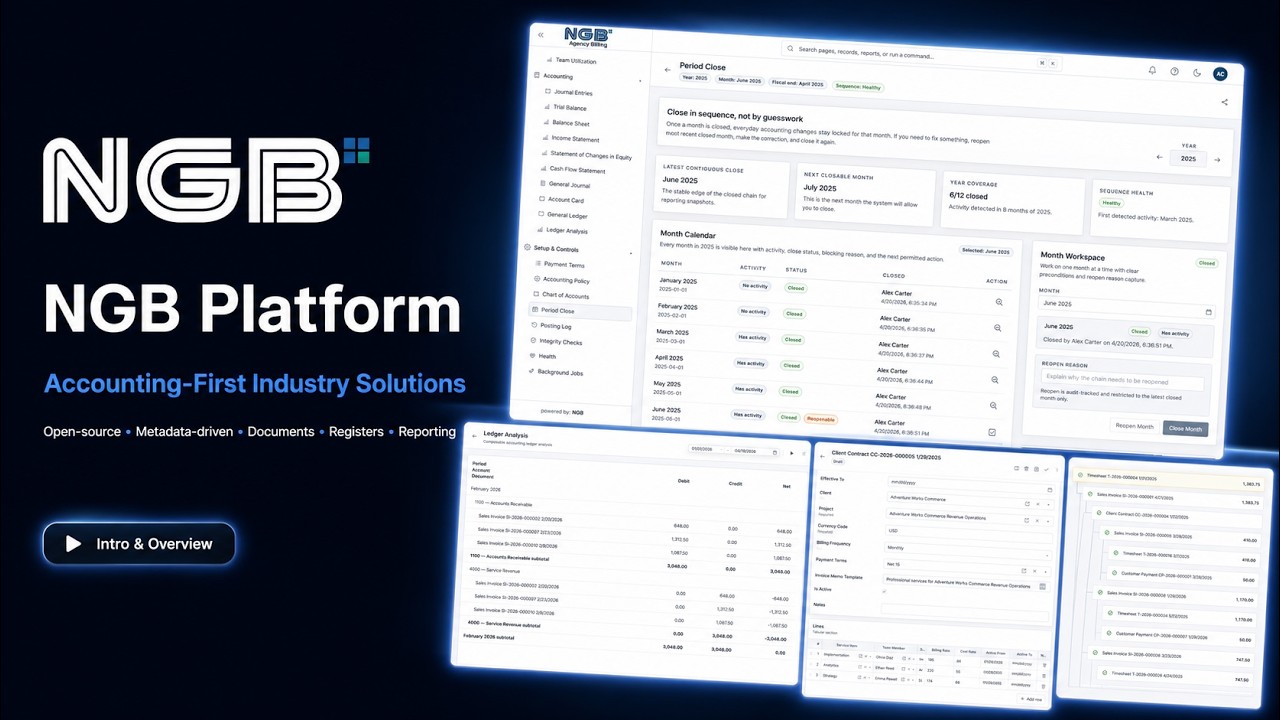
- What is NGB Platform
- Why NGB exists
- Who NGB is for
- What you can build with NGB
- Core capabilities
- Live demos
- Architecture overview
- Architecture flow
- Monorepo structure
- Technology stack
- Getting started
- Design principles
- Contributing
- License
NGB Platform is an open-source platform for building accounting-centric business applications and industry-specific solutions.
NGB provides a production-oriented foundation for systems built around:
- catalogs and business documents;
- posting and accounting effects;
- operational and reference registers;
- metadata-driven forms and lists;
- auditability and explainability;
- reporting and analytical views;
- vertical solutions built on a shared platform core.
NGB is not a low-code toy and not a monolithic ERP bundle. It is a platform for building serious line-of-business systems with a clear architecture, strong domain conventions, and a practical path from framework to real vertical applications.
Business software is usually forced into one of two extremes:
- generic web frameworks, which are flexible but leave the hardest business architecture problems unsolved;
- large ERP products, which are powerful but heavy, inflexible, and difficult to adapt cleanly.
NGB exists to offer a third path:
- a modular platform instead of one-off project scaffolding;
- a business-application architecture instead of generic MVC plumbing;
- an accounting-aware domain foundation instead of bolted-on finance logic;
- a shared platform core + vertical solutions model instead of duplicating infrastructure across products.
The goal is simple: help developers and product teams build production-grade business systems faster, with fewer architectural compromises and a stronger long-term foundation.
NGB is designed for:
- software engineers and architects building serious business applications;
- product teams creating vertical SaaS or internal business platforms;
- consultancies and implementation teams building industry-specific solutions;
- founders who need a reusable platform for multiple business products;
- teams that want source code ownership instead of vendor lock-in.
NGB is especially relevant when your solution includes one or more of the following:
- business documents with lifecycle and posting;
- accounting logic or financial statements;
- operational balances or register-style state tracking;
- metadata-driven UI and dynamic forms;
- auditable history and explainable system behavior;
- multiple industry solutions sharing one platform base.
NGB is designed for building serious business software.
It is well suited for applications where business documents, workflows, accounting, reporting, auditability, and domain-specific rules are core architectural concerns rather than secondary features.
With NGB, teams can build:
- vertical business applications;
- finance and operations platforms;
- accounting-centric SaaS products;
- internal enterprise systems;
- industry-specific ERP-style solutions;
- workflow-heavy back-office applications;
- custom business platforms with strong domain modeling;
- long-lived systems that require explainability, consistency, and extensibility.
The demo solutions included in this repository show a few possible applications of the platform, but they do not limit the range of systems that can be built with NGB.
- Modular architecture built for shared platform capabilities and vertical extensions.
- Clear separation between core domain, runtime, infrastructure, application hosts, and industry solutions.
- Metadata-driven catalogs and documents.
- Universal patterns for lists, forms, payloads, actions, and UI metadata.
- Consistent lifecycle model for business objects and business documents.
- Production-oriented accounting foundation.
- Operational registers and reference registers as first-class platform concepts.
- Append-only business history and effect-oriented modeling.
- Support for posting flows, balances, turnovers, and financial reporting.
- Platform reporting contracts and execution model.
- Interactive reporting surface for business and accounting scenarios.
- Report definitions, filters, grouping, exports, and vertical reports.
- PostgreSQL as the system of record.
- Background jobs infrastructure.
- Database migration tooling.
- Watchdog / health surface.
- Structured observability hooks.
- SSO integration through Keycloak.
- Shared UI framework.
- Metadata-driven web applications for vertical solutions.
- Custom branding and authentication theme support.
The demo applications include a preconfigured administrator account for evaluation purposes.
Default demo user
- Name: Alex Carter
- Role: Admin
- Email: alex.carter@demo.ngbplatform.com
- Password:
DemoAdmin!2026
This account is intended for demo and evaluation use only.
- Property Management — https://pm-demo.ngbplatform.com
- Trade — https://trade-demo.ngbplatform.com
- Agency Billing — https://ab-demo.ngbplatform.com
The repository currently contains the platform core and source code for the demo solutions in this monorepo. Live demos are intended to show how one platform can support multiple business domains with a shared architectural base.
NGB follows a layered platform architecture built around reusable platform hosts, shared contracts and metadata, a central execution core, specialized business engines, and PostgreSQL-based persistence.
At the top level, NGB provides dedicated platform hosts for API delivery, background processing, health and operability, and schema deployment. These hosts do not implement business behavior themselves. Instead, they compose and expose the platform through shared contracts, abstractions, and runtime orchestration.
At the center of the platform is NGB.Runtime. It acts as the execution core that coordinates catalogs, documents, posting, reporting, validation, and workflow behavior. Rather than scattering business logic across hosts, NGB concentrates orchestration in the runtime layer and delegates specialized responsibilities to dedicated platform engines.
Those engines include NGB.Accounting, NGB.OperationalRegisters, NGB.ReferenceRegisters, and the business audit log. Together they provide the core business mechanics of the platform: ledger semantics, register-based state handling, reference-state projection, and append-only auditability.
Persistence and database interaction are handled through NGB.PostgreSql, which serves as the platform’s infrastructure bridge for readers, writers, and migration support. Platform data is stored in PostgreSQL, while authentication is integrated with Keycloak.
flowchart TB
    classDef host fill:#fff4e5,stroke:#c77d1a,stroke-width:1.5px,color:#111827;
    classDef surface fill:#eef4ff,stroke:#2f5fb3,stroke-width:1.5px,color:#111827;
    classDef runtime fill:#eafaf1,stroke:#1f8f57,stroke-width:1.8px,color:#111827;
    classDef engine fill:#f3ecff,stroke:#7c3aed,stroke-width:1.5px,color:#111827;
    classDef infra fill:#f7f7f7,stroke:#6b7280,stroke-width:1.5px,color:#111827;
    classDef external fill:#ffffff,stroke:#9ca3af,stroke-width:1.2px,color:#111827;

    subgraph HOSTS["Platform Hosts"]
        API["NGB.Api<br/>HTTP / API host"]
        BG["NGB.BackgroundJobs<br/>Scheduled job host"]
        WD["NGB.Watchdog<br/>Health / operability host"]
        MIG["NGB.Migrator<br/>Schema deployment host"]
    end

    subgraph SURFACE["Contracts, Metadata, and Platform Surface"]
        CONTRACTS["NGB.Contracts<br/>Public DTOs and API contracts"]
        APPABS["NGB.Application.Abstractions<br/>Application-facing interfaces"]
        DEFINITIONS["NGB.Definitions<br/>Catalogs, documents, reports, behaviors"]
        METADATA["NGB.Metadata<br/>Metadata model and descriptors"]
        CORE["NGB.Core<br/>Common primitives and shared foundation"]
    end

    subgraph EXECUTION["Execution Core"]
        RUNTIME["NGB.Runtime<br/>Orchestration of catalogs, documents,<br/>posting, reporting, validation, and workflow"]
    end

    subgraph ENGINES["Business Engines"]
        ACCOUNTING["NGB.Accounting<br/>Ledger and posting semantics"]
        OR["NGB.OperationalRegisters<br/>Operational register engine"]
        RR["NGB.ReferenceRegisters<br/>Reference register engine"]
        AUDIT["Business AuditLog<br/>Append-only audit trail"]
    end

    subgraph INFRA["Persistence and Integration"]
        PG["NGB.PostgreSql<br/>Persistence, readers, writers, migrations support"]
    end

    subgraph EXTERNAL["External Systems"]
        DB[("PostgreSQL")]
        KC["Keycloak"]
    end

    API --> CONTRACTS
    API --> APPABS
    BG --> APPABS
    WD --> APPABS
    MIG --> PG

    CONTRACTS --> RUNTIME
    APPABS --> RUNTIME
    DEFINITIONS --> RUNTIME
    METADATA --> RUNTIME
    CORE --> RUNTIME

    RUNTIME --> ACCOUNTING
    RUNTIME --> OR
    RUNTIME --> RR
    RUNTIME --> AUDIT
    RUNTIME --> PG

    ACCOUNTING --> PG
    OR --> PG
    RR --> PG
    AUDIT --> PG

    API -. authentication .-> KC
    BG -. authentication .-> KC
    WD -. authentication .-> KC

    PG --> DB

    class API,BG,WD,MIG host;
    class CONTRACTS,APPABS,DEFINITIONS,METADATA,CORE surface;
    class RUNTIME runtime;
    class ACCOUNTING,OR,RR,AUDIT engine;
    class PG infra;
    class DB,KC external;
-
Platform Hosts
Entry-point hosts for HTTP APIs, background jobs, health monitoring, and schema deployment. -
Contracts, Metadata, and Platform Surface
Shared DTOs, application abstractions, metadata, definitions, and common primitives that define how the platform is described and consumed. -
Execution Core
The central orchestration layer implemented by NGB.Runtime. -
Business Engines
Specialized engines for accounting, operational registers, reference registers, and append-only audit logging. -
Persistence and Integration
PostgreSQL-based infrastructure through NGB.PostgreSql, plus integration with external systems such as PostgreSQL and Keycloak.
The following diagram shows the typical business flow through NGB.
sequenceDiagram
    participant User as User
    participant Web as Vertical Web App
    participant Api as Vertical API Host
    participant Rt as NGB Runtime
    participant Def as Definitions / Metadata
    participant Acc as Accounting / Registers
    participant Pg as PostgreSQL
    participant Rpt as Reporting

    User->>Web: Create or edit business document
    Web->>Api: Submit document payload + action
    Api->>Rt: Execute platform document flow
    Rt->>Def: Resolve metadata, rules, actions, UI behavior
    Rt->>Pg: Persist business document state
    Rt->>Acc: Produce posting and business effects when applicable
    Acc->>Pg: Append accounting, operational, and reference effects
    Pg-->>Rt: Commit durable business state
    Rt-->>Api: Return document, status, metadata, effects
    Api-->>Web: Return UI-ready response
    Web-->>User: Render document and actions

    User->>Web: Run operational or financial report
    Web->>Api: Execute report
    Api->>Rt: Resolve report definition and execution plan
    Rt->>Rpt: Build dataset, grouping, layout, and interactions
    Rpt->>Pg: Read source data and aggregates
    Pg-->>Rpt: Return result set
    Rpt-->>Api: Return report sheet + interactive targets
    Api-->>Web: Return report response
    Web-->>User: Render report, drilldowns, exports, navigation
This repository is organized as a single monorepo.
NGB.sln
│
├─ Platform core
│  ├─ NGB.Core
│  ├─ NGB.Metadata
│  ├─ NGB.Definitions
│  ├─ NGB.Contracts
│  ├─ NGB.Application.Abstractions
│  ├─ NGB.Runtime
│  ├─ NGB.Accounting
│  ├─ NGB.OperationalRegisters
│  ├─ NGB.ReferenceRegisters
│  ├─ NGB.Api
│  ├─ NGB.BackgroundJobs
│  ├─ NGB.Watchdog
│  ├─ NGB.PostgreSql
│  ├─ NGB.Persistence
│  ├─ NGB.Tools
│  └─ NGB.Migrator.Core
│
├─ Vertical solutions
│  ├─ NGB.AgencyBilling.*
│  ├─ NGB.PropertyManagement.*
│  └─ NGB.Trade.*
│
├─ UI workspace
│  ├─ ui/ngb-ui-framework
│  ├─ ui/ngb-agency-billing-web
│  ├─ ui/ngb-property-management-web
│  ├─ ui/ngb-trade-web
│  └─ ui/ngb-auth-theme
│
├─ Docker environments
│  ├─ docker-compose.ab.yml
│  ├─ docker-compose.pm.yml
│  └─ docker-compose.trade.yml
│
└─ Tests
   ├─ Platform unit and integration tests
   └─ Vertical unit and integration tests
NGB is built with a practical, production-oriented stack:
- Backend: .NET 10
- Database: PostgreSQL
- Schema versioning: Evolve
- Authentication / SSO: Keycloak
- Background jobs: Hangfire-based job infrastructure
- Logging / observability: Serilog + Seq-friendly structured logging setup
- Frontend: Vue 3 + Vite + Tailwind CSS + shared UI workspace
- Containerized local environments: Docker Compose
The demo applications include a preconfigured administrator account for evaluation purposes.
Default demo user
- Name: Alex Carter
- Role: Admin
- Email: alex.carter@demo.ngbplatform.com
- Password:
DemoAdmin!2026
This account is intended for demo and evaluation use only.
You should have the following installed:
- .NET SDK
- Docker and Docker Compose
- Node.js
- PostgreSQL client tools if you want to inspect databases manually
git clone https://github.com/ngbplatform/NGB.git
cd NGBThe Docker Compose setup mounts ASP.NET certificates from ${HOME}/.aspnet/https. On a new machine, generate development certificates first if needed:
dotnet dev-certs https --trustBefore starting the application in Docker on Windows, ensure that the $HOME environment variable is set in the current PowerShell session.
Check the current value:
echo "$HOME"If it is not set correctly, define it manually:
[System.Environment]::SetEnvironmentVariable('HOME', $env:USERPROFILE.Replace('\', '/'), 'User')docker compose -f docker-compose.pm.yml --env-file .env.pm up --builddocker compose -f docker-compose.trade.yml --env-file .env.trade up --builddocker compose -f docker-compose.ab.yml --env-file .env.ab up --builddotnet build NGB.slndotnet test NGB.slncd ui
npm install
npm run test:allExact local environment details may evolve over time. The live demos are the fastest way to see the platform in action.
NGB is built around a few strong principles:
Shared cross-cutting capabilities belong in the platform, not duplicated across solutions.
Industry solutions should extend the platform cleanly without turning the platform into vertical-specific code.
Accounting, registers, balances, and reporting are not afterthoughts. They are core platform concerns.
The platform should describe forms, lists, actions, and interactions as reusable metadata wherever that makes sense.
PostgreSQL is the authoritative source of business truth.
Business systems should make it possible to understand what happened, why it happened, and what effects were produced.
The goal is not a demo-first framework. The goal is a reusable foundation for real business software.
NGB Platform is released under the Apache License 2.0.
This license was chosen to make the platform easy to adopt, easy to evaluate, and practical for real engineering teams. It allows commercial use, modification, and redistribution while preserving license and copyright notices.
See the LICENSE file for details.
Contributions, discussions, issues, and pull requests are welcome.
If you want to explore NGB, the best starting points are:
- the live demos;
- the platform core projects in the solution;
- the vertical solutions in
NGB.PropertyManagement.*,NGB.Trade.*andNGB.AgencyBilling.*; - the shared UI workspace under
ui/.
Suggested contribution areas:
- documentation and developer onboarding;
- platform features and infrastructure improvements;
- UI/UX improvements;
- new demo scenarios and example solutions;
- test coverage and reliability improvements.
Licensed under the Apache License 2.0.
See:
- Website: https://ngbplatform.com
- Docs: https://docs.ngbplatform.com
- Property Management (Live Demo): https://pm-demo.ngbplatform.com
- Trade (Live Demo): https://trade-demo.ngbplatform.com
- Agency Billing (Live Demo): https://ab-demo.ngbplatform.com
If you are evaluating NGB, start with the live demos, then explore the monorepo structure and the platform architecture described above.