 Futureverse

Replies: 2 comments 19 replies

-
|
Here's the |
Beta Was this translation helpful? Give feedback.
-
|
Ok, I tried it with
I watched |
Beta Was this translation helpful? Give feedback.

-
|
Hi I don't think parallelly 1.23.0 or 1.26.0 would matter because in the end of the day they set up the same type of PSOCK workers. I've done a major rewrites in the future devel version, but nothing comes to mind that could explain this. So, I've tried to reproduce this using CentOS 7 and R 4.1.0, but I can't. If you have the time, you could do a divide-and-conquer approach to narrow in on a specific version between future 1.21.0 and future devel, by starting with a commit in the middle, e.g. remote::install_github("HenrikBengtsson/future@20d5247")and then do another divide and conquer in one direction or the other. |
Beta Was this translation helpful? Give feedback.

-
|
Just a quick update so I don't leave you hanging here: I can't reproduce it with any version installed from a Github hash. I had been installing it from a CRAN-like snapshot repo that we use and I can still reproduce the issue when I install from there (both with the reprex above and with my original code) but even when I do Suffice to say this is weird and it's making me look at our snapshotting process and also the workflow we do with Anyway, I'll let you know if anything |
Beta Was this translation helpful? Give feedback.
-
|
Thanks for the follow-up. Yes, this is odd, but as usual, there's almost always a reasonable explanation to it, but we just don't know. I don't think we need to do more investigation now, and let's hope you won't experience it with the upcoming future 1.22.0. I do think this helped identify one issue with RngFutureWarning:s as discussed in #508 (reply in thread), which I fixed going forward. Thanks again for you detailed, brilliant troubleshooting reports. |
Beta Was this translation helpful? Give feedback.

-
|
ok the mystery continues - i can reproduce this as well (unsurprisingly using the same templated infra and setup). Thus I started my dive in as well. Where I'm at now... is that I can actually reproduce both the memory leak...and the lack of it via both our MPN mirror of CRAN and the tag itself installed through remotes. Now, where this gets interesting - if I instead install where I swap in the src tarball from the github release into our toolchain, the memory leak goes away. In carefully watching, I noticed something else - during this pattern the only thing that happens is the tarball get directly installed from source basically: The contrast - our tool pkgr does a two pass install, where it firsts installs in a temp dir and grabs the binary, then installs the binary into the final directory. neither remotes nor the patched fix go through that two pass install, just directly install from src into the directory So the next step is to tease apart is it the fact that the remotes is using the install, or the fact that |
Beta Was this translation helpful? Give feedback.
-
|
ok - i have narrowed it down pretty confidently do there is something not 100% right in how pkgr builds the binary and stores it for installation. Unfortunately, I don't know why - its just shelling out to |
Beta Was this translation helpful? Give feedback.


Uh oh!
There was an error while loading. Please reload this page.
-
reposted from this stackoverflow at Henrik's request
Recently I've been playing with doing some parallel processing in R using
future(andfuture.applyandfurrr) which has been great mostly, but I've stumbled onto something that I can't explain. It's possible that this is a bug somewhere, but it may also be sloppy coding on my part. If anyone can explain this behavior it would be much appreciated.The setup
I'm running simulations on different subgroups of my data. For each group, I want to run the simulation
ntimes and then calculate some summary stats on the results. Here is some example code to reproduce my basic setup and demonstrate the issue I'm seeing:The outer loop is for testing two parallelization strategies: whether to parallelize over the subsets of data or over the 100 simulations.
Some caveats
plan(multicore)would be better here (though I'm sure if it would) but I'm more interested in figuring out what's happening withplan(multisession)The results
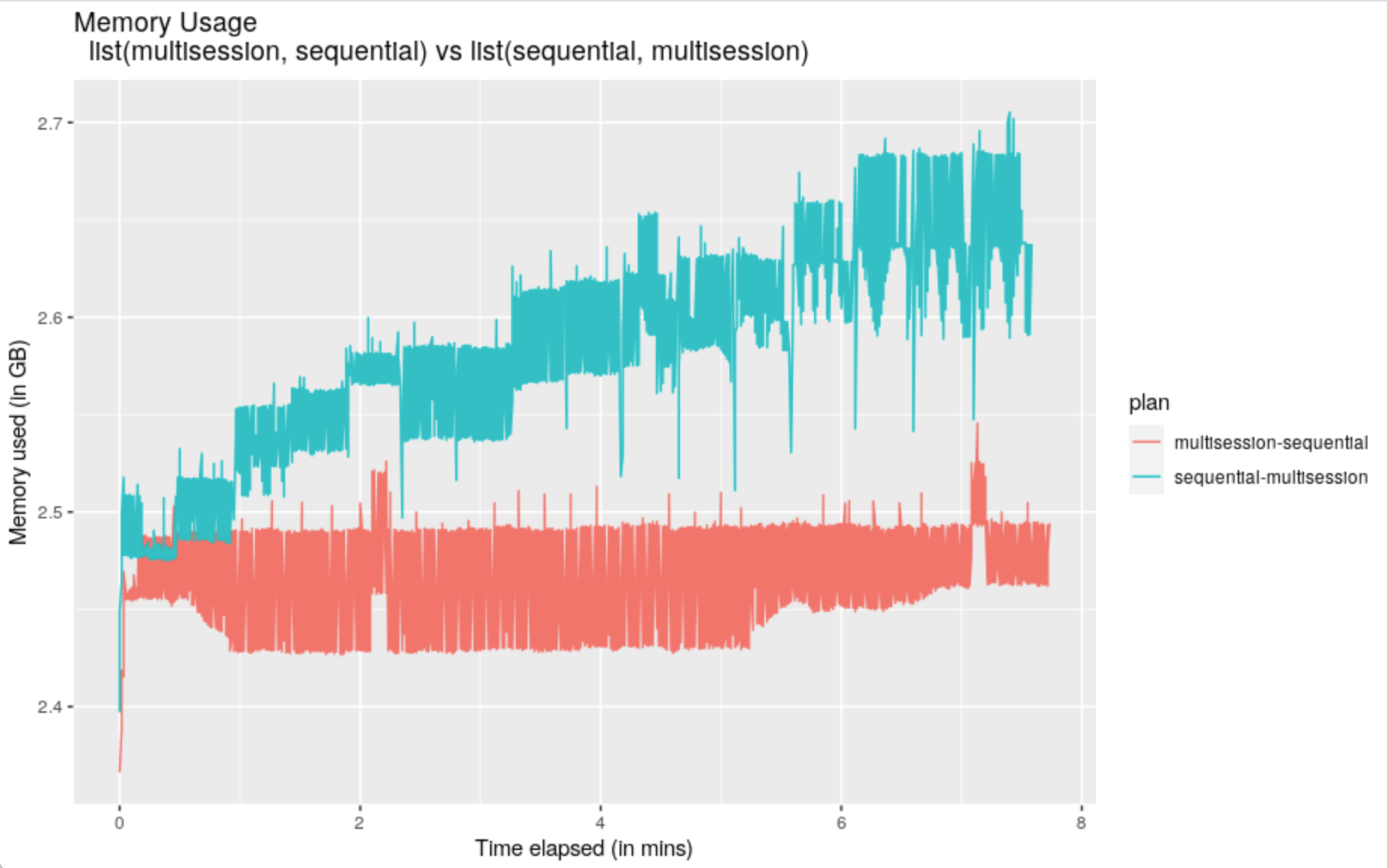
I ran this on an 8-vCPU Linux EC2 (I can give more specs if people need them) and created the following plot from the results (plotting code at the bottom for reproducibility):
First off,
plan(list(multisession, sequential))is faster (as expected, see caveat above), but what I'm confused about is the memory profile. The total system memory usage remains pretty constant forplan(list(multisession, sequential))which I would expect, because I assumed theresobject is overwritten each time through the loop.However, the memory usage for
plan(list(sequential, multisession))steadily grows as the program runs. It appears that each time through the loop theresobject is created and then hangs around in limbo somewhere, taking up memory. In my real example this got large enough that it filled my entire (32GB) system memory and killed the process about halfway through.Plot twist: it only happens when nested
And here's the part that really has me confused! When I changed the outer
future_lapplyto just regularlapplyand setplan(multisession)I don't see it! From my reading of this "Future: Topologies" vignette this should be the same asplan(list(sequential, multisession))but the plot doesn't show the memory growing at all (in fact, it's almost identical toplan(list(multisession, sequential))in the above plot)Note on other options
I actually originally found this with
furrr::future_map_dfr()but to be sure it wasn't a bug infurrr, I tried it withfuture.apply::future_lapply()and got the results shown. I tried to code this up with justfuture::future()and got very different results, but quite possibly because what I coded up wasn't actually equivalent. I don't have much experience with using futures directly without the abstraction layer provided by eitherfurrrorfuture.apply.Again, any insight on this is much appreciated.
Plotting code
Beta Was this translation helpful? Give feedback.
All reactions