 Mind Over Machine

Replies: 1 comment

|
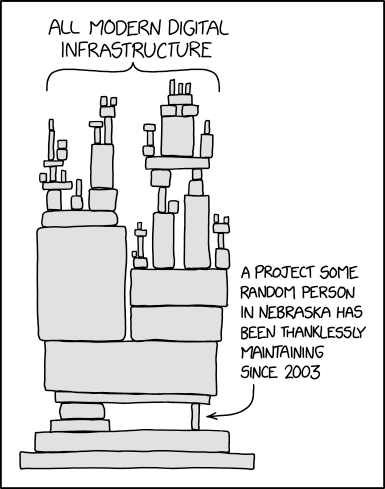
...attributed to @blikest WEB LABAt Mind over Machine, we are all about software that helps us create, because silicon won't "regenerate" itself. If you thought "over Machine" in our name was meant to be a contest, think again: how are we speaking our Mind to you right now? Machines are a mode of expression, just like language, music, dance, sports or architecture, and thus a subject of performance, skill, and expertise. In fact, software is 'literally' a language to instruct computers, in various abstractions of their core mechanism (binary logic, unless you have a quantum or cellular computer, in which case show your time machine!). As the most ubiquitous platform of our time, the language of the Web is of primary concern for us. We use it to deliver static text, images, audio and video, but can we "regenerate" this content, or its infrastructure if needed? The one depicted so by Randall Munrue's "Dependency" meme in 2020, and one of its countless generations recently:
We have concerns. Tim Berners-Lee has concerns. And the European Commission has mandates, effective 9/11 this year. Mind over Machine is opening its WEB LAB to prepare for a more resilient future, exercising our proposed standards of quality, those of the Open Science Framework, the W3C's foundational specifications, and actual implementations of open source web content and infrastructure in a Community of Practice - from servers through client-side applications to browsers. Our inaugural workshop will be about version control: 1. Git Base: As a distributed version control system, Git is our GOAT, but its freedom fuels a variety of hot takes. Merge or rebase? Hooks or aliases? Trunk or GitFlow? SemVer or GitDate? Remotes or Submodules? CODEOWNERS or RESPONSIBILITIES? We will set up bare repositories and push changes to a file documenting our discussions, which can serve as basis for project initiatives. Upcoming workshops: 2. Battle Royale: content management systems, single-page applications or static/dynamic site generation (CMS v. SPA v. SSG/SSR) - what problems do they solve and how? Can we recombine their powers? We will implement minimal reproductions of most celebrated features. Peer support will be encouraged, and available from our experienced members. 3. Interior Design for Nerds: How should we organize our codebase? 4-4-2? Flat folders? We will look at AI-generated codebases, rate their discoverability, and add some files of our own! |


Uh oh!
There was an error while loading. Please reload this page.
Uh oh!
There was an error while loading. Please reload this page.
The web is built on general standards (TCP/IP, HTTP, HTML, CSS, JS) to exchange and represent information,
yet centralized, special abstractions over them have become the norm for social media, web development, and AI,
all making us consumers out of producers through de-skilling and cognitive offloading.
While Digital Commons on the internet (Open Data, Open Source, Moore's law) are running dry,
these "Club Goods" are flooded with traffic, regulation, and fresh water.
Are corporations really making excludable a Good that was Public?
Or are we abandoning responsibility for Goods that are Private?
The "web3.0" has become a slogan to promote more decentralized standards,
like Tim Berners-Lee's SOLID protocol, the Fediverse's ActivityPub, Matrix or Radicle,
but all hinge on individuals actually choosing to host their own content.
Governments are realizing this, but it has been possible since web 1.0, and only became easier.
So how can we make it simple too to create websites independently?
All reactions