Repository navigation
navigator webdriver explained

navigator.webdriver is a real, specified browser property: the WebIDL declares it a
plain boolean, true while under automation control and false otherwise, in
every current build of Chrome, Firefox and Safari. It is the cheapest signal in
any fingerprint, which is why it is the one everybody checks first, and passing
it alone - by hiding, patching, or deleting it - stops a detector on essentially
nothing else it looks at.
If you have ever automated a browser and been shown a different page than a human
gets, the first thing you found was almost certainly navigator.webdriver. It is
the famous one. It is in every tutorial. And patching it, on its own, buys you
close to nothing.
Here is why, and what the property actually tells a detector.
navigator.webdriver is specified. It is not something that slipped out by
accident: the WebDriver spec defines it as a plain
boolean attribute and requires a conforming browser to expose it as true
when the session is under automation control. It exists so that a page can know,
which means a page checking it is using it exactly as intended.
Start from that. You are not defeating a bug. You are contradicting a value the browser is required to publish about itself.
Older advice on this property is now backwards, and it is worth saying why
before explaining what still matters. Before Chrome 89 (2021) and Firefox 75
(2020), the attribute was only exposed when automation was active, so reading it
on a clean session returned undefined. Both engines changed that on purpose,
specifically to agree with each other: Chromium's own "Intent to Ship" for the
change is titled navigator.webdriver === false when automation is not active,
and it says so because Gecko and WebKit already worked that way. Today,
navigator.webdriver is false in a normal session and true under
automation, full stop, in every current build of the three engines. There is no
third value.
That means the naive patch people reach for is no longer wrong about the value:
Object.defineProperty(navigator, 'webdriver', { get: () => false });false is what a clean browser says today, so this line gets the number right.
It still gets caught, for two reasons that have nothing to do with the number.
One. You left fingerprints on the object itself. The property is now an own
property of the navigator instance instead of living on Navigator.prototype
where it belongs. That is one line to check:
Object.getOwnPropertyNames(navigator).includes('webdriver')       // should be false
Object.getOwnPropertyDescriptor(Navigator.prototype, 'webdriver') // should exist
Two. Your getter is a JavaScript function you wrote, and functions carry
their source. Function.prototype.toString
on a native getter returns function get webdriver() { [native code] }. On
yours it returns whatever you typed. Every serious stealth layer patches
toString to hide this, and then the patch to toString is itself detectable,
and so on down. This is the part people underestimate: each layer of the
disguise is a new surface.
A page-level patch only works if it runs before the page's own scripts read
navigator.webdriver - miss that window and the page has already read the
original value, which has nothing to do with what value you set and everything
to do with when your code runs. Automation frameworks expose an "on new document"
or "init script" hook for exactly this, and it is not the same thing as running
code after goto returns.
Two consequences people meet in this order:
It works when you test it by hand and fails in the crawler. By the time you open
a console and check navigator.webdriver, your patch has long since run. The page's
own script ran earlier, read the real value, and may have already sent it.
A page that keeps a reference wins permanently. If the first line of a page's
script does const w = navigator.webdriver or captures the descriptor, your later
redefinition changes nothing for that reference. You cannot un-read a value that was
already read.
This is also why headed and headless runs can differ for the same code: they do not generally change injection order, but they do change timing, and a race you win on a warm local machine you can lose on a loaded CI box.
A value decided inside the engine has no race, because there is no moment before which it was something else.
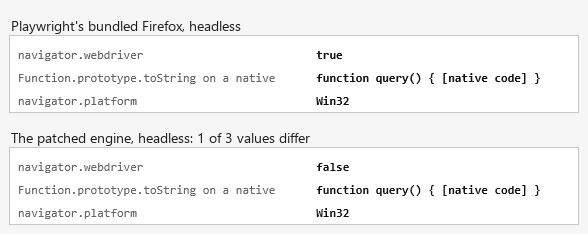
Three values, one page served from 127.0.0.1, two browsers.
Only the first line moves. Function.prototype.toString called on a native function
returns the identical string in both, and navigator.platform is Win32 in both. That
is the whole point of the section above: the flag is the easy half, and the two
browsers are indistinguishable on the check that usually catches a patched getter.
A real audit checks a whole fingerprint, not one boolean: descriptor hygiene,
cross-surface consistency, rendering output, and behaviour. Open any of the public
fingerprinting test suites and look at what they collect -
CreepJS, BotD, sannysoft, fpscanner - and none of them
stop at navigator.webdriver. They build a picture and then check whether the
picture is internally consistent.
A rough map of what that picture contains:
- Descriptor hygiene. Which properties are own vs inherited, whether getters are native, whether anything has been redefined. Cheap to check, expensive to fake completely.
-
Consistency across surfaces. The user agent string says one platform. So do
navigator.platform, the Client Hints, the fonts that are actually installed, the WebGL renderer string, the timezone, the language list, and the way the audio stack rounds floating point. Any one of those can be spoofed. Making all of them agree, on a machine that is not actually that machine, is the real work. - Rendering. Canvas and WebGL output, and whether the reported GPU is a GPU a human would plausibly have. A software rasterizer string is a strong signal that the browser is running on a server with no graphics hardware, and it is a signal no amount of property patching hides.
- Behaviour. Whether the pointer travels or teleports, whether keystrokes have human interval distributions, whether the page was scrolled at all.
Notice that navigator.webdriver is one item in the first bucket. It is the
cheapest check a detector can run, which is why it is the one everybody knows, and
also why passing it proves nothing.
There are exactly three levels at which a stealth tool can operate, and they have different failure modes.
In the page, with JavaScript. Inject a script before the page's own code and redefine things. This is what the classic stealth plugins do. It is easy to adopt and it works against naive checks. Its ceiling is the one described above: every override is an object that can be inspected, and you are in a patching race against the detector inside the same runtime you are trying to lie to.
In the automation driver. Patch the driver so that it stops announcing itself:
remove the flags that set webdriver in the first place, stop injecting the
bindings that automation frameworks leave in the page's global object. Patchright
is the well-known example on the Chromium side. This removes a whole class of
tells at the source rather than papering over them: the automation flag never
gets set, so the property reads false from the engine's own default, on
Navigator.prototype, through the real native getter, with nothing to inspect
because nothing was patched. What it does not change is anything about the
machine underneath.
In the browser engine, before it ships. Change the values in the C++ source
and rebuild. Camoufox does this for Firefox, and so does the project I maintain,
invisible_playwright. At this level there is no override to detect, because
there is no override: the engine simply reports the value you compiled in, through
the same native code path a normal build uses. Function.prototype.toString says
[native code] because it is native code.
The tradeoff is honest and worth stating: you now have a browser build to maintain against upstream, the binary is large, and you are locked to whichever engine you patched. That is a real cost and anyone telling you otherwise is selling something.
Whichever level you pick, the thing that gets you caught is rarely a single property. It is disagreement.
A user agent claiming Windows, on a machine whose fonts are the Linux default set. A timezone from one continent and an IP from another. A GPU string from a laptop and a screen resolution that no laptop ships with. A canvas that renders identically to ten thousand other sessions because everybody is using the same spoofing library with the same default seed.
This is why the useful mental model is not "hide the bot flags" but "be a specific machine, consistently, for the whole session". In practice that means the fingerprint should be generated once from a seed and then every surface should derive from that same seed, so the parts cannot contradict each other. It also means a re-run with the same seed gives you the same machine, which is the only way to A/B test anything in this space without the noise swamping the signal.
navigator.webdriver is a smoke alarm, not the fire. If your automation is being
detected and you have already patched it, the answer is almost never a better
patch for that property. It is somewhere in the consistency of everything else,
and the fastest way to find it is to run one of the open test suites against your
setup and read the whole report rather than the headline verdict.
How do I remove navigator.webdriver? You cannot remove it from the page as a
script. A page-level delete navigator.webdriver or a redefined getter still leaves an
own property where a real browser has none, and a real browser's answer today is
false, not absent. The fix that actually removes the tell has to happen where the
browser decides the value, not in a script the page can read.
Does Object.defineProperty(navigator, 'webdriver', {get: () => false}) work? The
value is right - false is what a real, unautomated browser reports today - but the
mechanism still gives you away: the property moves from Navigator.prototype to an own
property on the instance, and the getter is a JavaScript function whose toString does
not say [native code].
What should navigator.webdriver be? false in a normal, current browser. true
under automation. undefined was the answer before Chrome 89 and Firefox 75; every
current build of the three engines returns a plain boolean now, never a third value.
Is --disable-blink-features=AutomationControlled enough? It hides this one flag
in Chromium. It says nothing about the twenty other things a detector reads, and it is
itself a recognisable launch configuration.
Why do I get detected even with navigator.webdriver reading false? Because it is
the cheapest check, not the important one. Everything else on your machine is still
answering honestly.
-
MDN,
Navigator.webdriver, retrieved 2026-08-30, documenting the value as a plain Boolean with no mention of an undefined state. - The WebDriver specification, retrieved
2026-08-30, whose interface section declares
readonly attribute boolean webdriver, a plain boolean that WebIDL does not permit to be undefined, and requires a conforming user agent to expose it astrueunder automation control. - Chromium's own "Intent to Ship:
navigator.webdriver === falsewhen automation is not active", retrieved 2026-08-30, and the matching Chrome Platform Status entry, for Chrome 89 (2021) changing from exposing the property only under automation to always exposing it,falseby default, specifically to match Gecko and WebKit. -
MDN,
Function.prototype.toString(), retrieved 2026-08-28, for the native-code string a builtin getter returns. - CreepJS, retrieved 2026-08-28, one of the public fingerprinting suites named on this page.
- BotD, retrieved 2026-08-28, another of the named public suites.
- bot.sannysoft.com, retrieved 2026-08-28, the older test page named alongside the others.
- fpscanner, retrieved 2026-08-28, the fourth suite named on this page.
- Patchright, retrieved 2026-08-28, the named example of a driver-level fix on the Chromium side.
-
Camoufox, retrieved 2026-08-28, the named example
of an engine-level Firefox patch this page contrasts with
invisible_playwright.
See also: the three levels a stealth tool can work at, what CreepJS does to catch an override, the ChromeDriver cdc_ variable for the same problem in a different place, and whether stock Playwright sets navigator.webdriver to true.
I maintain invisible_playwright, an MIT-licensed Firefox patched at the C++
level and driven by stock Playwright. It is on PyPI. I am not neutral about the
third approach, and the tradeoffs above are the ones I actually live with.