Repository navigation
sannysoft explained
bot.sannysoft.com runs three groups of checks: a legacy pass/fail table of automation
flags, an unscored dump of navigator and screen properties, and a set of canvas
tests that quietly run twice, once in the page and once inside an iframe, then compare
the results. Passing the table proves only that you are not an unmodified headless
browser from around 2018; the canvas consistency check and the property dump are the
parts that still decide anything in 2026.
Everyone in browser automation ends up on this page, and most people read the colour of the rows instead of what they mean. Here is what each group tests, which ones are still meaningful in 2026, and the one nobody looks at that is the most interesting.
Read from the live page on 2026-07-27, by its element ids, not from memory.
Eleven rows, the oldest and best-known set. In page order:
| Row | What it reads |
|---|---|
| User Agent | whether the string contains HeadlessChrome
|
| WebDriver | navigator.webdriver |
| WebDriver Advanced | the same value read through a less obvious path, to catch a shallow override |
| Chrome | whether window.chrome exists and looks whole, on a Chromium build |
| Permissions | whether the Notifications permission state and Notification.permission agree |
| Plugins Length |
navigator.plugins.length being zero, which old headless builds reported |
| Plugins is of type PluginArray | the prototype of navigator.plugins, catching an array pretending to be one |
| Languages |
navigator.languages being empty |
| WebGL Vendor and WebGL Renderer | the unmasked strings |
| Broken Image Dimensions | the natural size of an image that failed to load |
Almost all of these are historical. They describe headless Chrome as it behaved around 2018, and every tool in this space fixes them on day one. Passing them is table stakes: it proves you are not using an unmodified headless browser, and nothing else.
Two of the eleven still carry weight, and they are the ones that are not about automation at all:
WebGL Vendor and Renderer name your graphics hardware. A software rasterizer here is a server tell that no amount of automation-flag fixing hides. There is a longer page on that.
Permissions is the interesting shape: it does not ask a single question, it asks two and compares the answers. That pattern, cross-checking two sources that must agree, is what everything modern is built on.
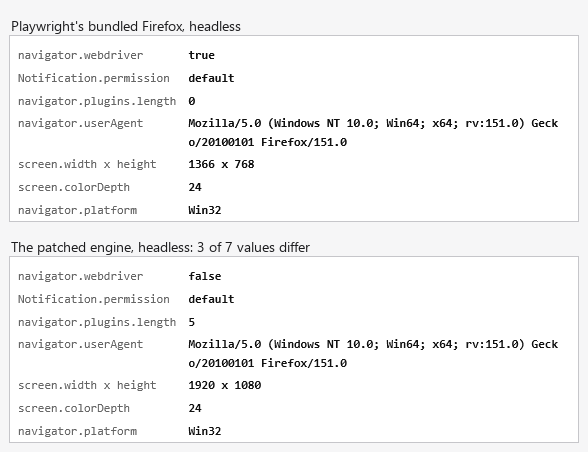
Seven of the values this page describes, read from one page served from 127.0.0.1,
first by Playwright's bundled Firefox and then by a patched engine. Three of the seven
differ.
The three that move are the three the table is really testing: navigator.webdriver
goes from true to false, the plugin count from 0 to 5, and the screen from
1366x768 to 1920x1080. The four that do not move matter as much, because they show
what this page is arguing: Notification.permission, the user agent, the colour depth
and navigator.platform are already the same in both, so a row that agrees is not
evidence of anything either way.
The long list below the table is not pass/fail. It prints values:
navigator.userAgent, appName, vendor, appCodeName, platform, language,
plugins, cookieEnabled, doNotTrack, sendBeacon, javaEnabled,
getUserMedia, mediaDevices, screen.width, screen.height, screen.colorDepth,
battery details, and more.
Nothing here is scored, which is why people scroll past it. It is also where the real information is, because these values have to agree with each other and with the platform you claim:
-
navigator.platformsaysWin32, and the font set is the Linux default. -
screen.widthandheightare a resolution no display ships in. -
colorDepthis 24 while the claimed GPU implies something else. -
vendoris empty on a build whose user agent says Chrome.
A detector does not need a red row to draw a conclusion from that list. It needs two values that cannot both be true.
The canvas section is the most revealing test on the page, and it is not a
fingerprint test at all: it checks whether your canvas gives the same answer in two
different execution contexts. The element ids give this away: canvas1, canvas2,
canvas3, canvas4, canvas5, and canvas3-iframe, canvas4-iframe,
canvas5-iframe.
Three of the canvas tests are run twice: once in the page, once inside an iframe, and the results compared.
That is not a fingerprint test. It is a consistency test, and it is aimed squarely at the way most anti-fingerprinting works. If your canvas protection is a script injected into the top-level document, the iframe gets a different execution context, and either the patch is not there or the noise it adds is seeded differently. Either way the two readings disagree, and a real browser's readings never do.
The same idea appears in media1 versus media, and in the battery rows: ask the
same question from two places and see whether the answers match.
This is why "does it pass sannysoft" is a weaker question than it looks. The table rows can all be green while the iframe comparison quietly shows that something is rewriting values in one context and not another.
Opened directly against a live Playwright-driven Chromium session, all eleven
rows in group one came back green - WebDriver and WebDriver Advanced both
read "passed," and navigator.webdriver resolved through a genuinely native,
unmodified getter (function get webdriver() { [native code] }), not a patched
one. Nothing in that specific session had touched the property; it simply
reported false on its own.
Worth being precise about what that does and does not establish. It confirms the point this page keeps making rather than undermining it: clearing group one is the easy part, achievable without any stealth layer doing anything at all in this case. It says nothing about which exact configuration produced that result, and a different launch configuration on the same underlying browser could read differently - the honest scope of this observation is "this is what one real, directly-checked session showed," not "this is guaranteed behaviour for every Playwright session everywhere." Test your own setup directly rather than trusting either this page's description or a general claim about what Playwright does by default.
That you are not running an unmodified headless browser from several years ago.
It does not prove your fingerprint is coherent, that your GPU string is plausible, that your font set matches your claimed platform, that your timezone agrees with your IP, or that your canvas gives the same answer everywhere it is asked. Those are the things that decide modern outcomes, and only the last one is on this page at all.
Use it as a smoke test. If a row is red, you have a real problem and should fix it. If every row is green, you have learned that you cleared the 2018 bar, which is worth exactly what it sounds like.
Open the page, then read the canvas section instead of the table. If the in-page and in-iframe hashes differ, whatever is protecting your canvas is doing it in one context only, and that inconsistency is more detectable than the original value would have been.
An engine that computes the value below the JavaScript layer does not have this problem, because there is no per-context patch to be missing: every context asks the same code and gets the same answer. The case for doing it at that layer is exactly this, and it is the same case as the three levels page, seen from the detector's side.
Is passing bot.sannysoft.com enough? No. It is a useful smoke test that catches obvious mistakes. Serious detection reads far more than these rows.
What is the canvas-in-iframe row for? It runs the same canvas test in the page and in an iframe and compares them. A patch applied to one context and not the other shows up here, and most people never look at it.
Why are some rows green on a real browser and red on mine? Because the page reads values a real browser answers plainly, and a spoofed one sometimes answers strangely. Compare against a stock browser before assuming a red row is a bug.
Should I aim for all green? Aim for the same colours a stock browser produces. All green is not the target; matching is.
What does it not check? Behaviour, the network layer, the TLS handshake, and whether your hardware is plausible. All of those decide more than this table does.
- This project's own run against the live page, described above under "What a real run against this page actually shows," checked directly rather than assumed.
- bot.sannysoft.com itself, the live test page, read 2026-07-27, for the element ids, the group structure, and the canvas-iframe comparison described throughout this page.
See also: how detectors decide you are a bot, what the WebGL vendor and renderer strings give away, why identical WebGL parameters are their own tell, and how to test your own setup against bot detection.
From the notes of invisible_playwright. sannysoft is a release gate here. The element ids above were read off the page, not remembered.
Documentation
- Installation
- Quickstart
- Configuration
- Pinning fingerprint fields
- CLI reference
- Differences from Playwright
Guides
-
Browser Identity
- navigator.webdriver is not the tell you think it is
- hardwareConcurrency, deviceMemory and storage quota
- Screen size and viewport tells in headless browsers
- Playwright headless vs headed: what detectors see
- Playwright User Agent: Why You Should Not Set It
- Client Hints and Sec-Fetch: headers that must agree
- Codec fingerprinting: canPlayType and MediaCapabilities
- Permissions API: the two answers that must agree
- CSS fingerprinting: what media queries reveal
- What privacy.resistFingerprinting actually does
- speechSynthesis.getVoices() returns an empty array
- Browser extensions are a fingerprint surface
- BFCache and pageshow.persisted under browser automation
- Service workers, storage partitioning and automation
- Web Workers: where page-level fingerprint patches fail
- fake-useragent is archived: what changes and what doesn't
- navigator.buildID and the stale build date tell
- navigator.maxTouchPoints and pointer consistency
- navigator.platform and oscpu on a spoofed OS
- navigator.vendor and productSub: the Firefox tells
- Accept-Language header vs navigator.languages
- window.devicePixelRatio: the pref that spoofs it
- Can you be fingerprinted in incognito mode?
- Is changing the user agent enough to avoid detection?
- Can a website tell you are running on a server?
- Can two devices share a browser fingerprint?
- Does clearing cookies stop fingerprint tracking?
- Color-gamut and HDR media queries as a fingerprint
- Battery API fingerprint: does Firefox expose it?
- Is navigator.connection a fingerprint in Firefox?
- Can the Gamepad API fingerprint or detect a bot?
- Do accelerometer and gyroscope APIs leak on desktop?
- prefers-reduced-motion and other OS-setting tells
- Does storage quota estimate reveal disk size?
- Can scrollbar width reveal my operating system?
-
Canvas, WebGL, Fonts and Audio
- Canvas fingerprint noise: why per-call randomising fails
- Firefox WebGL renderer strings: what ANGLE reports
- WebGL parameters: the numbers are the same on every GPU
- Your renderer string says NVIDIA. Your pixels say software.
- Why headless browsers render different fonts
- How to make Linux and macOS report real Windows fonts
- measureText and TextMetrics as a fingerprinting surface
- AudioContext fingerprinting, and why adding noise backfired
- Canvas and WebGL fingerprints, identical across OSes
- Emoji fingerprinting: why emoji look the same on any OS
- Detecting installed fonts in JavaScript by width
- WebGL shader precision as a fingerprint surface
- AudioContext sampleRate and latency as a fingerprint
- Is WebGPU a browser fingerprint?
- Why the same canvas draws differently on Windows and Linux
-
Network, Proxy and WebRTC
- WebRTC leak with a proxy in Playwright and Selenium
- WebRTC ICE candidate spoofing: the fields that give it away
- Playwright proxy in Python: per-context, and what leaks
- Playwright proxy not working? SOCKS5 auth in Python
- Playwright timezone does not match the proxy IP
- JA3 and JA4: why a TLS fingerprint cannot be patched
- Playwright in Docker: it runs, and still gets blocked
- Web scraping keeps getting blocked with good proxies
- Python web scraping blocked? The TLS fingerprint reason
- SOCKS5 vs HTTP proxy: what each does in the browser
- WebRTC IPv6 leak: why a proxy does not stop it
- HTTP/2 fingerprint: the layer above the TLS handshake
- TLS fingerprint vs User-Agent: the contradiction
- WebRTC has no ICE candidates behind a proxy
- WebRTC IP that matches the proxy exit, by design
- How to check if a proxy leaks your real IP
- about:webrtc: read your real ICE candidates
- Offline timezone resolution from a proxy exit IP
- Residential vs datacenter vs mobile proxies explained
- Sticky vs rotating proxy sessions: which to use
- Does a proxy leak DNS? DoH and DNS leaks explained
- HTTP/3 and QUIC fingerprint: what a site sees
- What is ASN and IP reputation in bot detection?
- What does a mobile carrier IP look like to a site?
- IPv6 vs IPv4: which does your proxy expose?
- Geolocation API vs IP location: keep them consistent
- Does chaining two proxies help avoid detection?
- ERR_HTTP2_PROTOCOL_ERROR in Playwright: causes and how to diagnose it
- ERR_TUNNEL_CONNECTION_FAILED in Playwright: what it means and how to fix it
- ERR_SOCKS_CONNECTION_FAILED in Playwright: what it means and how to fix it
- net::ERR_CONNECTION_RESET in Playwright
- net::ERR_PROXY_CONNECTION_FAILED in Playwright
- net::ERR_ABORTED in Playwright
- net::ERR_NAME_NOT_RESOLVED in Playwright
- net::ERR_CERT_AUTHORITY_INVALID in Playwright
- net::ERR_EMPTY_RESPONSE in Playwright
- net::ERR_CONNECTION_REFUSED in Playwright
- net::ERR_INVALID_AUTH_CREDENTIALS in Playwright
- JA4H: The HTTP-Header-Order Fingerprint, Explained
- How to check a proxy's status before you rely on it
-
The Automation Layer
- Function.prototype.toString and the [native code] check
- The ChromeDriver
cdc_variable, and why renaming it fails - Why an attached debugger makes automation detectable
- Execution context was destroyed, and when it means detection
- Human-like mouse movement: Bezier curves are the easy part
- Why a Playwright upgrade broke 97 of 133 tests overnight
- Playwright persistent profile: what it fixes and breaks
- Why humanized mouse movement can fail on hover()
- Why content_frame() returns None for a cross-origin iframe
- Orphaned Firefox processes on Windows: the killed-runner leak
- Firefox launches but Playwright can't drive it: packaging gap
- Why automating login is riskier than reusing a session
- Playwright new_page vs new_context: the viewport tell
- Playwright dialog and popup handling without a tell
- Playwright download files with Firefox and the tell
- Playwright connect_over_cdp does not work with Firefox
- Playwright mobile emulation on Firefox and isMobile
- Playwright isTrusted: are automated clicks real?
- Playwright set_input_files uploads and the tell
- Can websites detect Playwright? What is actually visible
- Does Playwright Set navigator.webdriver to True?
- Does Playwright Leave Traces a Website Can See?
- Does Playwright Change My Browser Fingerprint?
- Can I Use My Real Browser Profile With Playwright?
- Does Playwright Support Firefox Stealth?
- Is Playwright Firefox Harder to Detect Than Chromium?
- Does Playwright Get Detected on the First Request?
- Why Playwright's bundled Firefox is easy to detect
- ghost-cursor human mouse paths with Playwright
- Stock Playwright, patched Firefox: how they connect
- Intercept and mock network requests with page.route
- Record and replay HTTP traffic with HAR in Playwright
- Record a Playwright trace to debug a failed scrape
- Record a video of a Playwright browser session
- Save and reuse login with storage_state in Playwright
- Read and set cookies in a Playwright context
- Set geolocation and permissions per Playwright context
- Handle HTTP basic auth in Playwright (http_credentials)
- Isolate identities with a browser context per session
- Drag and drop elements in Playwright with drag_to
- When to use an HTTP client vs a real browser
- Migrating from requests + BeautifulSoup to a browser
- Playwright 1.61's WebAuthn Virtual Authenticator
- Playwright 1.62: Headless No Longer Shares the OS Clipboard
- Closed shadow roots: what Playwright cannot see
- Running Playwright Firefox on ARM64 Linux
- What is headless browser automation, and what differs
- Python browser automation without Selenium: the options
- Is Python good for automation? Yes, and here is why
-
AI Agents and Frameworks
- AI browser agents and stealth: what fits and what does not
- browser-use gets detected: what you can and cannot change
- crawl4ai stealth mode and custom browser engines
- Give a LangChain agent an invisible_playwright browser
- Feed invisible_playwright pages into a RAG index
- Computer-use agents and browser fingerprint detection
- Give an MCP browser server a stealth Firefox engine
- Give each AI agent a reproducible browser identity
- Run parallel browser agents with distinct fingerprints
- Why AI browser agents have their own timing signal
- Running an AI browser agent headless on a server
- Give a browser agent a persistent logged-in session
- smolagents: hand the agent an invisible_playwright tool
- Stagehand and stealth: why a Firefox engine won't drop in
- DOM-reading vs screenshot agents: which stealth helps
- Back a computer-use agent with a real browser engine
- AI agent retry loops trip rate limits, not fingerprints
- Playwright 1.62 Ships MCP In the Box
-
Detectors, Explained
- What bot.sannysoft.com actually checks, row by row
- How CreepJS decides you are lying
- What BotD actually detects, and what it does not
- Why a FingerprintJS visitor ID changes
- reCAPTCHA v3 score: why a fresh browser scores badly
- BrowserLeaks canvas and WebGL hash, explained
- What BrowserLeaks actually tests, surface by surface
- Browser trust scores explained: what the number means
- How do websites detect bots?
- What is a browser fingerprint?
- What data does a website collect about your browser?
- Does a VPN stop browser fingerprinting?
- Do websites know you are using a script?
- How accurate is browser fingerprinting?
- Can a website detect a virtual machine?
- Can websites detect a datacenter or proxy IP?
- getClientRects fingerprinting: subpixel geometry as ID
- Notification.permission as a bot-detection signal
- speechSynthesis voices as a cross-platform fingerprint
- Can a website detect typing by keystroke timing?
- Can a website detect Clipboard API access?
- What are mouse-dynamics behavioural biometrics?
- How Cloudflare Turnstile actually works
- How DataDome's bot detection actually works
- How Kasada's bot detection actually works
- PerimeterX (now HUMAN Bot Defender): what the sensor actually checks
- How Akamai Bot Manager actually works
- Imperva (Incapsula), Explained
- F5 Distributed Cloud Bot Defense (Shape), Explained
- Fastly Bot Management, Explained
- reCAPTCHA Enterprise vs reCAPTCHA v3
- Arkose Labs (FunCaptcha), Explained
- AWS WAF Bot Control, Explained
- Anubis: The Proof-of-Work Firewall, Explained
- Cloudflare's AI Labyrinth, Explained
- Beyond robots.txt: How Sites Actually Block AI Crawlers Now
- Vercel Bot Protection (BotID), Explained
- GeeTest v4 (Slide/Click Captcha), Explained
- Honeypot Fields and Hidden Links: How Sites Trap Scrapers
- Private Access Tokens (Privacy Pass), Explained
- hCaptcha, Explained
- hCaptcha Enterprise vs Standard
- Cloudflare Bot Management, Explained
- Queue-it virtual waiting rooms, explained for automation
-
Testing and Troubleshooting
- How to test bot detection without a false pass
- Playwright detected as a bot: the checklist to fix it
- Firefox preferences that silently do nothing
- Slow browser launch: a per-request timeout is not a budget
- Playwright screenshot returns noise: readback fix
- Canvas fingerprint changes every run: use a seed
- Playwright TargetClosedError: the causes and the fixes
- Why am I blocked with a clean fingerprint?
- Why Does My Playwright Script Get Blocked?
- Is Playwright headless detectable? What sites check
- Can You Run Playwright Without Being Detected?
- Why Playwright Works Locally but Fails in the Cloud
- Does Playwright Trigger reCAPTCHA More Often?
- net::ERR_SSL_PROTOCOL_ERROR in Playwright
- net::ERR_CONNECTION_TIMED_OUT in Playwright
- net::ERR_NETWORK_CHANGED in Playwright
- TimeoutError: Timeout 30000ms Exceeded
- 'Playwright "Frame Was Detached" Error'
- Playwright "Protocol Error (Page.navigate)"
- Playwright Strict Mode Violation: Resolved to N Elements
- Playwright "Element Is Not Attached to the DOM"
- Playwright "Subtree Intercepts Pointer Events"
- Content-Security-Policy Blocks Playwright's Injected Scripts
- Playwright "Executable Doesn't Exist" After Install
- 'Playwright "Page Crashed" Error'
- Does Playwright Trigger hCaptcha More Often?
- Keep Playwright Firefox memory flat on long runs
- Playwright Firefox: SEC_ERROR_UNKNOWN_ISSUER
- Playwright ERR_BLOCKED_BY_CLIENT via page.route
- Missing fonts in Docker break Playwright screenshots
- First Firefox launch fails on Windows, then works
- Selenium detected by Cloudflare: the defaults that fail
- Playwright blocked by CORS policy: not bot detection
-
Scraping with Playwright
- How to scrape without getting blocked
- How to scrape a site that blocks headless browsers
- How to scrape infinite scroll pages with Playwright
- How to rotate proxies when scraping with Playwright
- How to scrape data behind a login with Playwright
- How to run Playwright in Docker without getting detected
- How to use invisible_playwright in Docker
- Playwright bot detection: how to avoid it in Python
- How to scrape paginated pages with Playwright
- How to download files with Playwright
- How to upload files with Playwright, and verify it landed
- How to handle cookie consent banners in Playwright
- How to handle popups and modals in Playwright
- How to take full-page screenshots with Playwright
- How to generate a PDF with Playwright and Firefox
- How to wait for content to load in Playwright
- How to retry failed requests when scraping Playwright
- How to scrape pages in parallel with Playwright
- How to rate limit your own Playwright scraper
- How to scrape HTML tables with Playwright
- How to scrape iframe content with Playwright
- How to scrape shadow DOM content with Playwright
- How to capture XHR and API responses in Playwright
- How to scrape geotargeted content with Playwright
- How to scrape real estate listings with Playwright
- How to scrape job postings with Playwright
- How to scrape e-commerce product pages with Playwright
- How to track product prices with Playwright
- How to scrape hotel room prices with Playwright
- How to scrape flight prices with Playwright
- How to scrape classifieds listings with Playwright
- How to scrape vacation rental listings with Playwright
- How to scrape car listings with Playwright
- How to scrape apartment rentals with Playwright
- How to track product stock and restocks with Playwright
- How to scrape location-based store prices with Playwright
- How to scrape flexible-date fare calendars with Playwright
- How to scrape product reviews with Playwright
- How to scrape star ratings with Playwright
- How to scrape news article text with Playwright
- How to scrape business directory listings with Playwright
- How to scrape event and ticket listings with Playwright
- How to scrape restaurant menu data with Playwright
- How to scrape stock and financial data with Playwright
- How to scrape social media profiles with Playwright
- How to scrape forum and community threads with Playwright
- How to scrape image galleries with Playwright
- How to scrape video listings and metadata with Playwright
- Scrape local business results from a map with Playwright
- How to scrape sports stats and box scores with Playwright
- How to scrape cryptocurrency prices with Playwright
- How to scrape deals and coupon codes with Playwright
- How to scrape to CSV with Playwright
- How to scrape to JSON Lines with Playwright
- How to scrape into a SQLite database with Playwright
- How to export scraped data to Excel with Playwright
- How to extract JSON-LD structured data with Playwright
- How to extract Open Graph and meta tags with Playwright
- How to extract links and build a crawl frontier in Playwright
- How to scrape RSS and Atom feeds with Playwright
- How to download images in bulk with Playwright
- How to extract clean article text with Playwright
- How to scrape a sitemap.xml with Playwright
- How to scrape into a pandas DataFrame with Playwright
- How to clean scraped prices and dates with Playwright
- Scrape search results by driving a form in Playwright
- Scrape a map-based search with Playwright
- Scrape autocomplete and typeahead inputs with Playwright
- Scrape date-picker calendars with Playwright
- Crawl list pages to detail pages with Playwright
- Scrape lazy-loaded images with Playwright
- Extract data from canvas charts with Playwright
- Scrape a multi-step wizard flow with Playwright
- How to resume an interrupted scrape with Playwright
- Incremental scraping: only new items since last run
- Handle 403 and 429 backoff mid-scrape in Playwright
- Scrape load-more button pages with Playwright
- Scrape nested pagination with Playwright
- Scrape an SPA that changes URL via history API
- Use BeautifulSoup with invisible_playwright
- Run stealth Playwright tests with pytest fixtures
- Run invisible_playwright concurrently with asyncio
- Run invisible_playwright in GitHub Actions CI
- Can you run invisible_playwright serverless?
- Run invisible_playwright in Celery task workers
- Schedule invisible_playwright scrapes with cron
- Run invisible_playwright headful on a server with Xvfb
- Use invisible_playwright in an Airflow DAG
- Combine invisible_playwright with httpx for speed
- Wrap invisible_playwright in a FastAPI service
- Run invisible_playwright in a Jupyter notebook
- Block images to speed up scraping (and when not to)
- Wait for a specific API response in Playwright
- How to scrape course catalogs with Playwright
- How to scrape store locator pages with Playwright
- How to scrape stock levels with Playwright
- How to scrape accordion and tab content with Playwright
- How to scrape size charts with Playwright
- How to scrape delivery slots with Playwright
- How to scrape appointment availability with Playwright
- How to scrape auction listings with Playwright
- How to scrape public transport timetables with Playwright
- How to scrape GraphQL endpoints with Playwright
- How to scrape virtual scrolling tables with Playwright
- How to scrape shipping rates with Playwright
- How to scrape cursor-based pagination with Playwright
- How to scrape multi-select facet filters with Playwright
- How to scrape currency exchange rates with Playwright
- How to scrape WebSocket streams with Playwright
- How to scrape book metadata with Playwright
- How to scrape professional directories with Playwright
- How to scrape range slider filters with Playwright
- How to scrape currency and locale switchers with Playwright
- How to scrape software changelogs and release notes with Playwright
- How to scrape breadcrumb hierarchies with Playwright
- How to scrape microdata and RDFa markup with Playwright
- How to scrape server-sent events with Playwright
- How to scrape open data portals with Playwright
- How to scrape infinite carousels with Playwright
- How to scrape printer-friendly pages with Playwright
- How to handle A/B test variants when scraping with Playwright
- How to scrape recipe data with Playwright
- How to scrape vehicle recall notices with Playwright
- How to scrape public tender notices with Playwright
- How to scrape nutrition labels with Playwright
- How to scrape podcast episode listings with Playwright
- How to scrape weather station data with Playwright
- How to scrape newsletter archives with Playwright
- How to scrape wine and spirits catalogs with Playwright
- How to scrape insurance quotes with Playwright
- How to scrape fitness class schedules with Playwright
- How to scrape flight seat maps with Playwright
- How to scrape concert and tour dates with Playwright
- How to scrape museum and gallery exhibition dates with Playwright
- How to scrape warranty terms with Playwright
- How to scrape sortable data tables with Playwright
- How to scrape salary and pay scale data with Playwright
- How to scrape live sports scores with Playwright
- How to scrape video game prices with Playwright
- How to scrape domain WHOIS records with Playwright
- How to scrape podcast transcripts with Playwright
- How to scrape patent listings with Playwright
- How to scrape clinical trial listings with Playwright
- How to Handle a PDF That Opens in a New Tab with Playwright
- Does Playwright Support Firefox Extensions?
- Automating an Email OTP / Verification-Link Login with Playwright
- Automating TOTP-Based 2FA Login with Playwright
- How to Scrape a Sandboxed Iframe with Playwright
- Select from dropdowns with Playwright, native and custom
- Download and read PDFs linked from a page with Playwright
- How to scrape parking rates with Playwright
- How to scrape EV charging availability with Playwright
- How to scrape fuel prices with Playwright
- How to scrape ferry schedules with Playwright
- How to scrape library catalog availability with Playwright
- How to scrape package tracking status with Playwright
- How to scrape flight status boards with Playwright
- How to scrape snow reports with Playwright
- How to scrape pet adoption listings with Playwright
- How to scrape construction permit records with Playwright
- How to scrape court docket listings with Playwright
- How to scrape scholarship listings with Playwright
- How to scrape conference agendas with Playwright
- How to scrape package download statistics with Playwright
- How to scrape bank interest rates with Playwright
- How to scrape energy tariff comparisons with Playwright
- How to scrape school term calendars with Playwright
- How to scrape spare part compatibility with Playwright
- How to scrape numbers rendered as images with Playwright
- How to scrape CSS pseudo-element content with Playwright
- Puppeteer scraping examples, and what a real defense does
Comparisons
- Playwright stealth in Python: three levels that work
- Firefox or Chromium for anti-detect automation
- Chromium is not Chrome, and detectors know the difference
- Playwright stealth vs Camoufox: two patched Firefoxes
- Playwright stealth vs Patchright: driver vs engine
- Playwright stealth vs undetected-chromedriver and nodriver
- playwright-stealth vs a patched engine: page vs browser
- puppeteer-extra-plugin-stealth: unmaintained since 2023
- selenium-stealth hasn't been updated since November 2020
- pyppeteer's own maintainer says to switch to Playwright
- invisible_playwright vs rebrowser-patches: the same CDP fix
- invisible_playwright vs fingerprint-suite: injection vs engine
- invisible_playwright vs playwright-with-fingerprints
- invisible_playwright vs Scrapling
- invisible_playwright vs Ulixee Hero
- invisible_playwright vs SeleniumBase UC Mode
- Splash is unmaintained, and it was never a real browser
- invisible_playwright vs DrissionPage
- WebDriver BiDi vs CDP: does the new protocol hide you
- invisible_playwright vs hrequests
- zendriver vs invisible_playwright: Chrome CDP vs Firefox
- botasaurus vs invisible_playwright: framework vs library
- curl_cffi vs invisible_playwright: TLS client vs browser
- pydoll vs invisible_playwright: CDP without a driver
- selenium-driverless vs invisible_playwright stealth
- puppeteer-real-browser vs invisible_playwright
- Migrating from Selenium to Playwright for stealth
- Migrating from Puppeteer to Playwright for stealth
- undetected-chromedriver vs a patched Firefox browser
- scrapy-playwright vs a patched Firefox for stealth
- playwright-extra stealth plugins vs a patched browser
- tls-client vs a real browser: when TLS is enough
- Anti-detect browser or Playwright stealth: which you need
- undetected-playwright vs a patched Firefox binary
- How to Read a Stealth-Browser Benchmark Without Being Misled
- Web Scraping Proxy Costs: Build vs. Buy Your Stealth Stack
- Why Playwright Locators Never Throw StaleElementReferenceException
- invisible_playwright vs browser-use: different jobs
- Selenium vs Playwright: the differences that matter
- Alternative Chromium browsers for automation: what differs
- Browser automation testing tools: where each one fits
Integrations
- Using invisible_playwright with CodeceptJS
- Using invisible_playwright with Crawlee for Python
- Using invisible_playwright with Crawlee for JavaScript
- Using invisible_playwright with scrapy-playwright
- Using invisible_playwright with Robot Framework Browser
- Cypress, WebdriverIO, TestCafe and Nightwatch integration
- Using invisible_playwright with Microsoft's Playwright MCP
- Using the engine from Go, Java, C#, Ruby and Rust
docs/ source folder