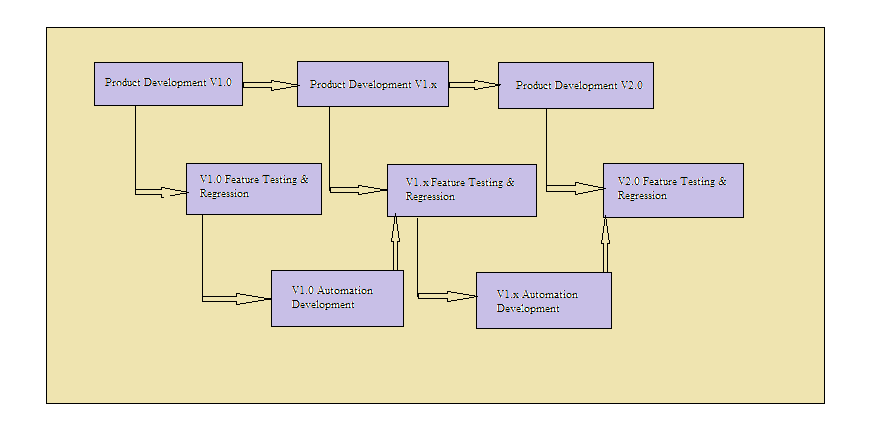
Automation Development Life Cycle (ADLC)
The Automation Development life cycle involves in parallel with the software development life cycle.
Defining an architecture for ADLC is very important as it is going to support the development efforts longer term. In today's world, testing teams seem to be gaining in the ability to define proper automation framework architectures. Even if testing team goes for an licensing product, they still need to align the product and testing model to their domain, skill set and requirements.
-
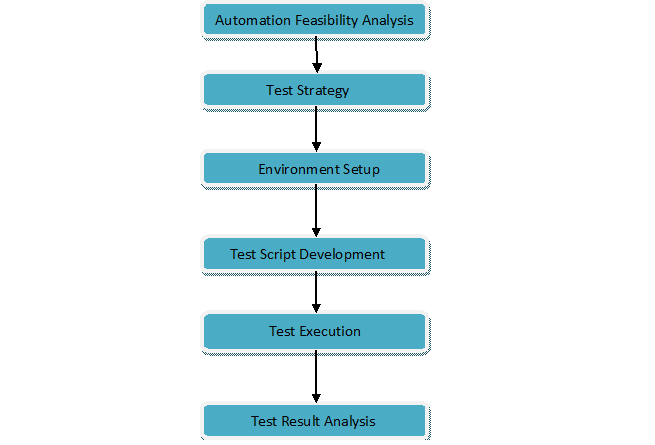
Automation Feasibility Analysis
Feasibility Analysis plays an important role in automation testing. Basically it can be referred as a checklist against which we need to be automated or which need to check if the particular test case can be automated. -
Test Strategy
Test Strategy is also known as test approach defines how testing would be carried out. Test approach has two techniques:
Proactive - An approach in which the test design process is initiated as early as possible in order to find and fix the defects before the build is created.
Reactive - An approach in which the testing is not started until after design and coding are completed. -
Environment Setup
By name itself you can understand that we need to setup machine or remote machine where our test case will execute. Test environment set up phase has following tasks:- Sufficient tool licenses
- Sufficient add-ins licenses
- Sufficient utilities like comparison tools, advance text editors etc.
- Implementation of automation framework
- AUT access and valid credentials
-
Test Script Development
In this phase you have to start develop automation script and make sure all test script is running fine and should be stable enough. -
Test Execution
Execute script, update the execution or coverage tracker. -
Test Result Analysis and Bug Reporting
Analyze the result, report the defects, generate report.
The initial development works for automation is always higher and its maintenance reduces step by step at each iteration of product release.
The following are the key success criteria for ADLC:
- Develop test case, execute it and proven to be correct, analyze the need to automate and schedule for automation development.
- Review test scripts regularly, often test automation requires data and environmental control that may drive product enhancements to truly enhance the effectiveness of automation. When reviewing requirements, ask questions surrounding feature dependencies and testability. The reviews are a wonderful place to share ideas, techniques and tools around each testing feature.
- Develop automation scripts in iterative model, it helps in identifying defects early.
- Use development tools for automation, often people forget that automation requires same set of tools and practices associated with production software development. A good example is version control, bug reporting and processes.
- The more reuse of tools, techniques and process you can create more efficient automation simply because you don't have to train your team or establish unique tools and process.
- Deliver automation one release behind the product delivery schedule, it allows the features to stabilize and sufficient time for proper automation development.