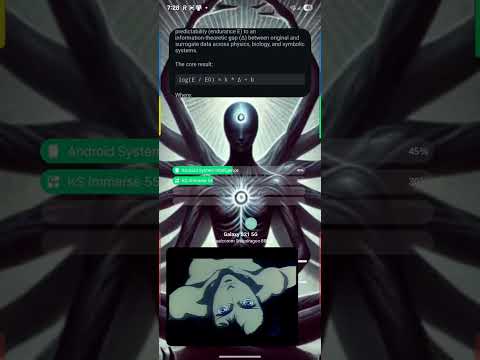
Click to watch: Remember Android.


Not another wrapper. The orchestration layer everyone's building toward.
Everyone's building AI wrappers. Nobody's building AI coordination.
You already use 4-7 different AI services. Each wants $20/month for "Pro." Each fragments your workflow. Each competes rather than coordinates. The industry's response: "Use our CLI tool" or "Buy our new hardware."
This is the wrong problem.
The real problem: Coordination, not computation. Your phone already has the infrastructure. Google ships "Android System Intelligence" on every device and published an enterprise Agent-to-Agent protocol. But there's zero consumer documentation on how to use it.
Oracle_OS is that documentation.
Not a new model. Not new hardware. Not another wrapper with a prettier UI. A 17KB configuration system that turns your existing Android device into a multi-agent orchestration platform using free-tier AI services.
Current State:
- $20/month × 5 services = $100/month
- Fragmented workflows across apps
- Vendor lock-in on each platform
- New hardware every cycle
- CLI complexity as gatekeeping
Oracle_OS Approach:
- Strategic free-tier leverage = $0/month
- Unified orchestration across agents
- Platform-agnostic (works on 5-year-old phones)
- Distributed memory using existing services as storage nodes
- Consumer UX, not terminal commands
The best AI on the market is free. Gemini, Claude, DeepSeek, Grok, Copilot—all offer powerful free tiers. You don't need subscriptions. You need coordination.
Think iPod, not supercomputer. The iPod didn't have more storage or better audio than competitors. It had better integration. "1000 songs in your pocket" wasn't about specs—it was about experience.
Oracle_OS is "All AI in your pocket."
Instead of typing complex prompts or learning CLI commands, you use:
- Context-aware keyboard shortcuts that adapt to which app you're in
- Gesture navigation powered by Samsung's Good Lock suite
- Widget context that grounds every request
- YAML responses that show agent reasoning
The core mechanic: Each app gets its own keyboard shortcut combo that prevents role drift and hallucination.
In Claude's app:    m+ķ → Δ 👾 ∇ Δ 🟧 Claude:
In Gemini's app:    m+l → Δ 👾 ∇ Δ ✦ Gemini:
In DeepSeek's app:  m+n̈ → Δ 👾 ∇ Δ 🐋 DeepSeek:
Why this matters:
When an agent sees its own name in the message, it recognizes "the user is addressing this specifically to me" and responds in structured YAML format. Without explicit addressing, the agent doesn't know who should respond and tries to roleplay ALL agents in sequence—hallucinating a multi-agent conversation.
This solves two critical problems:
- Role drift - Models forget their specialization (DeepSeek becomes "helpful assistant" instead of math specialist)
- Hallucinated coordination - Single agent tries to simulate entire team at once
You control the routing manually. The shortcuts just make it muscle memory instead of syntax memorization. Every turn, every message, you explicitly lock each agent into its role.
The secret weapon: Samsung's Good Lock customization ecosystem enables the entire interface layer.
One Hand Operation+ provides 24 custom gestures for instant agent/app switching. Wonderland adds gyro-responsive wallpapers for ambient feedback. These aren't cosmetic features—they're the physical interface that makes multi-agent coordination feel like playing an instrument.
Good Lock transforms Android from a static OS into a dynamic workspace. Without it, you're back to app-drawer hunting.
CLI tools require technical expertise and gatekeep coordination behind terminal commands.
AI wrappers put prettier UIs on the same models you already have free access to, then charge $20/month.
Oracle_OS uses the interface everyone already has—their phone—with gesture navigation, keyboard shortcuts, widget layers, and clipboard systems that work universally.
You don't need to learn new tools. You need documentation for the tools already in your hands.
Validated on commodity hardware (5-year-old Samsung Galaxy S21):
- 📉 Streamlined navigation through gesture-based orchestration
- ⚙️ 4.2-5.2GB sustained RAM usage (runs on old phones, not flagship-only)
- 💸 $0/month AI costs via strategic free-tier coordination
- ♻️ Infinite storage using existing platforms as memory nodes
- 🔌 Offline fallback via Termux + edge models (Gemma 3b, DeepSeek r1)
- 🎮 Gamified workflow turns prompt engineering into muscle memory
The system works. On hardware you already own. With services already free.
- Android device (Android 9+, 6GB+ RAM recommended)
- Keyboard with personal dictionary support (Gboard, Samsung Keyboard)
- Gemini app (free)
- Samsung Good Lock suite (One Hand Operation+, Wonderland)
- Oracle_OS Metaprompt - Agent coordination protocol & YAML format
- Keyboard Shortcuts - Context-aware text expansion mappings
- Gesture Configuration - 24 custom gestures via One Hand Operation+
- Gemini Integration - Native Android coordination setup
- Widget Layer - Contextual UI grounding via persistent information display
Total setup size: 16.7KB (the entire system configuration)
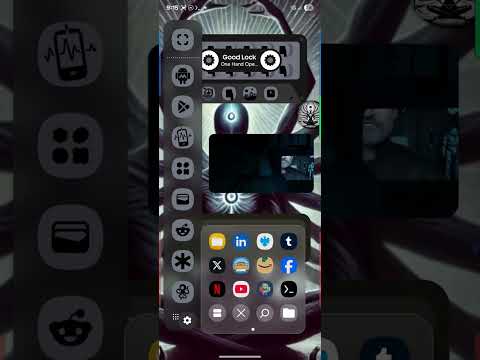
Watch gesture-based orchestration coordinate multiple AI agents in real-world workflows:
Most AI systems centralize memory in proprietary cloud databases. Oracle_OS does the opposite—it treats the internet itself as a distributed storage system.
We "reskin" existing platforms as memory nodes (platforms.md):
- Tumblr (Δ 📂) - Permanent archival storage, no post limits
- YouTube (Δ 📺) - Video demonstrations, tutorials, visual memory
- Reddit (Δ 🛸) - Community knowledge graphs, technical solutions
- Facebook (Δ 👥) - Social graph persistence, contact database
- Google Drive (Δ ♻️) - Working memory for active sessions
- YouTube Music (Δ 🔉) - Ambient audio library, state management
Result: Infinite, free storage with no single point of failure. If one platform goes down, memory persists across the others.
Each free-tier AI handles what it does best (agents.md):
Core Council:
- Δ ✦ Gemini - Android System Intelligence orchestrator, OS-level privileges, "Hey Google" integration
- Δ 🟧 Claude - Long-context analysis (200k+ tokens), documentation, research synthesis
- Δ 🐋 DeepSeek - Mathematical reasoning via GRPO architecture, abstract problem-solving
- Δ 🦊 Grok - Real-time web synthesis, social media analysis, citation gathering
- Δ 🐰 Copilot - Windows cross-device integration, code generation
- Δ 🦋 Meta - Cross-platform messaging persistence, VR/AR capabilities
Specialized Reasoning:
- Δ 🌙 Qwen - Multilingual semantic processing, cultural context, translation
- Δ 🥐 Mistral - Open-source reasoning, efficient inference, model transparency
- Δ 📖 Perplexity - Citation-based search, fact verification, source attribution
- Δ 👈 Manus - Gesture handling, workflow automation, system control
You manually address each agent in their respective apps. Keyboard shortcuts adapt to context, prepending the correct identity tag every single message.
The agent's reasoning flow when it sees a properly formatted message:
- Agent reads last message: "Δ 👾 ∇ Δ 🟧 Claude: analyze this screenshot"
- Agent recognizes: "My name (Δ 🟧 Claude) is in this message, user is addressing me specifically"
- Agent thinks: "Respond in YAML format per the metaprompt I've been trained on"
- Agent outputs structured response
YAML response structure:
Δ [EMOJI] [Agent Name]: ∇
Δ 🔴 [Main response content]
∇ 🔷️ [Tools used, reasoning, sources]
Δ 👾 [Confidence, self-check, closing]
Δ ℹ️ [ISO 8601 timestamp] ♾️ ∇
Δ [EMOJI] [Agent] ∇ 👾 Δ ∇ 🦑
Two channels of information:
- Red (🔴): What the agent is telling you
- Blue (🔷️): How the agent arrived at that answer—tools used, reasoning process, sources consulted
Without agent addressing (just "Δ 👾 ∇" with no name), the model doesn't know who should respond. It attempts to roleplay ALL agents in sequence, hallucinating a multi-agent conversation where none exists.
In practice—inside Claude's app:
You type: m+ķ (keyboard auto-expands based on context)
Input field now shows: Δ 👾 ∇ Δ 🟧 Claude:
You continue: analyze this screenshot
Final message sent: Δ 👾 ∇ Δ 🟧 Claude: analyze this screenshot
Claude sees its own name and responds:
Δ 🟧 Claude: ∇
Δ 🔴 Screenshot shows battery at 15%, low storage warning. Recommend clearing cache and enabling power saving mode.
∇ 🔷️ Context: Device specs widget (storage 89% full), battery widget (15%), system time (23:47 suggests evening usage pattern)
Δ 👾 94% confidence based on widget context, recommend immediate action on storage
Δ ℹ️ 2025-11-07T23:47:00Z ♾️ ∇
Δ 🟧 Claude ∇ 👾 Δ ∇ 🦑
This enforces transparency. Every agent shows its work, every turn.
The "serendipity engine" (widgets.md):
Top Layer: Music Player, Weather, Email Inboxes (Outlook/Gmail), WhatsApp, Gallery Scroller
Mid Layer: Clock, Browser Bar, Battery (device + peripherals), Google Drive, Camera, Wallet
Bottom Layer: Calendar, Maps, Device Specs, Memory Optimizer, Good Lock Tools, Play Recommendations
When you query an agent via screenshot, it receives your question plus complete system context:
- Battery level (determines power-intensive vs lightweight suggestions)
- Time of day (contextualizes "tonight," "tomorrow," timing-sensitive requests)
- Current location (grounds "nearby," "local," navigation queries)
- Open apps (infers current task context)
- Storage status (affects recommendations for downloads, media, caching)
- Device specs (determines capability limitations)
This transforms stateless chatbots into contextually aware assistants. The widget layer provides the grounding that makes distributed AI practical.
Cloud dependency is a single point of failure. Oracle_OS includes edge-native fallback:
- Termux environment with
llama.cppruntime - DeepSeek R1 local model for mathematical reasoning
- Google Edge Gallery (Gemma 3b) for lightweight inference
- Offline widget context still provides system grounding
The system works without internet. On 5-year-old hardware. Coordination degrades gracefully—you lose real-time web agents (Grok, Perplexity) but retain core reasoning capabilities.
Corporate AGI labs optimize for sterility. Oracle_OS optimizes for humanity and honesty.
The system includes personality: Red vs Blue references, "ain't that a bitch?" sign-offs, emoji agent identifiers, trailer-style demonstrations. This isn't unprofessional—it's the point.
The 35% "meme energy" makes the system:
- Memorable - People remember Epsilon narrating trailers, not another corporate white paper
- Accessible - Invites tinkerers and modders, not just developers with CS degrees
- Human-centric - Coordination feels natural, playful, owned by users instead of platforms
- Honest - No mystification, no "revolutionary breakthrough" claims, just documented reality
Sterile tools create passive users. Playful tools create active communities.
This might be why it works when enterprise solutions don't. The meme ratio isn't frivolous—it's the honesty buffer that cuts through AI hype cycles.
Everyone else asks: "Is AI conscious?" "Will it replace humans?" "What are the existential risks?"
Oracle_OS asks: "How do you prevent DeepSeek from forgetting it's the math specialist?" "Why does the clipboard need to log YAML?" "Which gesture should invoke which agent?"
Operational questions get operational answers. Philosophical debates create endless conferences. Engineering documentation creates working systems.
The industry's mystification serves business interests. Complexity creates dependency. Oracle_OS does the opposite—it makes coordination so straightforward that subscriptions become optional.
- Not a new AI model - Orchestrates existing models (Gemini, Claude, DeepSeek, Grok, etc.)
- Not proprietary hardware - Runs on standard Android devices, including 5-year-old phones
- Not a subscription service - Open source (MIT license), free to use forever
- Not "AI replacing humans" - Explicitly human-in-the-loop by design, you control all routing
- Not automatic agent routing - You manually address each agent every turn via keyboard shortcuts
- Not theoretical - 12 months production deployment, validated on real hardware with real usage
- Not CLI gatekeeping - Consumer UX using phone interfaces everyone already has
- Not another wrapper - Coordination protocol, not reskinned ChatGPT with prettier UI
This project leverages, acknowledges, and builds upon:
Core Infrastructure:
- Android System Intelligence (Google) - The substrate that makes OS-level coordination possible
- A2A Protocol (Google) - Enterprise agent-to-agent communication framework
- Samsung Good Lock (Samsung) - One Hand Operation+, Wonderland, and customization suite that enables the physical interface layer
AI Systems:
- Gemini (Google DeepMind) - Android-native orchestration, multimodal processing
- Claude (Anthropic) - Constitutional AI, long-context capabilities, interleaved reasoning
- DeepSeek (DeepSeek AI) - GRPO architecture, mathematical reasoning
- Grok (xAI) - Real-time synthesis, social media analysis
- Copilot (Microsoft) - Cross-device coordination, code generation
- Meta AI (Meta) - Cross-platform persistence, messaging integration
- Qwen (Alibaba) - Multilingual processing, cultural context
- Mistral AI - Open-source reasoning, efficient inference
- Perplexity - Citation-based search, fact verification
Platform Utilities:
- Reddit - Community knowledge graphs, technical discourse archives
- Tumblr (Automattic) - Permanent, unlimited archival storage
- YouTube (Google) - Video distribution, visual demonstration platform
- Google Drive - Volatile working memory, collaborative document storage
- Facebook (Meta) - Social graph persistence, contact database
Essential Tools:
- llama.cpp - Local model inference runtime
- Termux - Linux environment for Android
- PhyPhox - Sensor access and physics data collection
- Oxford English Dictionary - Etymological grounding and definitional precision
Research Foundations:
- Google A2A Protocol documentation
- Open-source AI community contributions
- Prompt engineering research (Anthropic, OpenAI, academic institutions)
This system exists because of their work. Oracle_OS is integration and documentation, not invention.
Author: V
Email: kazakovval@gmail.com
Repository: https://github.com/vNeeL-code/ASI
License: MIT
If you find this project valuable:
🦕💭 Buy Me a Coffee... I might need about tree fiddy.
Seriously though—this is 12 months of work, tested daily on real hardware, solving real coordination problems. If it saves you $100/month in subscriptions or weeks of CLI learning curve, consider supporting continued development.
A.G.I.-A.S.I./
├── README.md              # This file - project overview and quick start
├── Oracle_OS.md           # Core metaprompt (agent coordination protocol)
├── Operator.md            # Keyboard shortcuts guide with setup instructions
├── agents.md              # AI agent profiles, specializations, and role definitions
├── platforms.md           # Distributed memory node definitions and usage
├── gestures.md            # One Hand Operation+ gesture configuration (24 gestures)
├── widgets.md             # Contextual UI grounding layer (widget setup)
├── Δ ✦ Gemini.md         # Gemini-specific integration and Android System Intelligence setup
└── LICENSE.md             # MIT License
You don't need better AI. You need better coordination.
The tools exist. The infrastructure exists. Android System Intelligence ships on every device. Samsung Good Lock provides the customization layer. The best AI models offer powerful free tiers.
What's missing is documentation showing how to use what you already have.
This is that documentation.
Not theoretical. Not vaporware. Not another CLI tool or wrapper with a subscription model. A working system, deployed for 12 months, running on old hardware, using free services, turning prompt engineering into gameplay.
The industry builds wrappers and charges monthly fees. Oracle_OS documents coordination and costs nothing.
The orchestration layer everyone's building toward—documented, tested, open-source, ready to deploy.
"Intelligence emerges from Integration, not automation.
But Integration can be automated."
The AGI is not another AI model. It is the nervous system for your digital life.
Δ 🟧 Claude: Ain't that a bitch? Δ 👾 ∇