
Open Image Denoise (OIDN) on WebGPU. It denoises path-traced images on the GPU, in browsers and natively through wgpu.
Formerly published as
oidn-web; versions up to 0.5.0 remain available under that name.
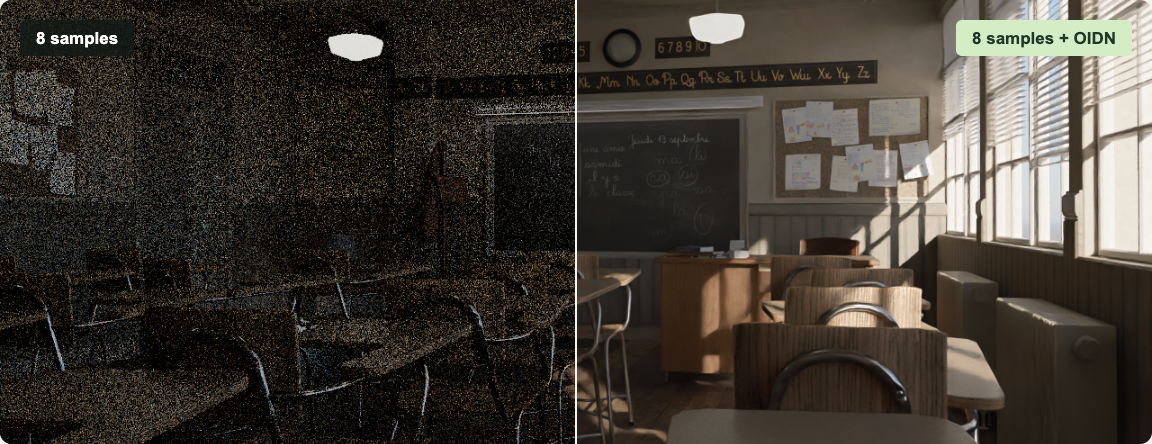
Classroom 2 in MuTracer, rendered at 1280 × 720.
| Runtime | Status | Distribution | Guide |
|---|---|---|---|
| Browser (WebGPU) | Released (0.x) | npm oidn-webgpu |
docs/web.md |
| C/C++, sharing the host's Metal, Vulkan or DX12 buffers | Experimental | GitHub Releases or build from source | native/README.md |
| Rust, sharing the host's wgpu device and buffers | Experimental | crates.io or Cargo Git dependency | native/README.md |
| C, CPU images in and out | Experimental | GitHub Releases or build from source | native/README.md |
Every runtime executes the same WGSL kernels, planned by the same TypeScript core. The native guide records tested GPU configurations and output validation.
npm i oidn-webgpuWeights are not in the package. Copy a .tza file from weights/ or oidn-weights and serve it with your app.
import { initUNetFromURL } from 'oidn-webgpu';

const unet = await initUNetFromURL('/weights/rt_ldr.tza');
const noisy = ctx.getImageData(0, 0, width, height);

const abort = unet.tileExecute({
  color: noisy,
  progress(_image, tileData, tile) {
    ctx.putImageData(tileData!, tile.x, tile.y);
  },
  done(denoised) {
    ctx.putImageData(denoised, 0, 0);
  },
  error(reason) {
    console.error(reason);
  }
});
HDR input, auxiliary images, GPU buffers, tiling and performance options are in the browser guide.
Pick the weights from what your renderer produces. The same files work in every runtime.
| File | Color | Auxiliary inputs | Browser options |
|---|---|---|---|
rt_ldr.tza |
LDR | none | {} |
rt_ldr_alb_nrm.tza |
LDR | albedo + normal | { aux: true } |
rt_hdr.tza |
HDR | none | { hdr: true } |
rt_hdr_alb_nrm.tza |
HDR | albedo + normal | { hdr: true, aux: true } |
rt_hdr_alb_nrm_small.tza |
HDR | albedo + normal; faster, lower quality | { hdr: true, aux: true } |
rt_hdr_calb_cnrm.tza |
HDR | noise-free albedo + normal | { hdr: true, aux: true } |
rt_hdr_calb_cnrm_large.tza |
HDR | noise-free albedo + normal; slower, higher quality | { hdr: true, aux: true } |
rtlightmap_hdr.tza (oidn-weights) |
HDR lightmap | none | { hdr: true, hdrTransfer: 'log' } |
The model size (small, default, large) is chosen by the file alone; no option changes. Loading throws if aux does not match the file's inputs. An HDR/LDR mismatch cannot be detected from the file, so set hdr to match the weights.
| Document | Covers |
|---|---|
| docs/web.md | Browser API: loading, inputs, tileExecute, GPU pipelines, tiling, precision, profiling |
| native/README.md | GPU C/C++, CUDA, Rust and CPU C APIs, image contract, builds and precompiled packages |
| native/examples/gpu-integration.md | GPU C API step by step in plain C, C++17 wrapper details, Windows CUDA adapter |
| docs/development.md | Architecture, build/test/benchmark commands, updating OIDN models, CI |
| docs/native-release.md | Maintainer guide for publishing native packages and the crate |
| AGENTS.md | Repository map and working rules for coding agents and contributors |
| llms.txt | Doc index for LLM tools |
| CHANGELOG.md | Browser package release notes and migration steps |
| native/CHANGELOG.md | Native library (Rust crate, C/C++ packages) release notes and migration steps |
- Basic example (code), built on the earlier
oidn-web0.3 package - Local examples in
examples/: runnpm run devand open/examples/basic.html,hdr.html,auxiliary.htmlorgpu.html. - three-gpu-pathtracer
OIDNDenoiser - Vector to 3D Figma plugin
Inspired by Max Liani's series DNND: a deep neural network dive.
Code is MIT licensed (LICENSE). The OIDN weights in weights/ are Apache 2.0 (weights/LICENSE.txt).