- Function calling another function
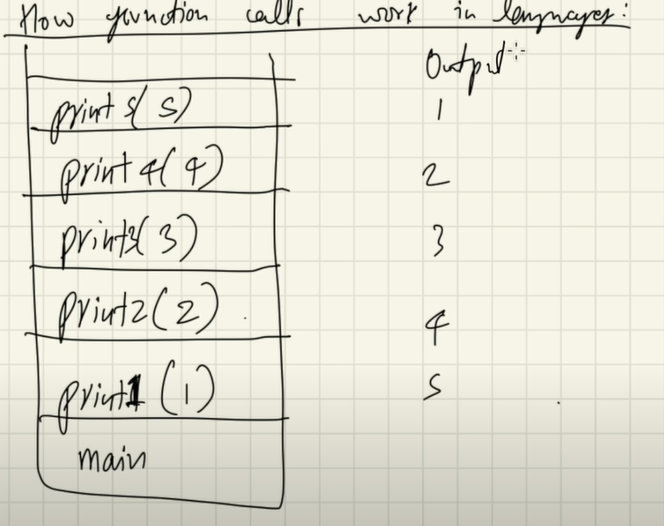
- Function are excuted in the STACK memory
public class NumberExample {
    public static void main(String args[])
    {
        print1(1);

    }

    static void print1(int n)
    {
        System.out.println(n);
        print2(2);
    }

    static void print2(int n)
    {
        System.out.println(n);
        print3(3);
    }

    static void print3(int n)
    {
        System.out.println(n);
        print4(4);
    }

    static void print4(int n)
    {
        System.out.println(n);
        print5(5);
    }

    static void print5(int n)
    {
        System.out.println(n);
    }
}
-
How function call works internally?
-
NOTE:
- While the function is not finished executing it will remain in STACK
- When a function finishes its execution it is removed from stack and the flow of program is restored to program where the function was called.
- Main function is the last function that is removed from STACK and the first one to enter into STACK memory
-
Same action is present in the body:
- Taking a number
- Printing a number
- calling another function
-
If all these function have the same body and are doing the same thing then why are we creating this function again and again?
Solution: call the function itself
-
Parmameter is calling n+1 and when the value of n is 5 it is not calling anything
-
Recurssion is a function that call itself
public class NumberExample {
    public static void main(String args[])
    {
        // write a function that takes in a number and print it
        // print first  5 numbers: 1 2 3 4 5
        print(1);

    }

    static void print(int n)
    {
        if(n ==5)
        {
            System.out.println(5);
            return;
        }
        System.out.println(n);
        print(n+1);
    }
}
- Base Condition in Recursion: It is a Condition where our recurssion will stop making new calls.
- If you are calling a function again and again, you can treat it as a seperate call in the stack
- If there are no Base Condition --> Function calls will keep happening --> stack will be filled again and again --> We know that every function call consumes memory --> at a given moment Memory of computer will exceed the limit, resulting into stackoverflow error
- It helps us in soving bigger/complex problem in a simple way.
- you can convert recursion solution into iteration & vice versa eg: First solve the problem statement using recursion and then convert it into iteration to get an optimized solution
- Space complexity is not constant because of recursive call
- It helps us in breaking down bigger problems into smaller problems

- This is called as Recursion Treee
- we will be using the Recursion Treee concept to solve complex and visulaize comolex problems.
- 4 ways to define string in java:
syntax:
char []arr = ['g','e','e','k','s'];
- It is Immutable class
syntax:
String str="geeks";

    OR

String str = new String("geeks");
- It is Mutable class
- It is thread safe
syntax:

StringBuffer str = new StringBuffer("geeks");
- It is Mutable class
- It is not thread safe
syntax:

StringBuilder str = new StringBuilder("geeks");
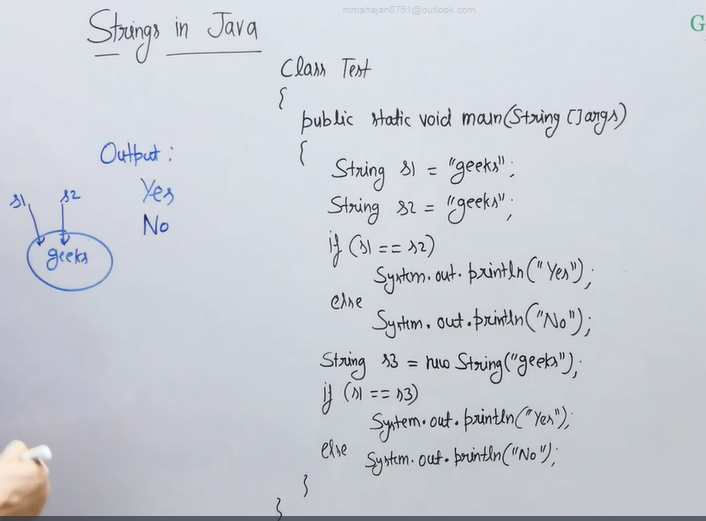
-
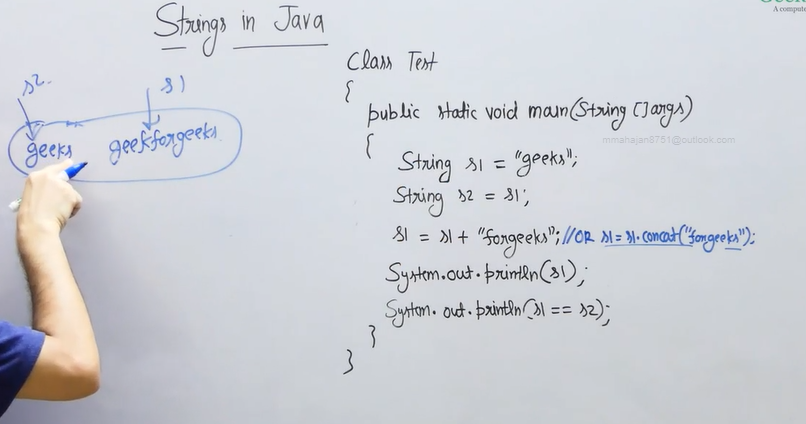
s1 == s1 --> It compare whether instance s1 & s2 belong to same memory aor not. for content comparison we have equal and compare method
-
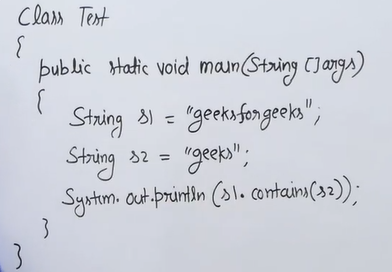
contains()
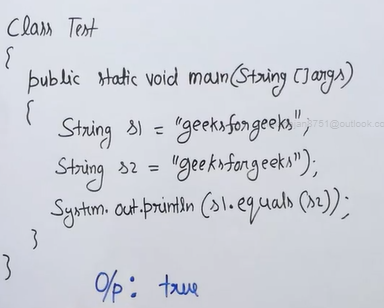
- equals()
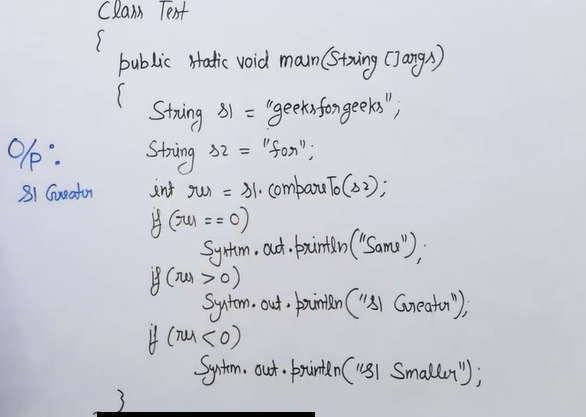
- compareTo()
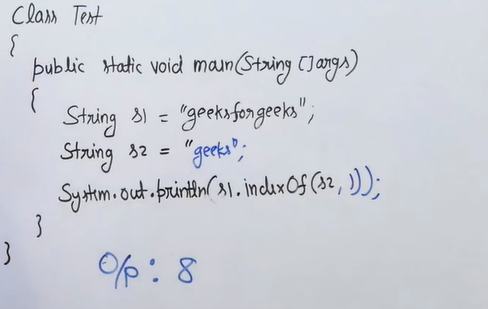
- indexOf()