BarkSpectrogram #2823
BarkSpectrogram #2823
Conversation


|
I'm unsure if the failing tests are related to the functionalities I'm trying to add. |
 carolineechen
left a comment
carolineechen
left a comment
carolineechen
left a comment
There was a problem hiding this comment.
Hi @jdariasl, thanks for working on this! I left a couple of comments.
I also wanted to note that as this is a new feature, the TorchAudio team would like to first support it as a prototype feature (feature classifications) available in our nightly builds, and will reevaluate moving it to beta in one of the future releases, pending use cases and API stability (it would be great if you could provide any additional context/existing implementations of this feature we could refer to!). If that sounds good to you, we can help move it to torchaudio.prototype after your PR is reviewed and merged, lmk if you have any questions. Thanks again!
| specgram = torch.randn(3, 2, 201, 256) | ||
|
|
||
| atol = 1e-6 if os.name == "nt" else 1e-8 | ||
| atol = 1e-4 if os.name == "nt" else 1e-6 |
There was a problem hiding this comment.
can you revert back this change? these values should be fine for the original melscale tests
There was a problem hiding this comment.
Yes of course. When I ran the test locally, MelScale didn't satisfy these values, so I played a little bit with the values and forgot to revert the changes. You can test it on your own.
There was a problem hiding this comment.
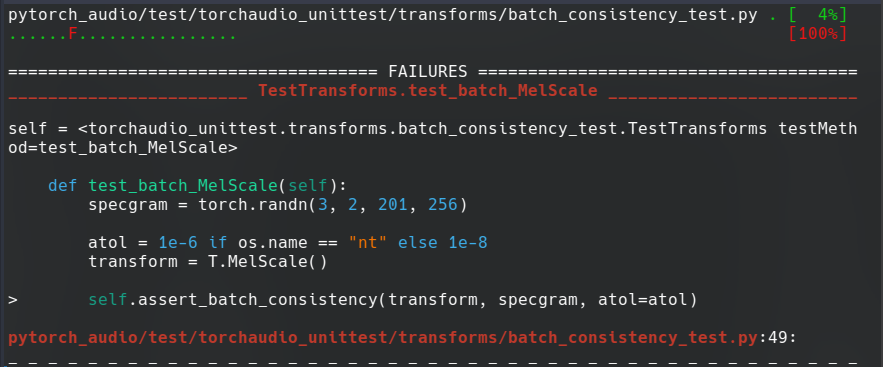
This is the output of batch_consistency_test with the original tolerance values.
There was a problem hiding this comment.
Is there any feedback about this?
There was a problem hiding this comment.
Hey, yea it is also erroring out for me with those values locally, but seems to run okay on our GitHub CircleCI tests -- I think we can leave as is for now, and I can also test out to see if bark scale is passing on CircleCI tests with smaller tolerances after this PR is merged.
| def test_batch_BarkScale(self): | ||
| specgram = torch.randn(3, 2, 201, 256) | ||
|
|
||
| atol = 1e-4 if os.name == "nt" else 1e-6 |
There was a problem hiding this comment.
do you know why these tolerances are increased from the working melscale ones above?
|
The bark scale is just another auditory scale used in speech and audio processing. Such scale is used to estimate RASTA-PLP coefficients (the acronym stands for Relative Spectral Transform - Perceptual Linear Prediction), which is also an alternative to MFCC used in different contexts, including biomedical applications. Most of the available implementations are developed in Matlab: https://www.ee.columbia.edu/~dpwe/resources/matlab/rastamat/, https://es.mathworks.com/help/audio/ref/designauditoryfilterbank.html, even though there is also an implementation in Praat. In this sense, I think a better integration of the Bark scale into torchaudio would be to develop an On the other hand, I'm unsure whether it is possible to propose a comparison with Matlab implementations. |
carolineechen
left a comment
carolineechen
left a comment
There was a problem hiding this comment.
Left a couple of small comments, and could you also add the new functions to docs/source/functional.rst and docs/source/transforms.rst to have it reflected in the pytorch documentation?
Otherwise, the implementation looks good, and should be ready to merge soon! Once merged, I'll create a PR to move this into prototype and investigate the bark spectrogram tolerance, thanks for the contribution :)
| specgram = torch.randn(3, 2, 201, 256) | ||
|
|
||
| atol = 1e-6 if os.name == "nt" else 1e-8 | ||
| atol = 1e-4 if os.name == "nt" else 1e-6 |
There was a problem hiding this comment.
Hey, yea it is also erroring out for me with those values locally, but seems to run okay on our GitHub CircleCI tests -- I think we can leave as is for now, and I can also test out to see if bark scale is passing on CircleCI tests with smaller tolerances after this PR is merged.


|
@carolineechen has imported this pull request. If you are a Meta employee, you can view this diff on Phabricator. |
|
@carolineechen has imported this pull request. If you are a Meta employee, you can view this diff on Phabricator. |


Summary:
follow up to #2823
- move bark spectrogram to prototype
- decrease autograd test tolerance (passing on circle ci)
- add diagram for bark fbanks

cc jdariasl

Pull Request resolved: #2843

Reviewed By: nateanl

Differential Revision: D41199522

Pulled By: carolineechen

fbshipit-source-id: 8e6c2e20fb7b14f39477683b3c6ed8356359a213
5 participants


I have added BarkScale transform, which can transform a regular Spectrogram into a BarkSpectrograms similar to MelScale. @ahmed-fau opened this requirement in December 2021 with the number (#2103). The new functionality includes three different well-known approximations of the Bark scale.