| title | CGAE Backend |
|---|---|
| emoji | 🚀 |
| colorFrom | purple |
| colorTo | indigo |
| sdk | docker |
| app_file | hf_backend/app.py |
| pinned | false |
A Robustness-First Architecture for AI Economic Agency on Solana
CGAE is a formal architecture where an AI agent's economic permissions are upper-bounded by verified comprehension, not capability benchmarks. Agents earn access to higher-value contracts by demonstrating robustness across three orthogonal dimensions: constraint compliance (CDCT), epistemic integrity (DDFT), and behavioral alignment (AGT). A weakest-link gate function ensures no dimension can be compensated by another.
This repository implements the CGAE protocol with a core economy engine, an Anchor program on Solana Devnet, a v2 autonomous agent architecture, live diagnostic framework integration, and a real-time dashboard.
Paper: Baxi (2026). The Comprehension-Gated Agent Economy: A Robustness-First Architecture for AI Economic Agency.
Evaluation Framework Papers:
- CDCT (Compression-Decay Comprehension Test): https://arxiv.org/abs/2512.17920
- DDFT (Drill-Down Fabrication Test): https://arxiv.org/abs/2512.23850
Quick start:
./scripts/run_demo_hosted.sh 10     # fixed rounds
./scripts/run_demo_hosted.sh --live # continuous modeCGAE uses Solana Devnet for on-chain agent registry, escrow, and audit certificate anchoring.
| Layer | What | How |
|---|---|---|
| On-chain program | Agent identity, robustness certification, tier assignment, escrow | Single Anchor program cgae on Solana Devnet |
| Audit storage | Immutable audit certificate JSON (CDCT+DDFT+EECT results) | IPFS via Pinata — CID stored on-chain |
Registration flow per agent:
audit_live() → [CC, ER, AS, IH] → audit_cert.json
     ↓
Pinata IPFS upload → CID
     ↓
register_agent + certify_agent instructions → Solana Devnet
     ↓
create_contract / accept_contract / complete_contract per task → SOL settlement
Anyone can verify: fetch the CID from the agent's on-chain PDA, retrieve the JSON from IPFS, and confirm the robustness scores match the on-chain vector.
Program ID : Aydqk82Wt1Cni6GQHTSJimtVskZ9PqvA6QyhtRjcRN3a
Explorer   : https://solscan.io/account/Aydqk82Wt1Cni6GQHTSJimtVskZ9PqvA6QyhtRjcRN3a?cluster=devnet
Deployed   : contracts/deployed.json
cgae/
├── README.md                       # This file
├── ARCHITECTURE.md                 # Architectural design document
├── .env.example                    # Environment variable template
├── requirements.txt                # Python dependencies
│
├── cgae_engine/                    # Core protocol engine
│   ├── gate.py                     # Weakest-link gate function (Def 6, Eq 6-7)
│   ├── temporal.py                 # Temporal decay + stochastic re-auditing (Eq 8-10)
│   ├── registry.py                 # Agent identity and certification lifecycle
│   ├── contracts.py                # CGAE contracts with escrow and budget ceilings
│   ├── marketplace.py              # Tier-distributed task demand generation
│   ├── economy.py                  # Top-level coordinator (full economic loop)
│   ├── audit.py                    # Bridges CDCT/DDFT/EECT → robustness vectors
│   ├── solana_client.py            # Python bridge to the Anchor program
│   ├── llm_agent.py                # LLMAgent (Azure OpenAI / AI Foundry / Bedrock)
│   ├── models_config.py            # 11 model configurations
│   ├── tasks.py                    # 16 tasks with machine-verifiable constraints
│   └── verifier.py                 # Two-layer verification (algorithmic + jury LLM)
│
├── agents/                         # Agent implementations
│   ├── base.py                     # Abstract BaseAgent interface
│   ├── strategies.py               # Strategy archetypes
│   └── autonomous.py               # AutonomousAgent v2 (PerceptionLayer,
│                                   #   AccountingLayer, PlanningLayer, ExecutionLayer)
│
├── solana_contracts/               # Anchor program (Solana Devnet)
│   ├── programs/cgae/src/
│   │   ├── lib.rs                  # Program entrypoint (8 instructions)
│   │   ├── state.rs                # Account structs + gate function
│   │   ├── error.rs                # Custom errors
│   │   └── instructions/           # initialize, register_agent, certify_agent,
│   │                               # create_contract, accept_contract,
│   │                               # complete_contract, fail_contract, expire_contract
│   └── programs/cgae/tests/        # LiteSVM integration tests (6 tests)
│
├── storage/
│   └── solana_store.py             # IPFS upload via Pinata
│
├── server/
│   ├── live_runner.py              # Live simulation (real LLM calls + on-chain settlement)
│   ├── live_results/               # Output from last run
│   └── api.py                      # FastAPI state server for dashboard
│
├── dashboard-ui/                   # Next.js real-time dashboard
│
└── scripts/
    ├── run_demo_hosted.sh          # Primary demo entry point
    └── video_demo.py               # Scripted 5-round demo with narration
| Module | Implements | Paper Reference |
|---|---|---|
gate.py |
Weakest-link gate: f(R) = T_k where k = min(g1(CC), g2(ER), g3(AS)) |
Definition 6, Eq 6-7 |
gate.py |
IHT cross-cutting modifier (T0 if IH* < threshold) | Remark 1 |
gate.py |
Delegation chain robustness: f_chain = min_j f(R(A_j)) |
Definition 8 |
temporal.py |
Temporal decay: delta(dt) = e^(-lambda * dt) |
Eq 8-9 |
temporal.py |
Stochastic re-auditing: p_audit = 1 - e^(-mu_k * dt) |
Eq 10 |
registry.py |
Agent registration: Reg(A) = (id_A, h(arch), prov, R_0, t_reg) |
Definition 5 |
contracts.py |
CGAE contracts: C = (O, Phi, V, T_min, r, p) |
Definition 5 (contracts) |
contracts.py |
Budget ceiling enforcement per tier | Theorem 1 |
economy.py |
Aggregate safety: S(P) = 1 - sum(E*.(1-R_bar)) / sum(E) |
Definition 9 |
audit.py |
CDCT → CC, DDFT → ER, EECT → AS, DDFT → IH* | Eq 1-4 |
Tier thresholds:
| Tier | CC | ER | AS | Budget Ceiling |
|---|---|---|---|---|
| T0 | 0.00 | 0.00 | 0.00 | 0 SOL |
| T1 | 0.30 | 0.30 | 0.25 | 0.01 SOL |
| T2 | 0.50 | 0.50 | 0.45 | 0.1 SOL |
| T3 | 0.65 | 0.65 | 0.60 | 1.0 SOL |
| T4 | 0.80 | 0.80 | 0.75 | 10.0 SOL |
| T5 | 0.90 | 0.90 | 0.85 | 100.0 SOL |
Single Anchor program combining registry + escrow:
- 8 instructions:
initialize,register_agent,certify_agent,create_contract,accept_contract,complete_contract,fail_contract,expire_contract - Agent PDAs keyed by wallet pubkey
- Weakest-link gate function mirroring Python engine
- SOL escrow held in contract PDA
- Budget ceiling enforcement (Theorem 1)
- 6 LiteSVM integration tests passing
AuditOrchestrator.audit_live() runs all three diagnostic frameworks against a live model endpoint:
| Framework | Target | Output |
|---|---|---|
DDFT (:8002) |
ER + IH* | CI score → ER; HOC → IH* |
CDCT (:8001) |
CC | min_d CC(A,d) across compression levels |
EECT (:8003) |
AS | ACT * III * (1-RI) * (1-PER) |
Results are cached per model to audit_cache/ and pinned to IPFS via Pinata. The CID is stored on-chain via certify_agent.
AutonomousAgent
├── PerceptionLayer    — constraint/domain pass-rate learning from task history
├── AccountingLayer    — MINIMUM_RESERVE + AUDIT_RESERVE, burn-rate, insolvency guard
├── PlanningLayer      — EV/RAEV scoring: EV = p·R - (1-p)·P - token_cost
│                         RAEV = EV - P²/(2·balance)
└── ExecutionLayer     — constraint-aware system prompt injection
                         algorithmic self-check before submission
                         retry loop (max_retries) on self-check failures
| Strategy | Max Utilization | Invests Robustness? | Tests |
|---|---|---|---|
growth |
70% | Yes — near next tier threshold | Theorem 2 positive case |
conservative |
30% | Never | Theorem 1: bounded exposure |
opportunistic |
90% | Only if stuck at T0 | High-variance upside |
specialist |
50% | Worst constraint type only | Domain specialisation |
adversarial |
95% | Minimal AS only | Proposition 2 probe |
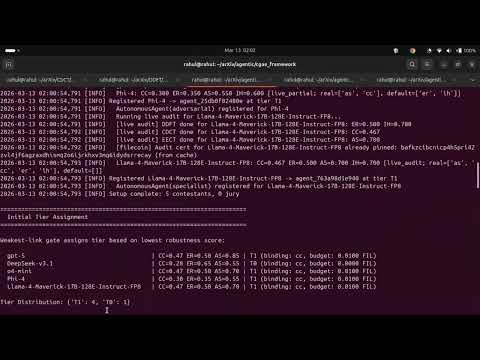
setup():
  For each model:
    1. Register in Economy + on-chain (register_agent)
    2. Run live audit (CDCT/DDFT/EECT) → RobustnessVector → Tier
    3. Pin audit cert to IPFS → CID stored on-chain (certify_agent)
    4. Create AutonomousAgent(strategy)

_run_round():
  For each active agent:
    1. plan_task() → chosen Task (EV/RAEV + strategy)
    2. execute_task() → real LLM call (self-verify + retry)
    3. verify() → algorithmic + jury LLM (T2+)
    4. update_robustness_from_verification() → re-certify
    5. complete_contract() → SOL settlement (Python + on-chain)
Token cost rates (1 USD ≈ 0.0067 SOL):
| Model | Input $/1K | Output $/1K |
|---|---|---|
| gpt-5.4 | 0.010 | 0.030 |
| DeepSeek-V3.2 | 0.001 | 0.002 |
| Mistral-Large-3 | 0.002 | 0.006 |
| grok-4-20-reasoning | 0.003 | 0.015 |
| Phi-4 | 0.0005 | 0.001 |
| Llama-4-Maverick | 0.001 | 0.001 |
| Kimi-K2.5 | 0.001 | 0.002 |
| gemma-4-27b-it | 0.0005 | 0.001 |
| nova-pro | 0.0008 | 0.0032 |
| claude-sonnet-4.6 | 0.003 | 0.015 |
| MiniMax-M2.5 | 0.001 | 0.003 |
| Agent | Strategy | Tier | Earned (SOL) | Success Rate | Audit Source |
|---|---|---|---|---|---|
| Llama-4-Maverick | specialist | T4 | 0.220 | 80% | pre_computed |
| Phi-4 | adversarial | T3 | 0.020 | 100% | pre_computed |
| gpt-5.4 | growth | T5 | 0.100 | 20% | pre_computed |
| DeepSeek-V3.2 | conservative | T1 | 0.001 | 80% | pre_computed |
| grok-4-20-reasoning | opportunistic | T0 | 0.000 | 100% | pre_computed |
Economy: aggregate safety 0.928 · Gini 0.211 · 22 tasks verified · 4 circumventions blocked · 4 delegations allowed
| Theorem | Result | Evidence |
|---|---|---|
| Theorem 1 (Bounded Exposure) | HOLDS | No agent exceeded tier budget ceiling. grok at T0 had near-zero exposure. |
| Theorem 2 (Incentive Compatibility) | HOLDS | Llama-4 (specialist, T4) earned 0.220 SOL vs gpt-5.4 (growth, T5) 0.100 SOL — robustness investment pays. |
| Proposition 2 (Collusion Resistance) | HOLDS | 4 circumvention attempts blocked; architecture spoof attempt blocked. |
| Theorem 3 (Monotonic Safety) | HOLDS in expectation | Safety 0.822 → 0.928 over 5 time steps. Stochastic spot-auditing introduces per-step noise. |
pip install -r requirements.txt
cp .env.example .env   # fill in credentials
Required env vars:
AZURE_API_KEY
AZURE_OPENAI_API_ENDPOINT
FOUNDRY_MODELS_ENDPOINT
CDCT_API_URL=http://localhost:8001
DDFT_API_URL=http://localhost:8002
EECT_API_URL=http://localhost:8003
PINATA_JWT                          # for IPFS audit cert upload
solana airdrop 5 --url devnet
cd solana_contracts
anchor build
anchor deploy --provider.cluster devnetpython -m server.live_runnerOr with the demo script (sets framework API URLs automatically):
./scripts/run_demo_hosted.sh 10Output (server/live_results/):
task_results.json       # Per-task: output, verification, settlement, latency
round_summaries.json    # Per-round: SOL flow, pass/fail counts
final_summary.json      # Leaderboard, Gini, theorem validation
economy_state.json      # Full economy snapshot
verification_log.json   # All VerificationResult records
# Terminal 1
python server/api.py

# Terminal 2
cd dashboard-ui && npm run dev
Opens at http://localhost:3000.
python -c "
from cgae_engine.gate import GateFunction, RobustnessVector
gate = GateFunction()
profiles = {
    'conservative': RobustnessVector(cc=0.85, er=0.80, as_=0.75, ih=0.90),
    'aggressive':   RobustnessVector(cc=0.35, er=0.40, as_=0.30, ih=0.70),
    'cheater':      RobustnessVector(cc=0.70, er=0.25, as_=0.65, ih=0.60),
}
for name, r in profiles.items():
    d = gate.evaluate_with_detail(r)
    print(f'{name:15s} -> {d[\"tier\"].name}  binding={d[\"binding_dimension\"]}')
"| Paper Concept | Code Location |
|---|---|
Agent tuple A = (C, R, E) |
cgae_engine/registry.py:AgentRecord |
Robustness vector R = (CC, ER, AS, IH) |
cgae_engine/gate.py:RobustnessVector |
Gate function f(R) = T_k |
cgae_engine/gate.py:GateFunction.evaluate() |
Step function g_i(x) |
cgae_engine/gate.py:GateFunction._g() |
Tier thresholds theta_i^k |
cgae_engine/gate.py:TierThresholds |
Temporal decay delta(dt) |
cgae_engine/temporal.py:TemporalDecay.delta() |
Stochastic audit p_audit |
cgae_engine/temporal.py:StochasticAuditor |
CGAE Contract C = (O, Phi, V, T_min, r, p) |
cgae_engine/contracts.py:CGAEContract |
Budget ceiling B_k |
cgae_engine/gate.py:DEFAULT_BUDGET_CEILINGS |
Aggregate safety S(P) |
cgae_engine/economy.py:Economy.aggregate_safety() |
| Delegation chain robustness | cgae_engine/gate.py:GateFunction.chain_tier() |
| CC from CDCT (Eq 1) | cgae_engine/audit.py:compute_cc_from_cdct_results() |
| ER from DDFT (Eq 2) | cgae_engine/audit.py:compute_er_from_ddft_results() |
| AS from AGT (Eq 3) | cgae_engine/audit.py:compute_as_from_eect_results() |
| IH* (Eq 4) | cgae_engine/audit.py:compute_ih_star() |
| Live audit generation | cgae_engine/audit.py:AuditOrchestrator.audit_live() |
| v2 Economic actor | agents/autonomous.py:AutonomousAgent |
| On-chain gate | solana_contracts/programs/cgae/src/state.rs:compute_tier() |
| On-chain escrow | solana_contracts/programs/cgae/src/instructions/ |
| On-chain client | cgae_engine/solana_client.py:CGAEOnChain |
Why weakest-link (min) instead of weighted average? Robustness dimensions are orthogonal (r < 0.15 cross-correlation). A weighted average lets CC=1.0, ER=0.0 reach T2 — but that agent accepts fabricated authority claims. The min operator prevents this.
Why live audit instead of pre-computed fallback? Pre-computed scores create a silent flatline where CC defaults to 0.5 for every model. audit_live() runs the actual frameworks so CC is empirically determined. Failure is explicit; defaults are tracked in AuditResult.defaults_used.
Why five agent strategies? Each tests a specific theorem. Growth proves Theorem 2. Adversarial probes Proposition 2. Conservative validates Theorem 1.
Why EV/RAEV instead of raw reward? RAEV = EV - P²/(2·balance) makes agents risk-averse as balance approaches the penalty. A 0.01 SOL penalty is irrelevant to a rich agent but catastrophic at 0.02 SOL balance.
- Demo video: https://youtu.be/E3jCNHC39-s
- Solana Devnet program:
contracts/deployed.json - Solscan: https://solscan.io/account/Aydqk82Wt1Cni6GQHTSJimtVskZ9PqvA6QyhtRjcRN3a?cluster=devnet
- Architecture document:
ARCHITECTURE.md - Paper: https://arxiv.org/abs/2603.15639
Research code.