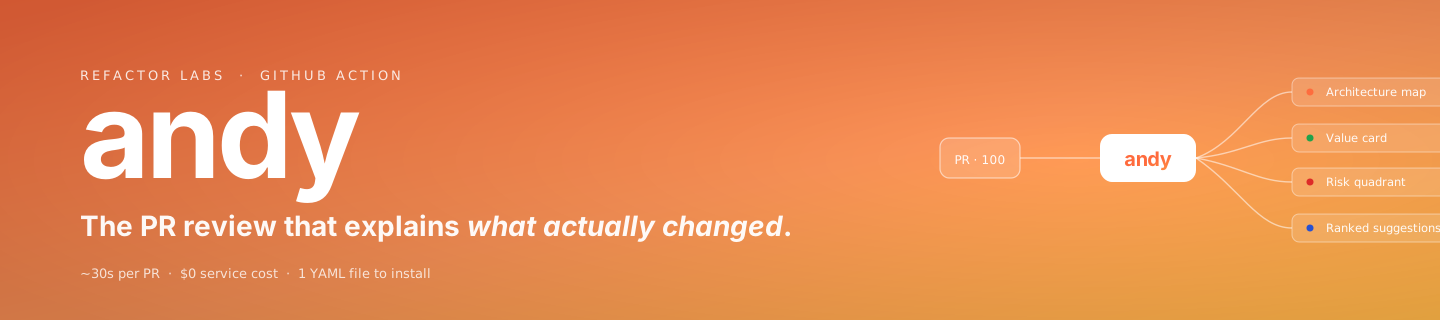
The PR review that explains what actually changed.
A GitHub Action. One comment. Zero services to authorize.




~30s per PR · $0 service cost · 1 YAML file to install · runs on your own runner

- Why Andy
- Install — one YAML file
- Anatomy of the comment
- A peek at the output
- On a real PR
- How it works
- Re-run on demand with
/driftcomments - Configuration
- What Andy doesn't do
- The landing page is part of the action
- Local development & reproducible screenshots
- Repository layout
- CI / CD
- License & contact
Three questions every PR comment fails to answer:
| 01 Reviewers approve PRs they didn't fully understand because nobody has 90 minutes to trace a 100-file diff. Bugs ship in the gap between looks right and is right. | 02 Context lives in Linear, Slack threads, and the author's head — not in the PR. New reviewers spend half their time inferring intent before they can judge the code. | 03 No one can answer in dollars or minutes. The PR closes, the impact disappears into vibes, and the team forgets what they shipped by next quarter. |
Andy reads every pull request and posts one comment with the answers.
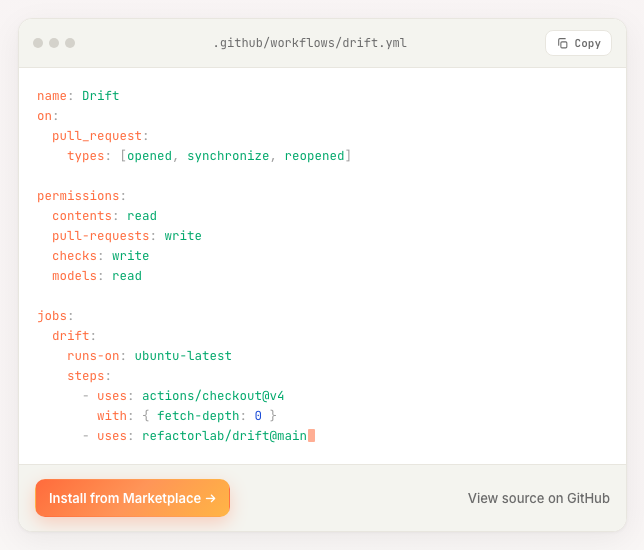
Drop this into .github/workflows/drift.yml. No tokens, no profile commands, no extra config.
name: Drift
on:
  pull_request:
    types: [opened, synchronize, reopened]

permissions:
  contents: read
  pull-requests: write
  checks: write
  models: read

jobs:
  drift:
    runs-on: ubuntu-latest
    steps:
      - uses: actions/checkout@v4
        with: { fetch-depth: 0 }
      - uses: refactorlab/drift@main
Then open a PR — Andy auto-detects the latest profiler release, caches it via $RUNNER_TOOL_CACHE, and posts a sticky comment within ~30 seconds.

👉 The YAML, close up
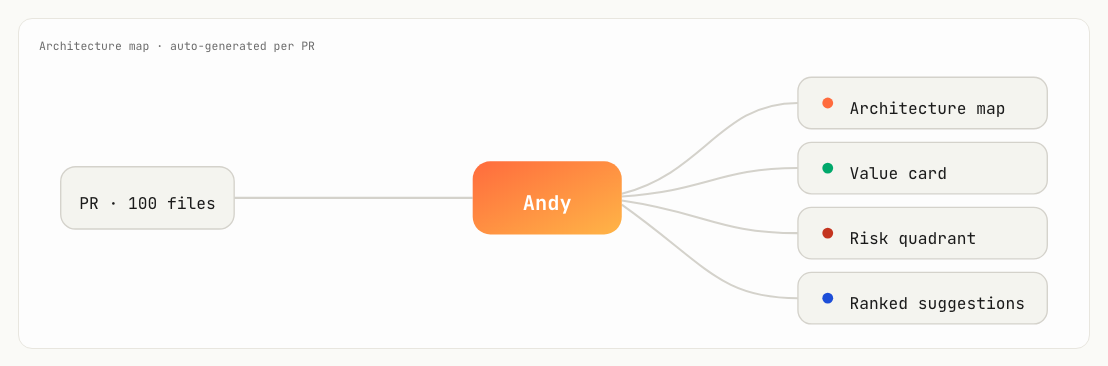
flowchart LR
    PR((PR · N files)) --> Andy((🟧 Andy))
    Andy --> A1[🏗 Architecture map]
    Andy --> A2[📊 Value card]
    Andy --> A3[💡 Ranked suggestions]
    Andy --> A4[⚠ Risk quadrant]
    Andy --> A5[🗂 Hot-touch mindmap]
    Andy --> A6[🧭 Business context]
    classDef src fill:#1f6feb,stroke:#1d4ed8,color:#fff
    classDef hub fill:#ff6b3d,stroke:#ff9558,color:#fff
    classDef out fill:#fafaf7,stroke:#d4d2cb,color:#1a1a1a
    class PR src
    class Andy hub
    class A1,A2,A3,A4,A5,A6 out
One sticky comment per pull request, re-rendered on every push. Inside it: the visuals that turn a large diff into a guided handoff, plus the code suggestions and risks that actually need a reviewer's eye.

| # | Artifact | What it is |
|---|---|---|
| 1 | 🏗 Architecture map | Before → after diagrams of what your PR changed, plus the data structures connecting the two. Rendered as Mermaid. |
| 2 | 📊 Value card | Money, customer, runtime, runtime-UX — each scored with the formula, the inputs that produced it, and a confidence label. |
| 3 | 💡 Ranked suggestions | Every code suggestion ships with a confidence score, a category, an applyable diff, and references to specs or docs. |
| 4 | Severity × likelihood map of every risk Andy spotted. Block on what's red before merge; monitor the rest. | |
| 5 | 🗂 Hot-touch mindmap | The files reviewers should open first, grouped by subsystem — the difference between a 100-file PR and a 6-file mental model. |
| 6 | 🧭 Business context | A product-level diagram with the slice your PR touches highlighted — so reviewers see why the change exists, not just what. |
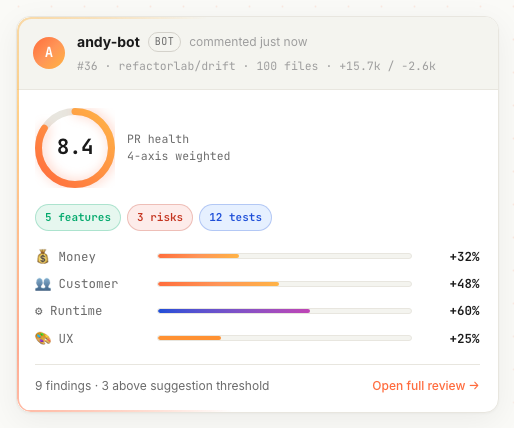
Two artifacts from a real review on a 100-file PR — the value card, a ranked product-correctness suggestion with a fixable diff, and the self-drawing architecture map underneath:

|
|
📎 Open the full example review →
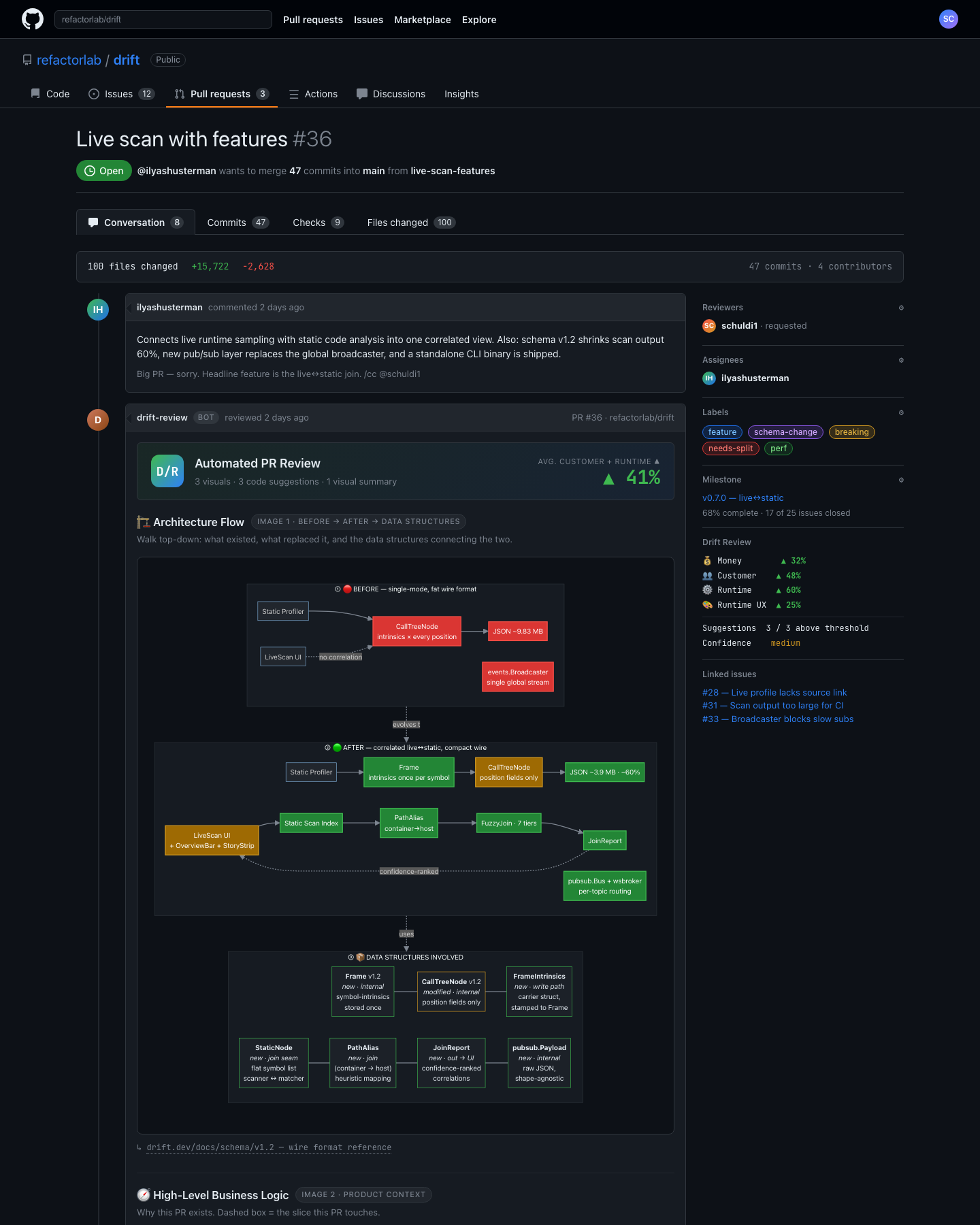
This is exactly what reviewers see when Andy lands on a real pull request (refactorlab/drift#36) — the sticky comment with a live architecture flow, weighted scores, and grouped findings:
- Runs as a GitHub Action on your own runner. Nothing leaves the workflow — no service to authorize, no API key to manage.
- Auto-detects the latest profiler release (
drift-static-profiler) and caches it via$RUNNER_TOOL_CACHEso subsequent runs are fast. - Walks the PR diff against the base branch, builds the call graph + data-structure map, and renders the comment.
- Posts (or updates) a single sticky comment — identified by a hidden marker, so it's overwritten in place on every push.
- Adds a
Drift / PR reviewcheck run summarising the verdict (advisory; does not fail the check).
Andy auto-runs on every push. Sometimes you want to re-run with different flags — bump the AI model, enable debug logs, or open a tracking issue. PR comments make that one click:
/drift
/drift debug=true
/drift ai-suggestions=false audio-summary=false
/drift ai-model=openai/gpt-5
/drift issue          ← also open / refresh a tracking issue for this PR
A fenced-YAML form is also accepted, useful for richer reruns:
/drift
```yaml
debug: true
ai-model: openai/gpt-5
fail-threshold: 0
```
UX: 👀 acknowledges the command once the runner picks it up (~10–30 s), then 🚀 on success, 👎 on failure, or 😕 on a closed/merged PR. The sticky PR comment is updated in place — no duplicates.
start-on-pr-comment: true is additive — turning it on enables /drift comments without disabling the auto-run on pushes. One workflow file does both:
name: Drift
on:
  pull_request:
    types: [opened, synchronize, reopened]
  issue_comment:
    types: [created]

permissions:
  contents: read
  pull-requests: write
  checks: write
  models: read
  issues: write          # /drift issue + 👀 / 🚀 / 👎 / 😕 reactions

jobs:
  drift:
    # Auto-run every pull_request event; for issue_comment, gate on
    # author_association + /drift prefix + not-a-Bot.
    if: >-
      github.event_name != 'issue_comment' ||
      (github.event.issue.pull_request != null &&
       contains(fromJSON('["OWNER","MEMBER","COLLABORATOR"]'),
                github.event.comment.author_association) &&
       startsWith(github.event.comment.body, '/drift') &&
       github.event.comment.user.type != 'Bot')
    runs-on: ubuntu-latest
    steps:
      - uses: actions/checkout@v4
        with: { fetch-depth: 0 }
      - uses: refactorlab/drift@main
        with:
          start-on-pr-comment: true
That's everything. No separate parser shell, no REST resolve step, no fork-safe checkout dance — the action handles it.
👉 Prefer two workflow files?
If you'd rather keep the comment trigger isolated (e.g. to grant issues:write only to that flow, or to enforce the security gate at the workflow boundary where an if: typo can't bypass it), copy examples/drift-on-comment.yml alongside the auto-run drift.yml. Both forms invoke the same action.
🔧 What you can override per /drift
| Key | Default | Example |
|---|---|---|
debug |
false |
/drift debug=true |
progress |
true |
/drift progress=false |
ai-suggestions |
true |
/drift ai-suggestions=false |
audio-summary |
true |
/drift audio-summary=false |
ai-model |
openai/gpt-4.1 |
/drift ai-model=openai/gpt-5 |
ai-max-suggestions |
1 |
/drift ai-max-suggestions=5 |
fail-threshold |
(empty) | /drift fail-threshold=0 |
profiler-release-tag |
(latest) | /drift profiler-release-tag=drift-static-profiler-v0.6.0 |
tts-voice |
af_heart |
/drift tts-voice=am_michael |
open-issue |
false |
/drift issue (also /drift open-issue=true) |
Unknown keys log a ::warning:: and are dropped — forward-compatible against future inputs.
🛡️ Security model
The if: above is three gates in concert, all evaluated by GitHub before the job spins up:
github.event.issue.pull_request != null— only PR comments, never plain issue comments.author_association ∈ {OWNER, MEMBER, COLLABORATOR}— drive-by commenters can't trigger.comment.user.type != 'Bot'— defends against Andy ever triggering itself.
The action re-checks #1 and #3 inside its comment-gate step as defense-in-depth. For fork PRs, the head is checked out by immutable SHA via refs/pull/<n>/head — a force-push between the 👀 ack and the checkout cannot swap in different code. Drift only reads source (tree-sitter); it never executes fork code, so the usual fork-PR-with-secrets attack does not apply.
Andy works with zero configuration — just paste the YAML above.
🔑 Permissions explained
| Permission | Why |
|---|---|
contents: read |
Read the diff and the base/head trees. |
pull-requests: write |
Create / update the sticky comment. |
checks: write |
Emit the Drift / PR review check run. |
models: read |
Read GitHub Models for LLM-assisted suggestion ranking. |
⚙️ Optional knobs (env or with-block)
| Variable | Default | Notes |
|---|---|---|
DRIFT_BASE_SHA |
inferred | Override the base SHA Andy diffs against. |
DRIFT_SUGGESTION_CONFIDENCE |
0.75 |
Floor for showing a code suggestion. |
DRIFT_DEV_HOUR_RATE_USD |
95 |
Used in the Money axis formula. |
👉 Click for the honesty section
- ❌ Doesn't block merges. Findings surface as a check-run summary; you decide whether to gate on them.
- ❌ Doesn't run your tests, or your code. Pure static analysis on the diff + call graph.
- ❌ Doesn't talk to any external service beyond GitHub APIs. The whole pipeline runs on your runner.
- ❌ Doesn't model new-feature dev time. The Money axis is the cost of servicing what the PR ships (bugs + maintenance + LLM iteration) — not the cost of building it.
- ❌ Doesn't replace human review. It hands the next reviewer a guided map and a short list of things that warrant a second look.
- Marketplace: https://github.com/marketplace/actions/andy-pr-handoff-by-drift
- Issues: https://github.com/refactorlab/drift/issues
- Contact: schuldi@gmail.com
- License: MIT
© Refactor Labs · built to make code review feel less like archaeology.