Appearance
The Appearance tab controls everything about how the dancer display looks — transitions, colors, background image, and fonts.
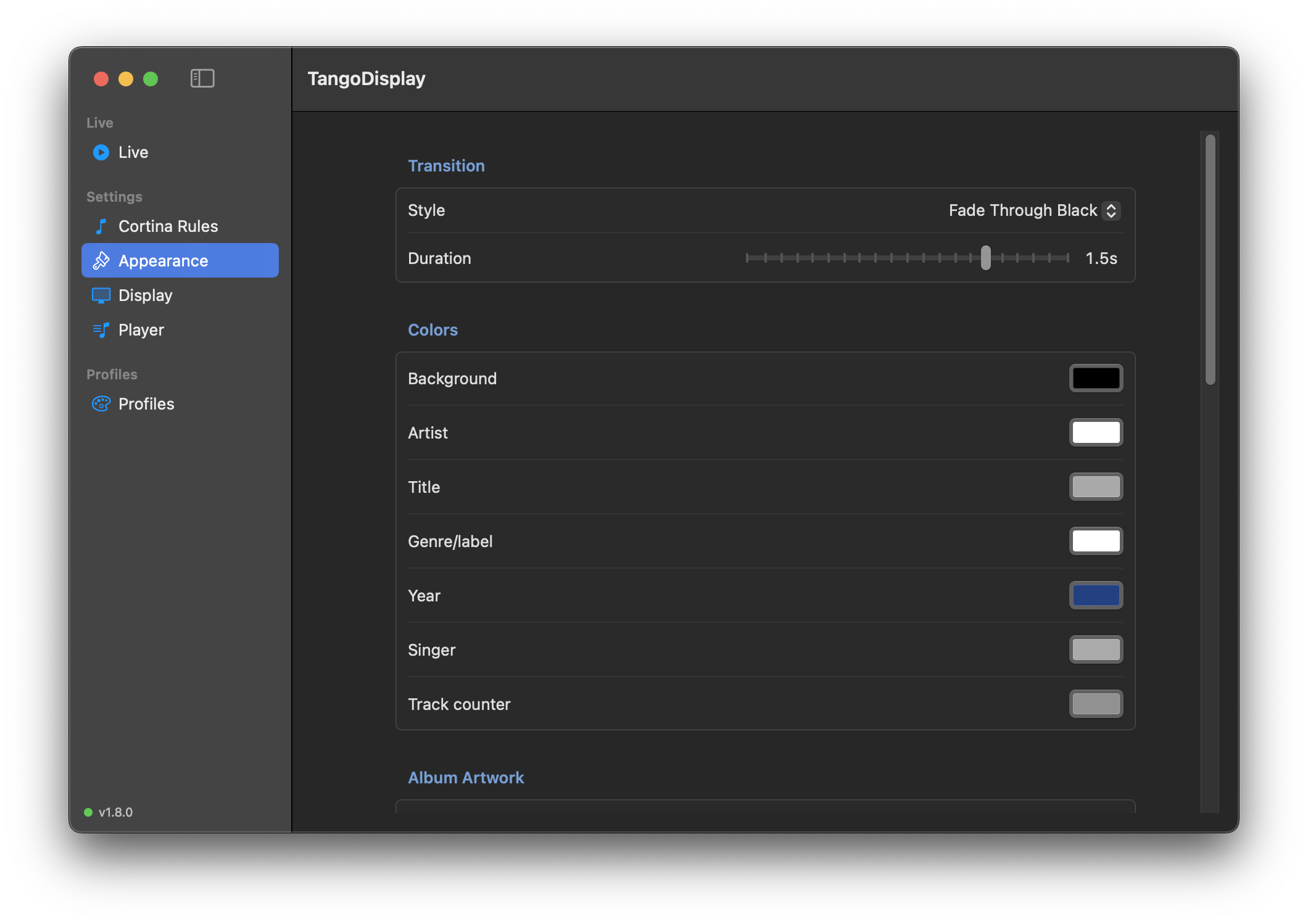
| Setting | Description |
|---|---|
| Style | How the display transitions between tracks. Options include Fade Through Black, Cross-Fade, and Cut. |
| Duration | Length of the transition in seconds (drag the slider). |
Set the color of each element on the dancer display:
| Element | What it colors |
|---|---|
| Background | The solid background fill (used when no background image is set, or behind a semi-transparent image) |
| Artist | The large artist/orchestra name text |
| Title | The track title text |
| Genre/label | The smaller genre or record label line |
| Year | The recording year (e.g. 1952) — only shown when Show Year is enabled |
| Track counter | The "Track X of X" text in the corner |
| Singer | The vocalist/singer line — always configurable here; the Singer line only appears on the display when Include singer is enabled (set in Fonts) |
Click any color swatch to open the macOS color picker.
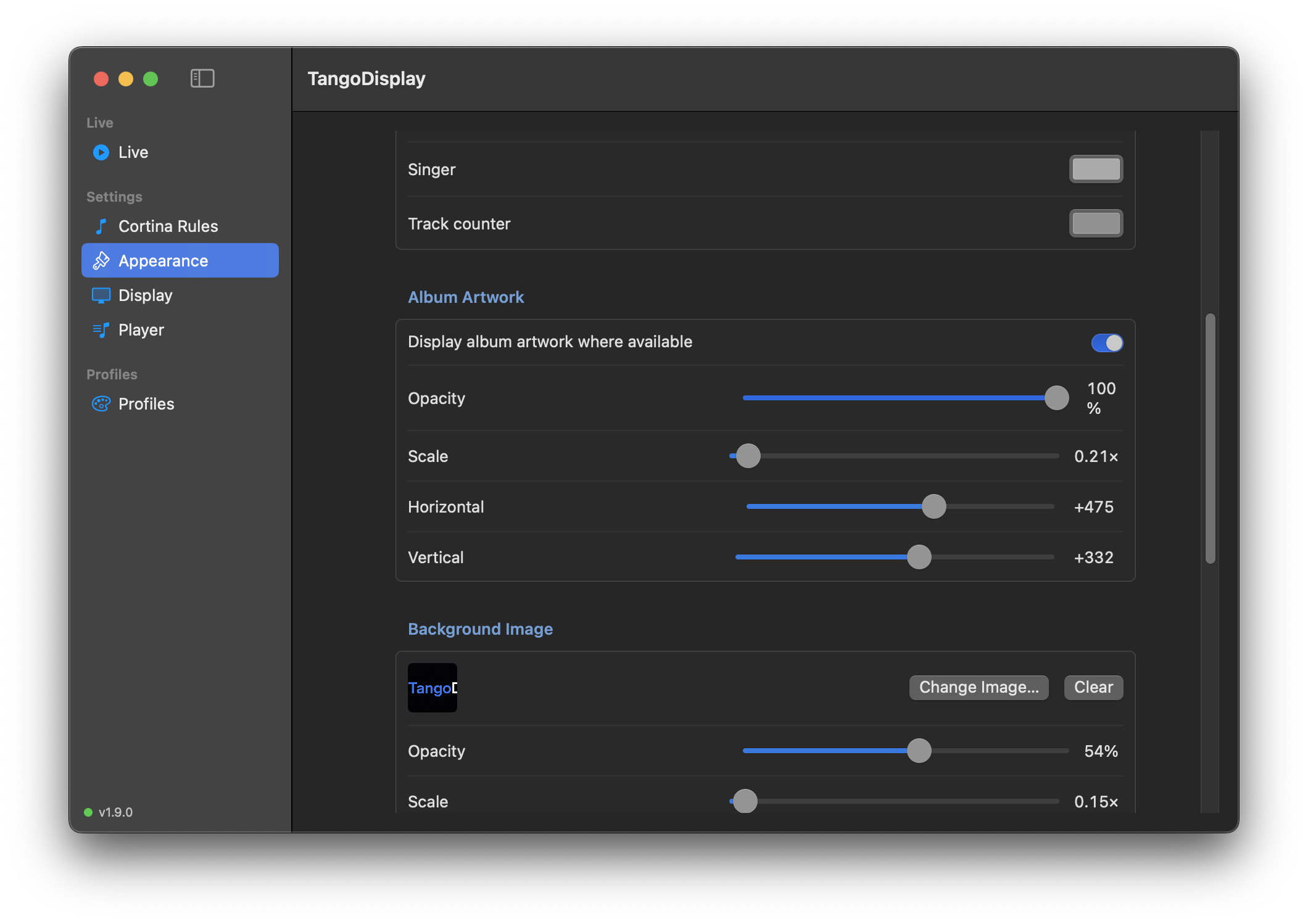
| Control | Description |
|---|---|
| Display album artwork where available | Toggle artwork display on/off |
| Opacity | 0 % = invisible, 100 % = fully opaque |
| Scale | 1× = natural size; increase to fill more of the screen |
| Horizontal offset | Move the artwork left (negative) or right (positive) |
| Vertical offset | Move the artwork up (negative) or down (positive) |
Artwork is fetched automatically from the playing track for all three player sources — Music.app, Swinsian, and Embrace. It fades in and out in sync with track transitions using the same transition style and duration configured above. When no artwork is available the display falls back gracefully (nothing is shown in that layer).
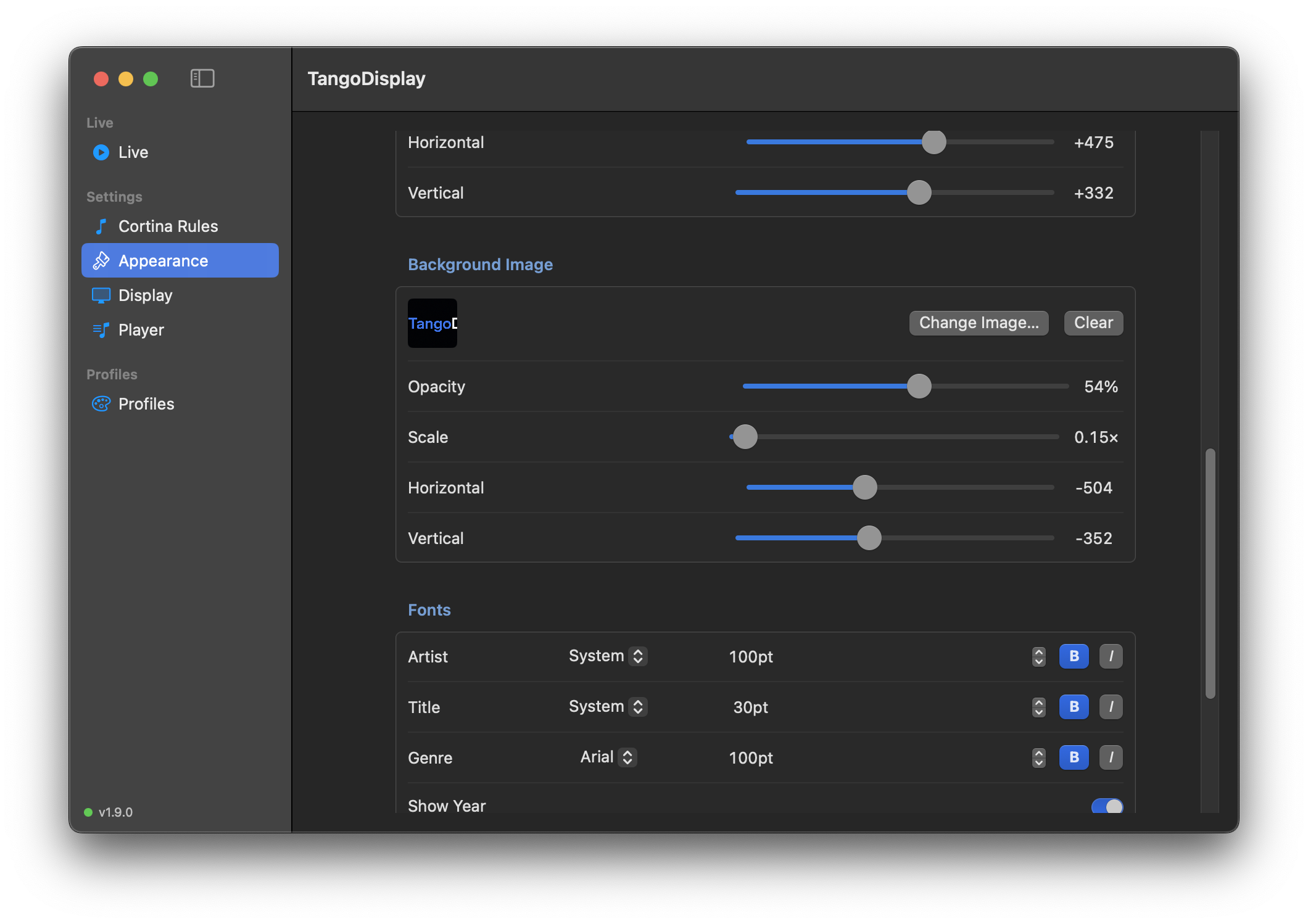
| Control | Description |
|---|---|
| Pick Image… / Change Image… | Opens a file picker to select any image file (label changes to Change Image… once an image is loaded) |
| Clear | Removes the background image |
| Opacity | 0 % = fully transparent (solid background color shows), 100 % = fully opaque |
| Scale | Zoom the image in or out (1× = original size, higher = zoomed in) |
| Horizontal | Pan the image left or right |
| Vertical | Pan the image up or down |
Use Scale + Horizontal + Vertical to frame exactly the part of the image you want behind the text.
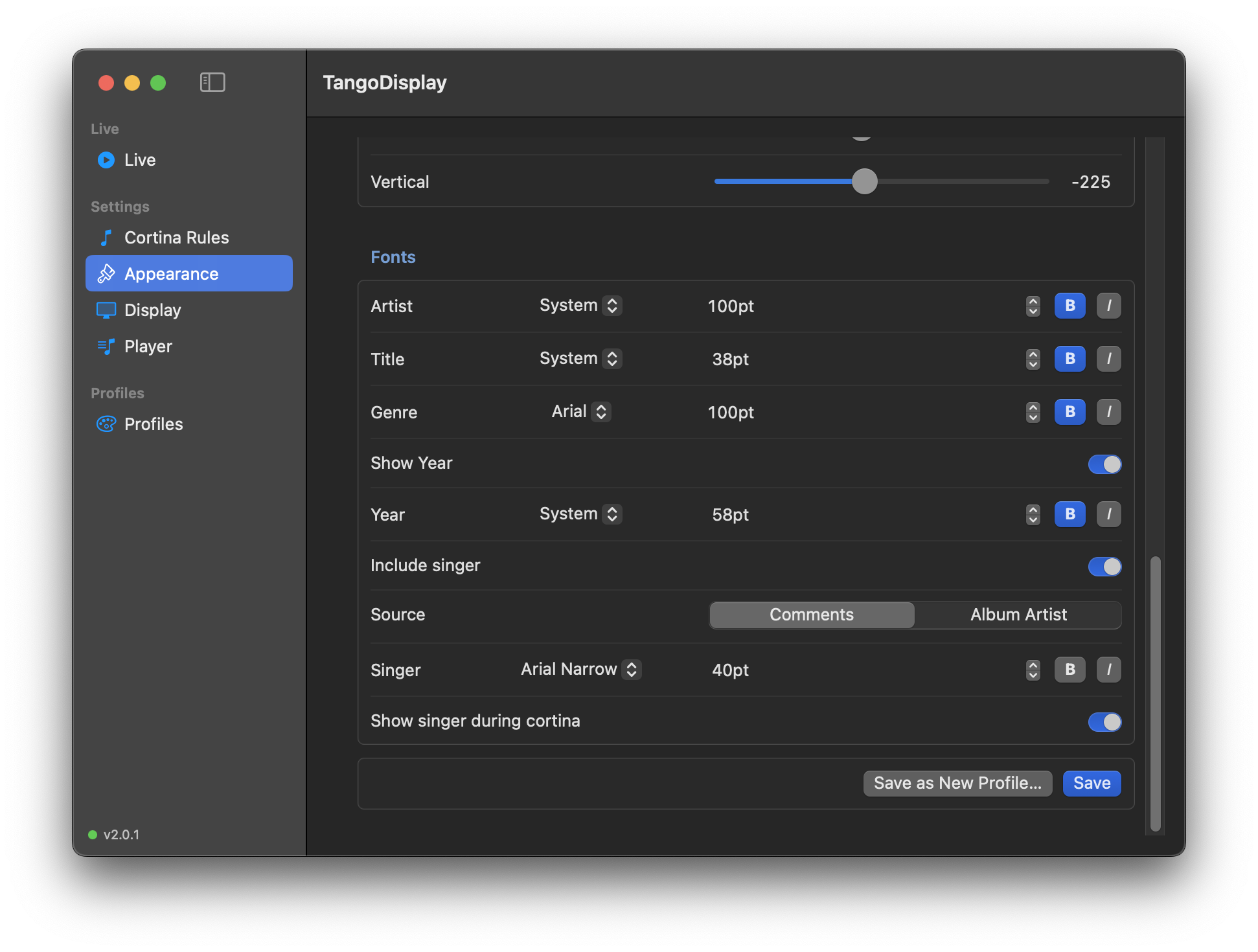
Configure the typeface, size, and style for each text element:
| Column | What you set |
|---|---|
| Font name | Choose from installed system fonts |
| Size | Point size of the text |
| Up/Down arrows | Fine-tune the point size |
| B | Bold |
| I | Italic |
The rows are Artist, Title, Genre, Year, and Singer. Year only appears when Show Year is enabled — toggle it on with the Show Year switch above the Year row.
Enable the singer line with the Include singer toggle. When on, a Source picker lets you choose where the singer name comes from:
| Source | Description |
|---|---|
| Comments | Reads the track's Comment metadata field. Useful when you've tagged vocalist names into comments in your library. This is the default and matches the behaviour of earlier versions. |
| Album Artist | Reads the Album Artist metadata field. Useful when Album Artist holds the vocalist name (common in some tango library workflows). |
A Singer font row appears below the source picker so you can set the typeface, size, and style independently of the other text elements.
When the singer line is on, a second toggle — Show singer during cortina — controls whether the vocalist name also appears in the cortina "Coming Up" preview.
- Save — updates the currently active profile with the new settings
- Save as New Profile… — creates a new named profile (see Profiles)
Changes take effect on the dancer display immediately.