Access your local web server from anywhere -- no account, no subscription, no cloud in the middle. BitBang uses WebRTC to connect browsers directly to your device, peer-to-peer.
Install:
pip install bitbang              # Linux / macOS
python -m pip install bitbang    # Windows (or any platform)
Quick test:
bitbang-fileshare ~/Downloads            # Linux / macOS
python -m bitbang fileshare ~/Downloads  # Windows (or any platform)
This prints a URL and QR code. Anyone with the link can browse and download files directly from your machine, or they can upload files to the specified directory. Note, you can verify it works outside your local network, by scanning the QR code from a phone on cellular (turn off WiFi).
Take an existing Flask or FastAPI app and add remote access.
# Flask
from bitbang import BitBangWSGI
...
app = Flask(__name__)
adapter = BitBangWSGI(app)
adapter.run()  # Prints QR code and public URL
# FastAPI
from bitbang import BitBangASGI
...
app = FastAPI()
adapter = BitBangASGI(app)
adapter.run() # Prints QR code and public URL| ngrok | Cloudflare Tunnel | Tailscale | BitBang | |
|---|---|---|---|---|
| Account required | Yes | Yes | Yes | No |
| Free tunnels | 1 | Unlimited | Unlimited | Unlimited |
| Data path | Their servers | Their servers | P2P | P2P |
| Viewer needs install | No | No | Yes | No |
| Configuration | CLI flags | Config file + DNS | Dashboard | None |
BitBang's data path is direct between peers. The signaling server brokers the initial connection, then steps aside.
Fileshare allows you to easily/quickly share local files without uploading them to a third-party service. It's intended to be an example of a simple (yet useful!) BitBang application. It's just a straightforward Flask app.
bitbang-fileshare big_sourcetree.tar.gz       # Share a single file
bitbang-fileshare ~/Documents/project         # Share a directory (uploads enabled)
python -m bitbang fileshare c:\ide\files      # Windows
Files transfer directly from your machine to the recipient. The recipient can also upload files to your machine.
The Webcam app streams video from your webcam to a browser using WebRTC media channels and BitBang. It can be used as an easy-to-setup monitoring/security camera using your laptop, for example.
bitbang-webcam                  # Linux / macOS
python -m bitbang webcam # Windows (or any platform)The examples/ directory contains two simple examples which show how to integrate BitBang into your current Python web frameworks:
cd examples/simple_fastapi && python3 app.py
cd examples/simple_flask && python3 app.pyThese options are available from the BitBang constructor (same options for BitBangASGI):
adapter = BitBangWSGI(app,
    program_name='BitBang',    # Identity name, shows in browser title
    server='bitba.ng',         # Signaling server (default: bitba.ng)
    ephemeral=False,           # Use a temporary identity (not saved to disk)
    identity_path=None,        # Use a specific identity file
    regenerate=False,          # Delete and regenerate identity
    debug=False,               # Enable verbose logging
    ice_servers=None,          # Custom TURN server config
)
If your app uses argparse, add_bitbang_args and bitbang_kwargs can wire up the standard CLI flags for you:
from bitbang.adapter import BitBangWSGI, add_bitbang_args, bitbang_kwargs

parser = argparse.ArgumentParser()
parser.add_argument('path')
add_bitbang_args(parser)
args = parser.parse_args()

adapter = BitBangWSGI(app, **bitbang_kwargs(args, program_name='myapp'))
These options appear like this on the command line:
--ephemeral              Use a temporary identity
--identity PATH          Use a specific identity file
--regenerate             Delete and regenerate identity
--server HOST            Signaling server hostname
--turn-url URL           TURN server URL (e.g. turn:myserver.com:3478)
--turn-user USER         TURN server username
--turn-credential PASS   TURN server credential
--debug                  Enable verbose logging
Each app gets its own persistent RSA keypair and URL, stored in ~/.bitbang/<program_name>/identity.pem. This means the URL for each BitBang program stays the same across restarts. Use --regenerate to get a new URL, or --ephemeral for a one-time session.
bitba.ng provides a TURN server when a peer-to-peer connection isn't possible, but you can provide your own TURN server if you prefer via the command-line options or through the constructor by specifying ice_servers in browser-native WebRTC format. The defaults should work fine though, so you shouldn't need to provide these.
The Internet is often thought of as a fully connected network -- every machine is accessible from every other machine. But there are rules governing accessibility on the Internet...
- Machines on the Internet are accessible by other machines on the Internet -- and by machines on your local network.
- Machines on your local network are only accessible by other machines on your local network.
Because of rule 2, machines on your local network aren't reachable from outside -- nor are the resources they hold: files, cameras, sensors, compute, or the web app you're currently developing. Cloud services exist to fill this gap: Dropbox for files, AWS IoT for sensors, Tailscale for compute, and ngrok for web apps -- among others. These services apply rule 1, but each comes with the friction of account creation, fees, and your data living on someone else's server.
BitBang connects a browser directly to any machine on your local network, from anywhere on the Internet. No cloud intermediary, no account, no third party in the middle. It uses a novel application of the peer-to-peer technology WebRTC.
WebRTC is the behind-the-scenes technology that makes Zoom and Google Meet video conferencing possible. WebRTC offers the highest bandwidth and lowest latency possible, which is good when you're streaming live video, or practically anything else. It's mature, well-tested, and has ubiquitous support across all browsers. In addition to delivering low-latency media, it can also deliver raw data over "data channels", which is what BitBang uses.
Browsers normally connect to web servers over a TCP socket. BitBang replaces this with a WebRTC data channel:
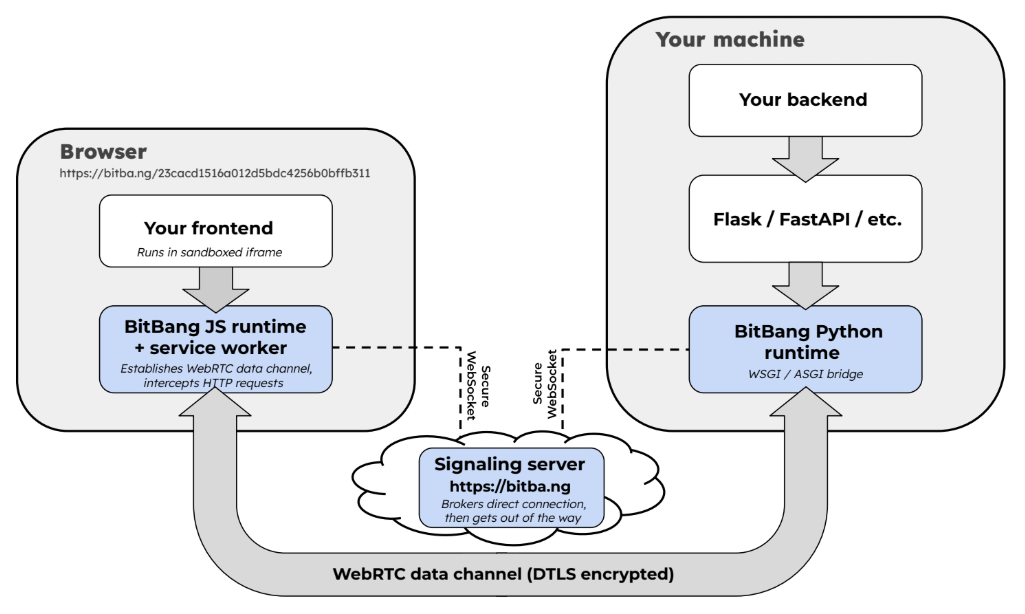
The signaling server (bitba.ng) brokers the WebRTC handshake, then has no further involvement and never sees application data.
The signaling server source is available here. It:
- Serves the BitBang browser runtime
- Validates connecting devices via RSA challenge
- Maintains WebSocket connections to active devices
- Brokers ICE candidate and SDP exchange between browsers and devices
After the P2P connection is established, the signaling server is not involved. We are providing a signaling server for testing, etc. at https://bitba.ng. It mostly brokers connections, so it doesn't need many resources.
WebRTC mandates encryption:
- Data channels: DTLS 1.2+
- Media streams: SRTP
- Signaling: HTTPS and WSS
Furthermore, each BitBang "device" generates an RSA keypair. The public key hash becomes its unique 128-bit ID, which is used in its BitBang public URL. The signaling server challenge-verifies key ownership (and hence ID) before accepting connections.
BitBangProxy -- A standalone binary that proxies any server on the local network. Run it once; the target is specified in the URL at browse-time.
https://bitba.ng/<proxy-id>/192.168.1.10
https://bitba.ng/<proxy-id>/nas.local
https://bitba.ng/<proxy-id>/octopi.local:5000
ESP32 support -- Native BitBang for microcontrollers, including video streaming and OTA updates. It's an IoT network with no account set-up, subscription, etc. Espressif has released a closed-source WebRTC library. Ours is a port of libdatachannel, and it's open of course.
MIT
Issues and pull requests are welcome.