

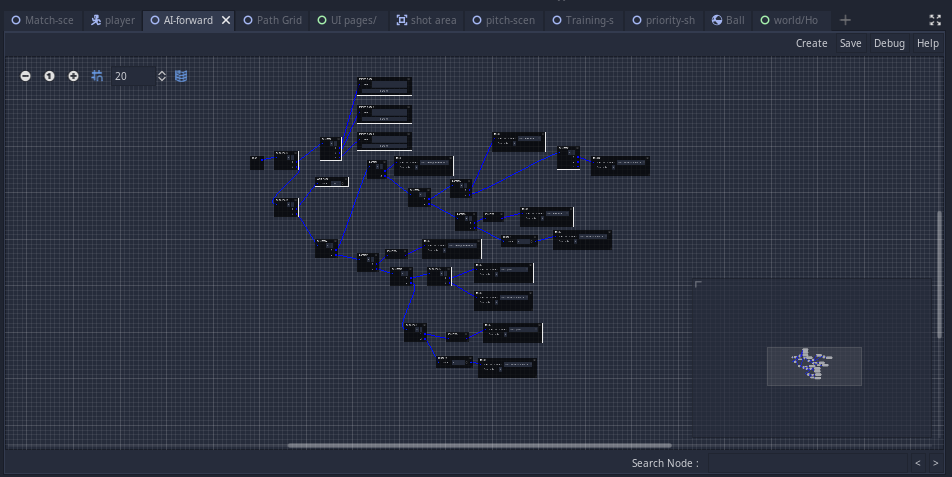
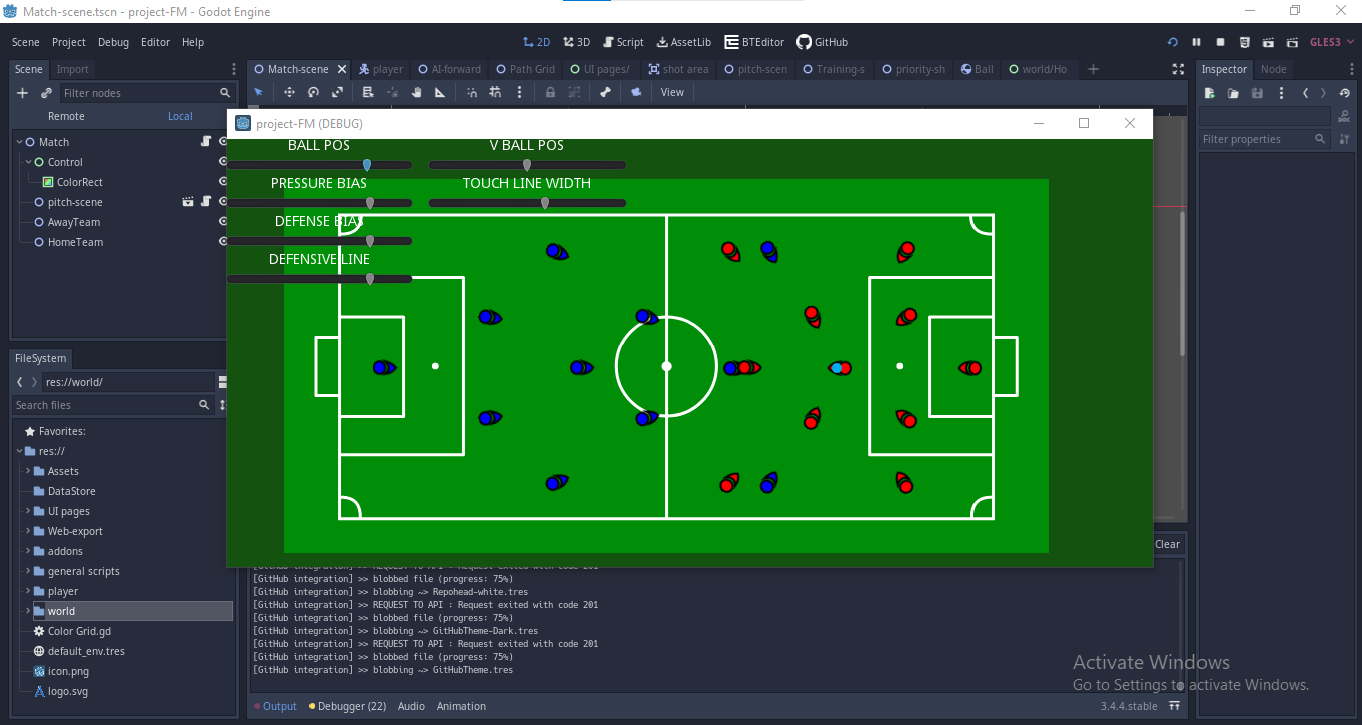
This project is a football manager game inspired by PES 2017 and Top Eleven. It is meant to feature the tactics used to make a football manager game. This article will feature Artificial Intelligence techniques such as Behaviour Trees and state machines. It will also feature data structures and algorithms, including SQL basics. All these were implemented in the project’s current stage.
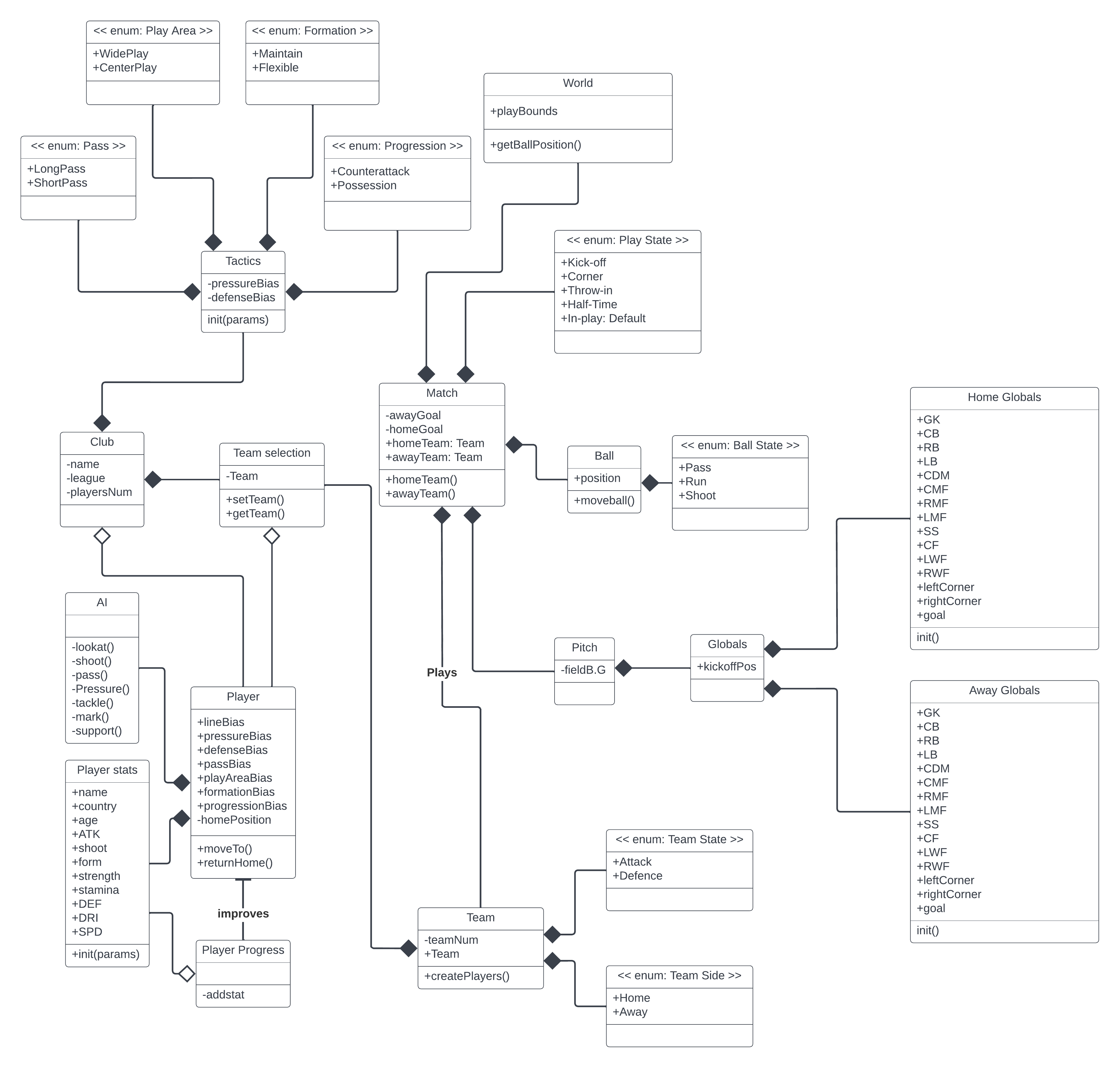
The behaviour tree is a custom AI behaviour designed to control the movement of players around the pitch

🧠 High-level (Conceptual / Architectural) – what the team brain and player brain represent and how they interact.
⚙️ Mid-level (Algorithmic / System design) – how to model their decision-making, adaptability, and compatibility.
🔬 Low-level (Implementation / Data-driven) – how to represent and update these in code and data structures (later).
- Core Idea
Simulation represents intelligence through stats and interactions. Each player has a Player Brain, and each team has a Team Brain. These brains cooperate, conflict, and evolve through matches, training, and chemistry-building — much like neural learning.
- Key Concept: “Neural Harmony”
Each player’s synergy index and understanding level form a “compatibility vector” with the team brain. The closer this vector is to the team’s strategic vector, the smoother the play and the better the team performance.
Each player has an internal neural network that:
Takes stimuli (match context, team instructions, ball state, pressure, stamina, etc.)
Activates neural pathways representing different strategies (pass, dribble, hold, press, shoot, reposition)
Outputs a decision vector — which action to take, and how confidently.
Adjusts synaptic weights (learning) after each event — depending on success, failure, or team feedback.
In short:
The Player Brain converts environment + team signals → decision + internal state update.
2.1 Input Layer (Perception)
Inputs represent the world as the player “feels” it. Example vector (normalize to 0–1):
Input Description ball_distance Distance to ball goal_distance Distance to opponent goal nearest_enemy Distance to nearest opponent teammate_support Average proximity of nearby teammates stamina_level 1.0 = fresh, 0.0 = exhausted pressure_level Intensity of opponent press team_alignment Cosine similarity with team brain form Recent performance metric (momentum/confidence) role_bias Weight from tactical role (e.g. AMF, CB, etc.)
→ This becomes your input vector x (≈ 8–12 dimensions).
2.2 Hidden Layer (Interpretation)
We simulate mental state neurons. Each neuron corresponds to a mental bias:
Neuron Meaning RiskNeuron tolerance for risky passes/shots visionNeuron awareness of team spacing pressureNeuron reaction under press fatigueNeuron resistance to exhaustion adaptNeuron ability to adapt to new tactics egoNeuron tendency to act individually
Each has an activation:
a_i = σ( Σ_j (w_ij * x_j) + b_i )
where σ = sigmoid or tanh activation.
Hidden neurons form the personality pattern of the player.
Outputs represent action tendencies:
Output Meaning shoot_prob pass_prob dribble_prob hold_prob press_prob retreat_prob
The vector of outputs is normalized (softmax) so sum = 1.
You can then choose the action:
Deterministically: pick the max value
Probabilistically: sample based on output weights (makes behaviors less robotic)

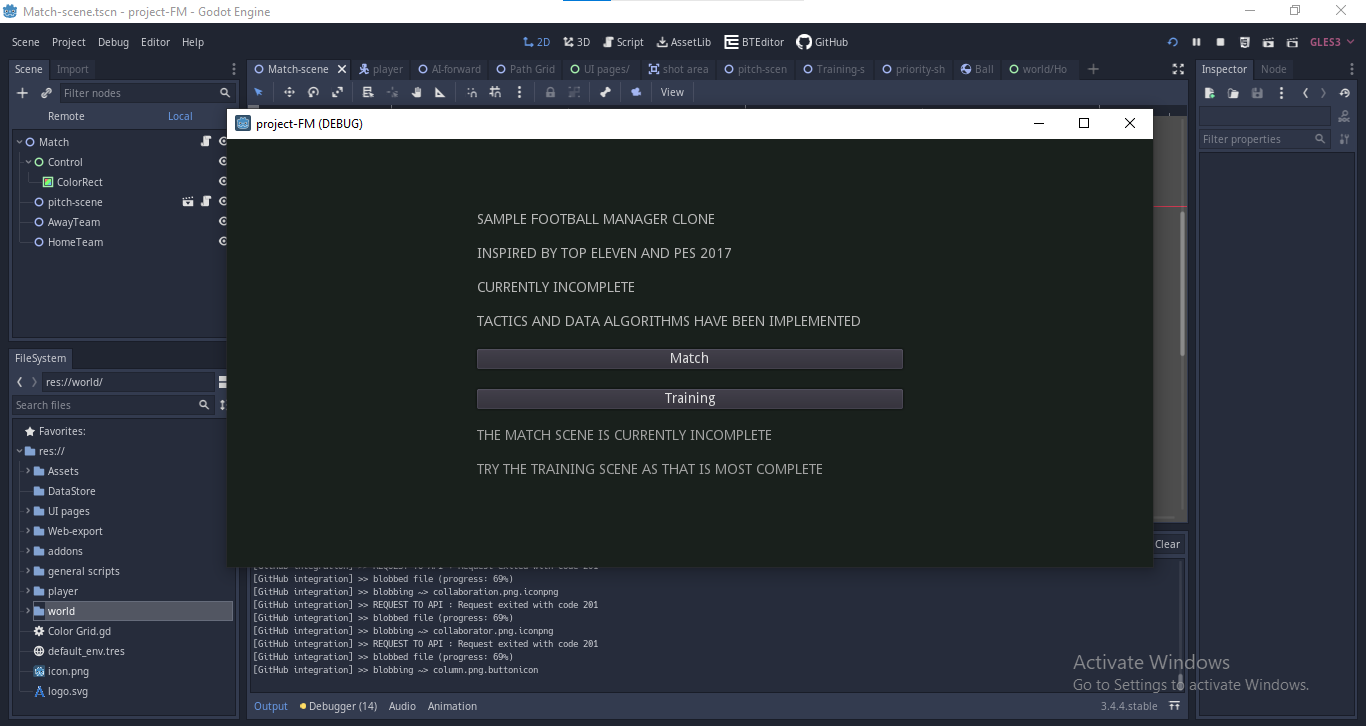
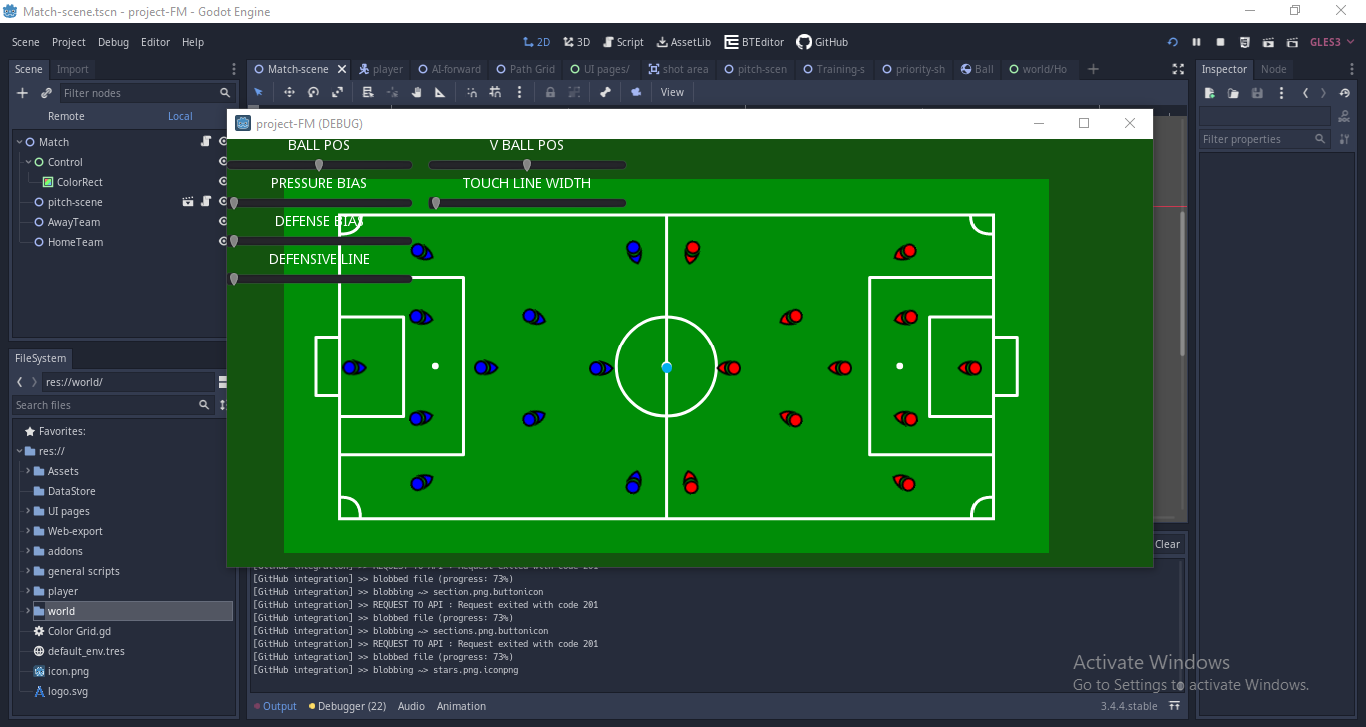
To see my thought process, look through this article on medium -> https://rotimia.medium.com/my-process-on-making-a-football-manager-clone-93e05903a843