Automatic backup, history tracking, and instant restore for your Home Assistant configuration.
Home Assistant Version Control provides complete version history for your setup. It automatically tracks every change to your YAML configuration files using a robust local Git backend. Browse your history, visualize diffs, and restore individual files or your entire configuration to any previous state with a single click.
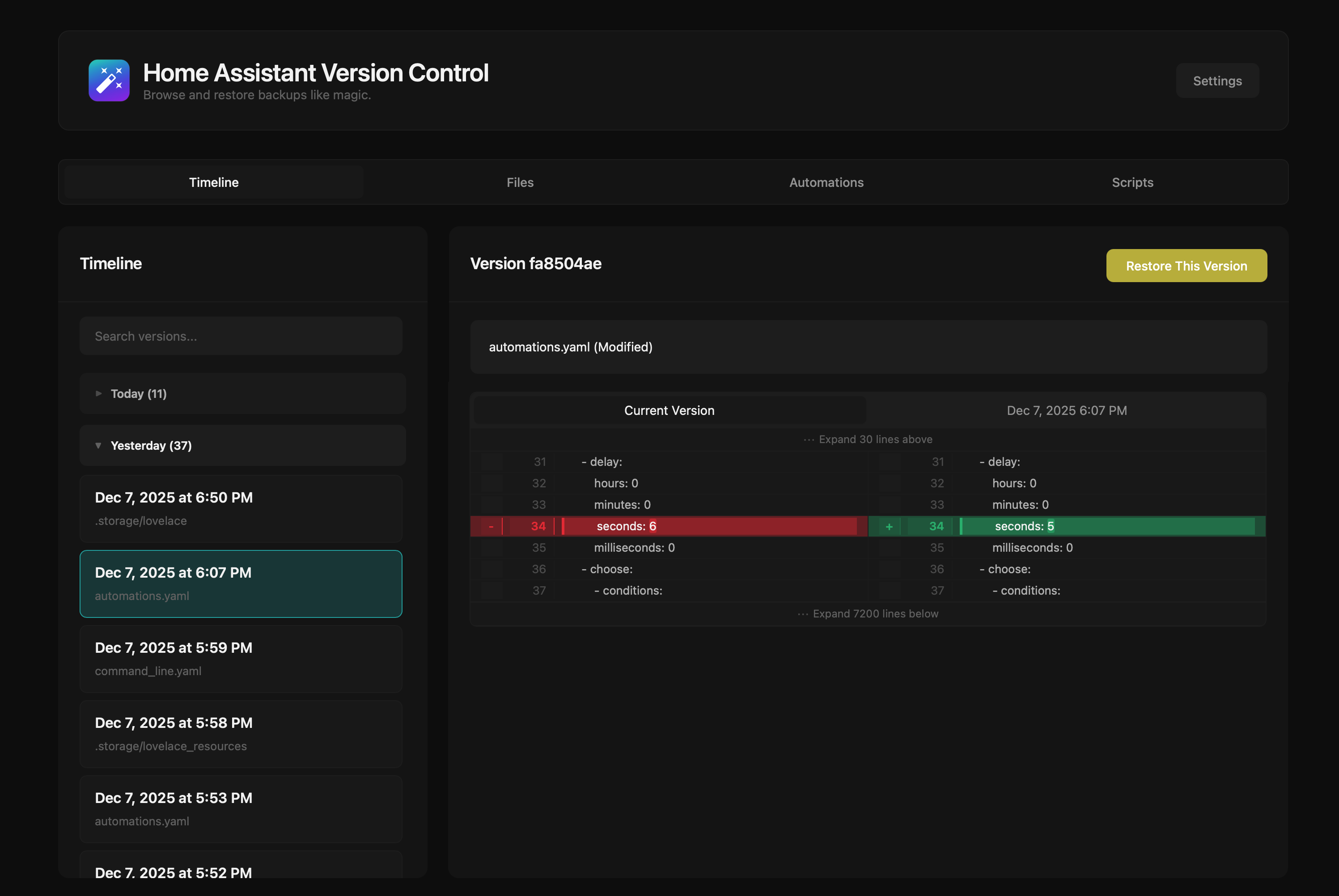
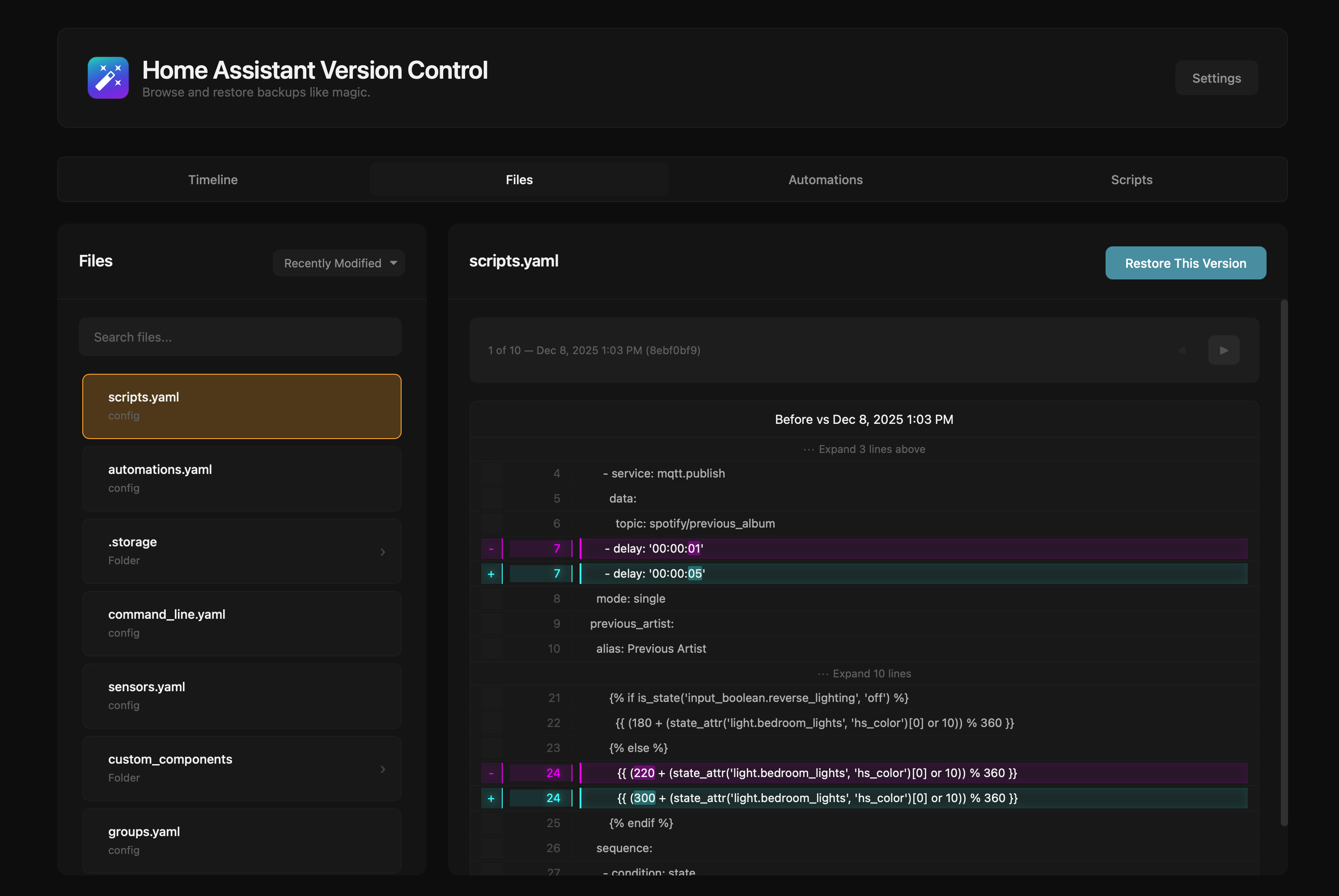
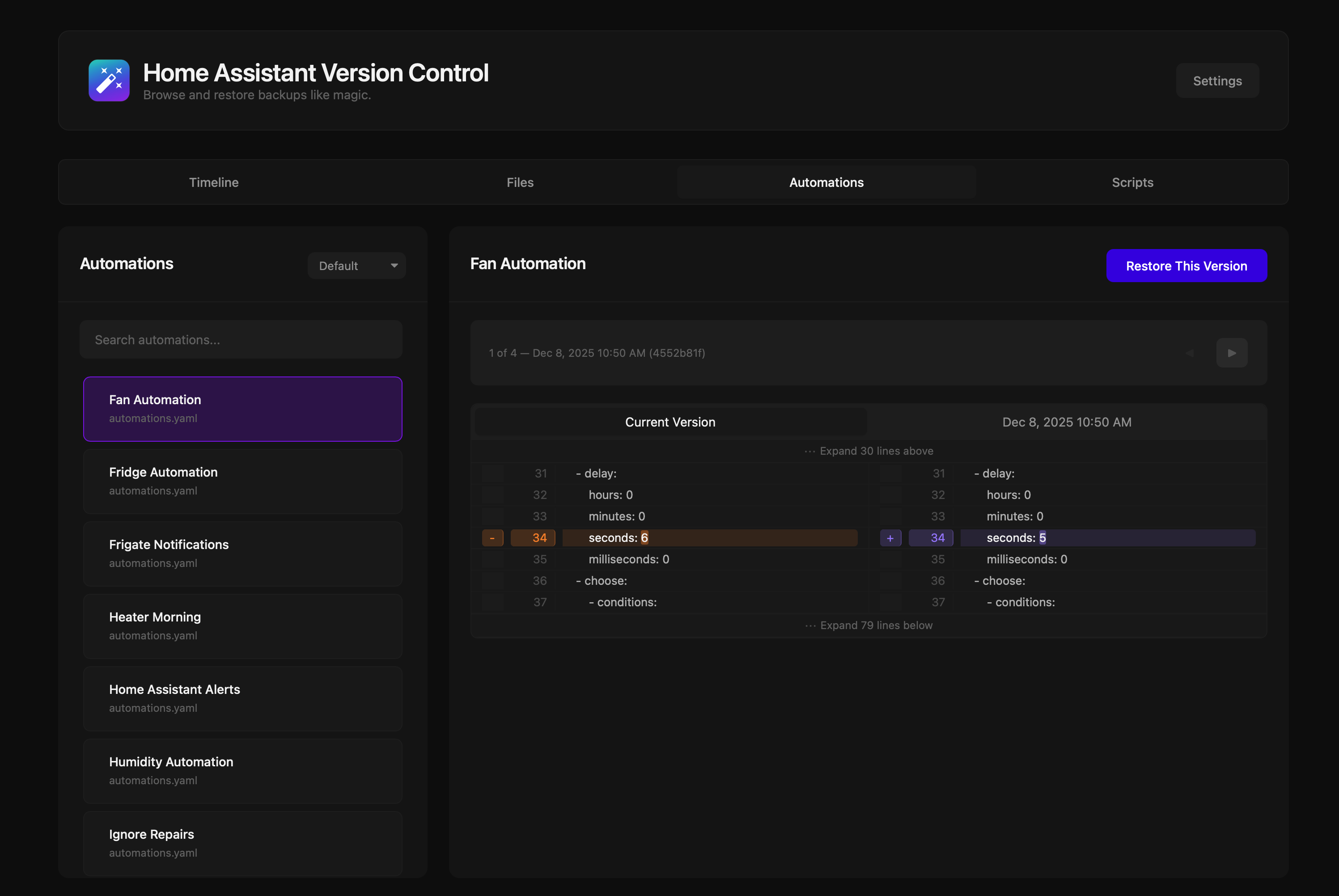
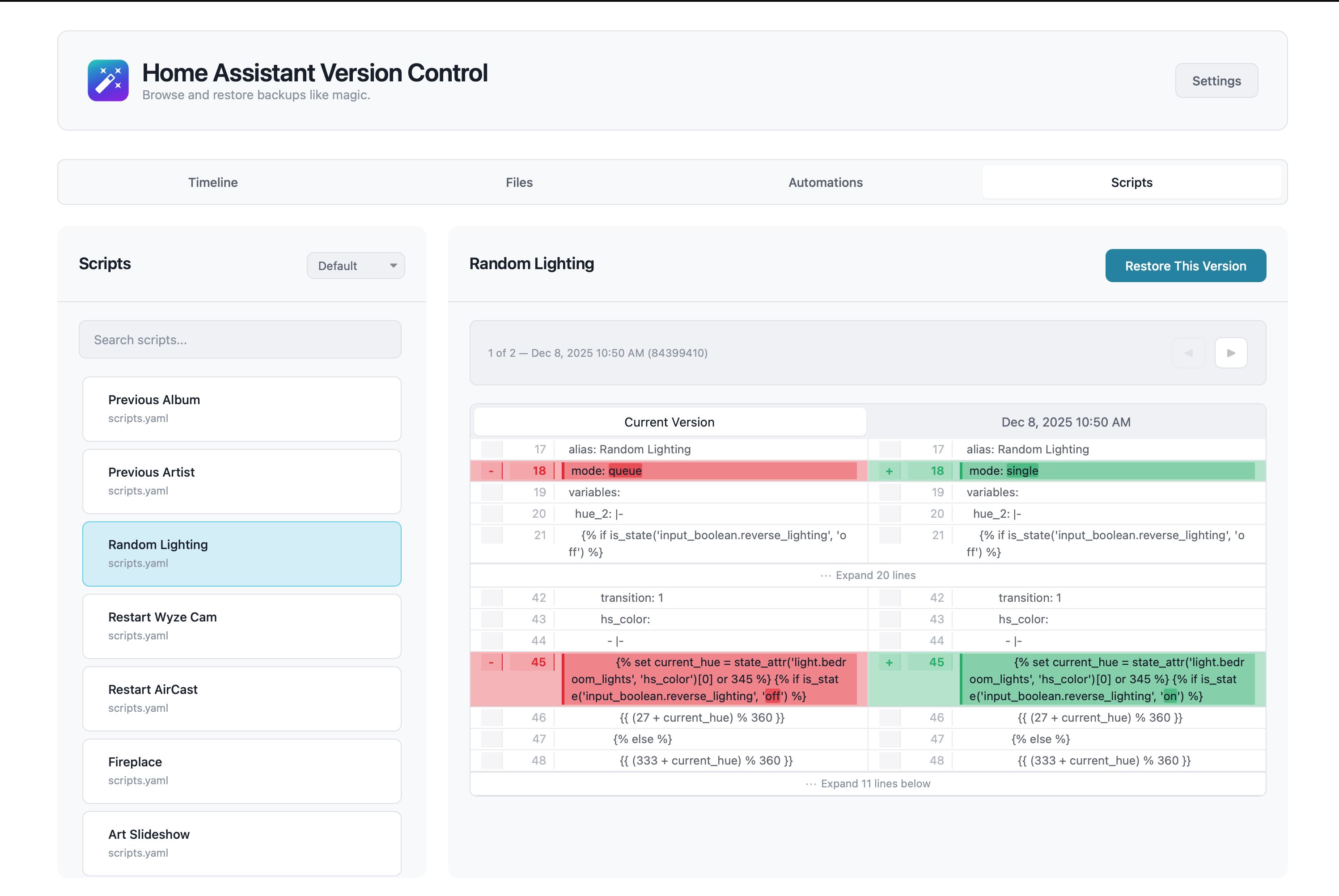
- Zero-Effort Backups: Every edit is saved automatically.
- Smart Debouncing: Multiple rapid edits are grouped into a single save snapshot (customizable delay).
- Comprehensive Tracking: Monitors
.yaml,.yml, andlovelacedashboard files (both UI and YAML mode). - Efficient Storage: Uses Git deduplication to minimize disk usage by storing only the differences between versions.
- Chronological Feed: View changes grouped by "Today," "Yesterday," and "Earlier."
- Visual Comparisons: Compare the current version against any backup side-by-side. Additions are highlighted in green, deletions in red.
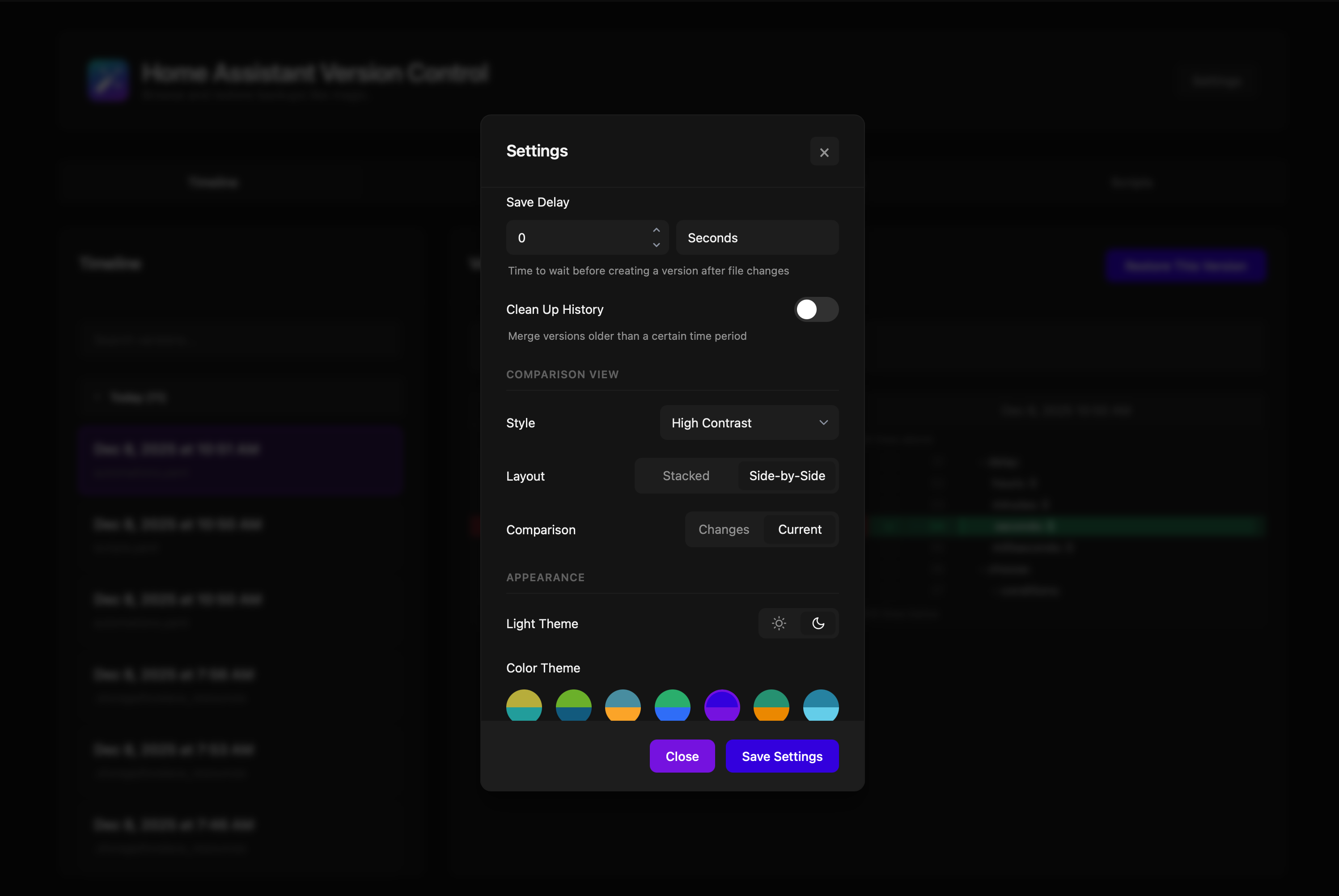
- History Management: Automatically merges versions older than the specified time period to keep your history clean.
- Granular Control: Restore specific files or revert your entire configuration.
- Smart Reloads: Automatically reloads Home Assistant when restoring automation or script files to apply changes immediately.
- Instant Rollback: Long-press the restore button to revert the entire system to a previous point in time.
- Color Theme: Choose from seven preset color palettes.
- Light Themes: Toggle between Light and Dark modes.
- Comparison View:
- Style: Customize your comparisons with 8 different themes (High Contrast, GitHub Classic, Neon, etc.).
- Layout: Choose between Stacked (Unified) or Side-by-Side views.
- Comparison:
- Current (Default): Compare against your Current File on disk to see how far you've deviated since that backup.
- Changes: Compare against the Previous Version to see exactly what changed in that specific backup.
Important
- Existing Git Repos: If you already have a
.gitfolder in your/configdirectory, back it up first. The add-on will use your existing repository but may conflict with your workflow through auto-commits and automatic merging of old history. For best results, delete the existing.gitfolder and let the add-on create a fresh repository. - Backup Strategy: While this add-on provides excellent version control, do not rely on it as your sole backup method. Always maintain external backups (e.g., Google Drive, Samba) of your Home Assistant instance.
There are two ways to install Home Assistant Version Control: as a Home Assistant add-on or as a standalone Docker container.
-
Add Repository: Click the button below to add the repository to your Home Assistant instance:
Or manually add it:
- Navigate to Settings → Add-ons → Add-on Store
- Click the three dots (⋮) in the top right corner and select Repositories
- Add the repository URL:
https://github.com/saihgupr/ha-addons
-
Install the Add-on: The "Home Assistant Version Control" add-on will now appear in the store. Click on it and then click "Install".
-
Start: Start the add-on and click "Open Web UI" to access the interface.
-
Optional (External Access): To access the UI externally at port
54001, enable the port in the add-on's Configuration tab (disabled by default).

For Docker users who aren't using the Home Assistant add-on, you have three deployment options:
Option A: Docker Compose (recommended):
-
Download the compose.yaml file:
curl -o compose.yaml https://raw.githubusercontent.com/saihgupr/HomeAssistantVersionControl/main/compose.yaml
-
Edit the file to set your paths and timezone:
nano compose.yaml
# Update the volume path: /path/to/your/ha/config
# Update timezone: TZ environment variable (e.g., America/New_York)
-
Start the service:
docker compose up -d
Access the interface at http://localhost:54001.
Option B: Docker Run (pre-built image):
docker run -d \
  -p 54001:54001 \
  -v /path/to/your/config:/config \
  -v /path/to/havc-data:/data \
  -e TZ=America/New_York \
  -e SUPERVISOR_TOKEN=your_long_lived_access_token_here \
  -e HA_URL=http://homeassistant.local:8123 \
  --name home-assistant-version-control \
  ghcr.io/saihgupr/home-assistant-version-control:latest
Replace /path/to/your/config with the actual path to your Home Assistant configuration directory.
Option C: Build locally:
git clone https://github.com/saihgupr/HomeAssistantVersionControl.git
cd HomeAssistantVersionControl/homeassistant-version-control
docker build --build-arg BUILD_FROM=alpine:latest -t home-assistant-version-control .

docker run -d \
  -p 54001:54001 \
  -v /path/to/your/config:/config \
  -v /path/to/havc-data:/data \
  -e TZ=America/New_York \
  -e SUPERVISOR_TOKEN=your_long_lived_access_token_here \
  -e HA_URL=http://homeassistant.local:8123 \
  --name home-assistant-version-control \
  home-assistant-version-control
Note
- The
SUPERVISOR_TOKENandHA_URLare optional. You can omit those lines if you don't need Home Assistant restart/reload features. - The
/datavolume is optional but recommended. It persists your settings (debounce time, retention settings) between container restarts.
Access the interface at http://localhost:54001.
- Restore Single File: Click the "Restore" button on any file in the timeline.
- Restore All Files: Long-press (2 seconds) the "Restore" button on a timeline entry to revert all tracked files to that exact moment.
- File Watcher: The system continuously monitors your
/configfolder for changes to YAML files. - Stabilization: When a change is detected, it waits 2 seconds to ensure Home Assistant has finished writing the file (preventing corruption).
- Debounce: It then waits for your configured Debounce Time (default 5s) to batch related edits into a single commit.
- Snapshot: A Git commit is created with a timestamp.
- Cleanup: If enabled, old snapshots are consolidated periodically.
The add-on automatically tracks configuration files while ignoring system files.
| Tracked ✅ | Ignored ❌ |
|---|---|
configuration.yaml |
Database files (.db, .db-shm) |
automations.yaml, scripts.yaml |
Log files (*.log) |
secrets.yaml |
Python cache (__pycache__) |
Lovelace dashboards (.storage/lovelace*) |
Binary files (Images, Videos) |
esphome/*.yaml |
Temporary files |
All other .yaml and .yml files |
Files in .gitignore |
Tip
Excluding Files (e.g., secrets.yaml):
You can prevent specific files from being tracked by adding them to a .gitignore file in your /config directory. Just list the filenames (one per line) that you want to hide, and the add-on will automatically exclude them from version control.
API for advanced users or automation.
| Method | Endpoint | Description |
|---|---|---|
POST |
/api/git/add-all-and-commit |
Manual Backup: Forces a commit of all current changes. |
POST |
/api/run-retention |
Run Cleanup: Manually triggers the history retention cleanup process. |
POST |
/api/retention/cleanup |
Advanced Cleanup: Run cleanup with custom time parameters. |
POST |
/api/restore-commit |
Time Travel: Restore ALL files to a specific point in time. |
POST |
/api/restore-file |
Restore File: Restore a single file to a specific commit. |
POST |
/api/git/hard-reset |
Hard Reset: Reset the repository to a specific commit (destructive). |
POST |
/api/ha/restart |
Restart HA: Triggers a Home Assistant restart. |
GET |
/api/git/history |
Get History: Returns the full commit history log. |
GET |
/api/git/file-diff |
File Comparison: Get the diff for a specific file in a commit. |
GET |
/api/git/commit-diff |
Commit Comparison: Get the full diff for a specific commit. |
Reset the repository to a specific commit. WARNING: This is destructive and will discard all changes since that commit.
Parameters:
commitHash(string, required): The full or short hash of the commit to reset to.createBackup(boolean, optional): Iftrue, creates a safety backup commit of the current state before resetting. Default:false.
Example:
{
  "commitHash": "a1b2c3d4",
  "createBackup": true
}Restore all files to their state at a specific commit. This creates a new commit on top of the current history, preserving history.
Parameters:
commitHash(string, required): The hash of the commit to restore.
Example:
{
  "commitHash": "e5f6g7h8"
}Restore a single file to its state at a specific commit.
Parameters:
commitHash(string, required): The hash of the commit containing the version of the file you want.filePath(string, required): The relative path to the file (e.g.,automations.yaml).
Example:
{
  "commitHash": "i9j0k1l2",
  "filePath": "scripts.yaml"
}Run the history retention cleanup process with custom parameters.
Parameters:
days(number, optional): Keep history for the last N days.hours(number, optional): Keep history for the last N hours.minutes(number, optional): Keep history for the last N minutes.months(number, optional): Keep history for the last N months.
Example:
curl -X POST http://homeassistant.local:54001/api/retention/cleanup \
  -H "Content-Type: application/json" \
-d '{"hours": 24}'For a simpler backup approach that stores everything as plain YAML folders, check out Home Assistant Time Machine. It gives you a clean interface to view YAML backups and restore individual items with a click.
Found a bug or have a feature request? Please submit an issue on GitHub.
If you find this add-on helpful, please ⭐ star the repository!
