
Switch the ports of an ExSYS managed USB hub on and off, from the shell or from Ruby, without being constrained by the vendor's binary-only tool.
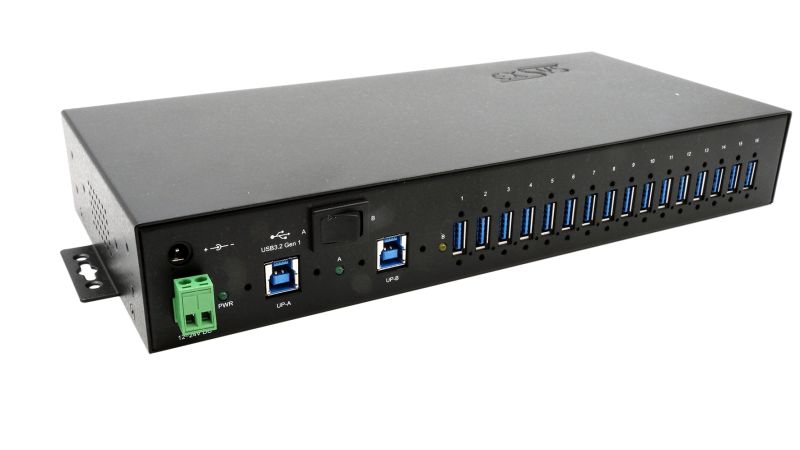
The hub is driven over a serial line, not over USB: switching a port is a serial command, and the data path is not involved. Every command is answered, and that reply is how the port state is read back and how a refused command is reported.
  ┌───────────────┐                            ┌─────────────────────┐
  │               │                            │                     │
  │     host      │                            │     EX-1526HMVS     │
  │               │  USB 3.2 (data)            │                     │
  │               │◂──────────────────────────▸│     UP-A / UP-B     │
  │               │                            │                     │
  │   exsys-usb   │  serial, 9600 8N1          │                     │
  │  (this gem)   │◂──────────────────────────▸│  management (FTDI)  │
  │               │                            │                     │
  │               │                            │  16 ports, 1 .. 16  │
  └───────────────┘                            └─────────────────────┘
The serial line is /dev/ttyU0 on FreeBSD, /dev/ttyUSB0 on Linux.
You need read and write access to it: the device is usually owned by a
group such as dialout or plugdev, so check ls -l on it and add
yourself to that group rather than reaching for sudo.
exsys-usb discover lists the lines that could be a hub, so you do not
have to guess which one it is. See Finding the hub.
The hub answers only to its password, pass unless it has been
changed. Port numbering starts at 1 and runs to however many ports
the hub reports having: the gem asks it, rather than assuming sixteen.
gem install exsysThe only runtime dependency is uart, which pulls in ruby-termios
-- a C extension, so a compiler and the Ruby headers must be available
when it builds.
Tested on Ruby 3.1, 3.3 and 3.4, on FreeBSD and on Linux.
dev=/dev/ttyU0
exsys-usb -d ${dev} on                # All on
exsys-usb -d ${dev} off               # All off
exsys-usb -d ${dev} on 1 2            # Only turn on port 1 and 2
exsys-usb -d ${dev} toggle 3, 5       # Toggle port 3 and 5
exsys-usb -d ${dev} set 3:on 5:off    # Turn on port 3, turn off port 5
exsys-usb -d ${dev} -D false set 3:on # Turn on port 3, all others off
exsys-usb -d ${dev} -c on 1 # Turn on port 1, and save to flash| Action | Effect |
|---|---|
on [PORT...] |
Power the listed ports, or every port |
off [PORT...] |
Unpower the listed ports, or every port |
toggle [PORT...] |
Invert the listed ports, or every port |
set PORT:STATE... |
Set the listed ports; -D decides the rest |
status [PORT...] |
Report the ports, one N on / N off per line |
discover |
List the lines that could be a hub |
query |
What the hub says it is: id, ports, firmware |
commit |
Save the current port state to flash |
factory-reset |
Factory reset; refuses without --yes |
reset |
Reboot the hub; refuses without --yes |
Warning
reset and factory-reset both drop power to every port, so both
refuse without --yes. reset reboots the whole hub; it is not the
way to power-cycle one device, which is off then on.
factory-reset is not the inverse of commit. It issues the hub's
RD command: every port drops and the password goes back to pass.
Nothing in the protocol reloads a saved state -- the hub applies it
at power-on by itself.
A port state in set is written PORT:STATE, where STATE is one of
1, on, ON, true, TRUE, t, T or their false counterparts
0, off, OFF, false, FALSE, f, F.
| Option | Meaning |
|---|---|
-d, --device=DEV |
Serial line to the hub (required, but see |
discover) |
|
-p, --password=STR |
Hub password; defaults to pass |
-c, --commit |
Also write the new state to flash |
-y, --yes |
Mean a destructive action |
-v, --verbose |
Report the port states after a change |
-D, --default=BOOL |
State for the ports set does not name |
--debug[=FILE] |
Trace the serial exchange to stderr, or FILE |
-V, --version |
Print the library version |
-h, --help |
Print the usage |
The debug trace shows every frame sent and received, with the password blanked out; when it is written to a file, that file is created readable only by you.
status prints one port per line, which greps and awks without
parsing:
exsys-usb -d ${dev} status            # every port
exsys-usb -d ${dev} status 3 7        # just those two
exsys-usb -d ${dev} -v on 3 # switch, then report0 when the command was carried out, 1 otherwise -- a malformed
argument, a port outside 1..16, an unreachable serial line, or a
command the hub refused. The error goes to stderr, so a script can
rely on the status:
exsys-usb -d /dev/ttyU0 off 3 || echo "could not switch port 3 off"The management side of the hub is an ordinary FTDI FT232, so the host can be asked which serial lines are attached and what their serial numbers are:
exsys-usb discover/dev/ttyUSB0 A50285BI 1-1.2.4.4
/dev/ttyUSB1 - 1-1.3
One line per adapter: the device to pass to -d, the FT232's own
serial number, and where it sits in the USB tree. A - is a name this
host cannot give — an EEPROM carrying no serial, or a topology that
could not be established. The same list from Ruby:
ExSYS::ManagedUSB.available
# => [ { :device => "/dev/ttyUSB0", :serial => "A50285BI",
#        :usb_path => "1-1.2.4.4" },
#      { :device => "/dev/ttyUSB1", :serial => nil,
#        :usb_path => "1-1.3" } ]
A candidate is not a hub. That FT232 is not an ExSYS part and
carries no ExSYS id, so this lists every FT232 on the host — a
USB-serial cable, a debug probe, a second hub — and nothing short of
opening the line and asking (?Q, the query action) tells them
apart. Opening an unknown line means writing to somebody else's
device, which is why this reports rather than decides. A program that
switches ports should not pick one silently when there is more than
one: the ports of an unrelated hub exist, accept the frames, and report
success.
Write down a serial or a path, not the line. The number in
/dev/ttyUSB1 is neither the hub's nor the USB device number: it is
the usbserial (Linux) or ucom (FreeBSD) layer's own index, and it is
the lowest one free when that adapter is probed. So it depends on what
else attached first, and it is reused — unplug whatever holds
ttyUSB0 and the next thing to attach takes ttyUSB0. Two hubs can
swap lines across a reboot, or while the machine is up.
The other two are stable, in different ways, and which one is wanted depends on the question:
| Name | Stays with | Answers |
|---|---|---|
:serial |
the adapter | "this particular hub" |
:usb_path |
the socket | "whatever is plugged in there" |
Move a hub to another port and its serial goes with it while its path changes; swap in a replacement hub and the path is unchanged while the serial is not. For naming one particular hub the serial is the answer. The path is for a hub whose EEPROM carries no serial to be named by, and for a bench where the socket is the fixed thing.
Both platforms report a path, by different means. Linux states it, in
/sys. FreeBSD states nothing of the kind, so it is walked out of the
sysctl tree: each device's %location gives the port it occupies on
its parent and %parent names that parent, so collecting the ports
from the adapter up to the root hub builds the same shape. The
numbering is each host's own, though — FreeBSD counts buses from 0 and
Linux from 1 — so a path names a socket on the machine that reported
it and does not travel to another.
Discovery reads /sys/class/tty through udevadm on Linux and
dev.uftdi through sysctl on FreeBSD; any other platform raises
rather than answering an empty list, an empty list being a claim that
nothing is attached.
# Instantiate the hub (Linux: ttyUSB?, FreeBSD: ttyU?)
# and enable debug output to stderr
hub = ExSYS::ManagedUSB.new('/dev/ttyU0', debug: STDERR)

# Chain turning on every port, then switch off ports 4, 5 and 6
hub.on(:all).off(4,5,6)

# Toggle each port in turn
hub.ports.each do |p|
    hub.toggle(p)
end

# Set the state of ports 1 and 2
hub.set({ 1 => true, 2 => false })

# Set ports 1 and 2, forcing every other port off
hub.set({ 1 => true, 2 => true }, false)
Reading the state back has no command-line equivalent; it is a library call, and answers in whichever shape suits the caller:
hub.get           # => { 1 => true, 2 => false, ... }
hub.get(:on_off)  # => { :on => [1, 3], :off => [2, 4, ...] }
hub.get(:on)      # => [ 1, 3 ]
hub.get(:off) # => [ 2, 4, ... ]on, off and toggle want an explicit port list, and :all is how
you say every port. An empty list is refused rather than read as
"all": hub.off(*ports) with an empty ports is the very same call as
hub.off, so a computed list that came back empty would otherwise
switch all sixteen. The command line is unaffected -- naming no port
there still means every port.
Switching is a read-modify-write, and the library holds the serial line -- locked -- across the whole exchange, so two processes driving the same hub cannot lose each other's changes.
A read-decide-write spans two calls, so it needs the line held across both. Wrap them in a session:
hub.session do
    hub.on(1) unless hub.get[1]
end
The hub will also describe itself, over the same line and without a password:
hub.query       # => { id: "CENTOS", ports: 16, firmware: "v02",
                #      raw: "CENTOS000516v02" }
hub.port_count  # => 16, asked once and remembered
:all covers exactly those ports, and a port the hub does not have is
refused. The count is read from the same field the vendor's own tool
reads, checked against it for hubs reporting 4, 8, 16 and 32 ports.
It is asked once and kept for the life of the object, which outlasts any one connection -- the serial line is opened per operation, not held. So a hub object is bound to the hub it first asked. If the device is unplugged and another appears under the same name, build a new one; nothing in the library can notice the swap.
hub.factory_reset(confirm: true) issues RD and carries the warning
above. The keyword is required: it is the one operation here that
nothing undoes, and the one most easily reached by misunderstanding.
It was called restore up to 0.6; the old name now raises rather than
run.
Sessions nest, so the methods above stay correct when called inside
one, and a session belongs to the thread that opened it: another thread
opens, and locks, its own line. The wire protocol is documented in the
ExSYS::ManagedUSB class comment.
rake test # or: ruby -Itest test/test_managed_usb.rbThe suite drives the library and the executable against a model of the
hub's serial protocol (test/support/), so it needs neither a hub nor
the uart/termios gems.
MIT, see LICENSE.