This is data management activity of New York University's Data Management and Analysis (CSCI-UA 479) class.
├── data
│   ├── nation_subset.sql
│   ├── CAERS-Quarterly--20220930-EXCEL.csv
├── src
│   ├── nation_subset_analysis.sql		#Analyze nation_subset data
│   ├── create_staging_t.sql			#Create table for CAERS events
│   ├── caers_event_data_import.sql		#Add actual data to the tables
│   ├── staging_table_analysis.sql		#Analyze caers event data for normalization
│   ├── normalization_t_ddl.sql			#Create table to implement the data model
└── README.mdCreate ER Diagram based on tables in SQL file - nation_subset.sql.

nation_subset.sql contains information about countries (such as population, languages, etc.). This data is sourced from a site for another relational database (https://www.mariadbtutorial.com/), so the import statements have been adapted to postgres. The data is contained in multiple tables.
continents
- It has a one-to-many relationship with
regions. This relationship exists because of a foreign keycontinent_idinregionsthat referencescontinents(continent_id)
countries
- It has a one-to-many relationship with
regions. This relationship exists because of a foreign keyregion_idincountriesthat referencesregions(region_id) - It has a one-to-many relationship with
country_languages. this relationship exists because of a foreign keycountry_idincountry_languagesthat referencescountries(country_id) - It has a one-to-many relationship with
country_stats. This relationship exists because of a foreign keycountry_idincountry_statsthat referencescountries(country_id) - It has a many-to-many relationship with
languages. This relationship exists because third tablecountry_languagesreferences both primary keyscountries(country_id)andlanguages(language_id)as its foreign keys.
country_languages
- It has a one-to-many relationship with
countries. this relationship exists because of a foreign keycountry_idincountry_languagesthat referencescountries(country_id) - It has a one-to-many relationship with
languages. this relationship exists because of a foreign keylanguage_idincountry_languagesthat referenceslanguages(language_id)
country_stats
- It has a one-to-many relationship with
countries. This relationship exists because of a foreign keycountry_idincountry_statsthat referencescountries(country_id)
languages
- It has a one-to-many relationship with
country_loanguages. This relationship exists because of a foreign keylanguage_idincountry_languagesthat referenceslanguages(language_id) - It has a many-to-many relationship with
countries. This relationship exists because third tablecountry_languagesreferences both primary keyscountries(country_id)andlanguages(language_id)as its foreign keys.
region_areas
regions
- It has a one-to-many relationship with
continents. This relationship exists because of a foreign keycontinent_idinregionsthat referencescontinents(continent_id) - It has a one-to-many relationship with
countries. This relationship exists because of a foreign keyregion_idincountriesthat referencesregions(region_id)
Create table for the data sourced from FDA CAERS website, and examine dataset using PostgreSQL for normalization.
(All related SQL files are in src folder)
-- 1. Thie query tries to determine whether or not report id is unique

SELECT
  report_id,
  count(*) as report_id_count
FROM staging_caers_event_product
GROUP BY report_id
HAVING count(*) > 1
ORDER BY report_id_count DESC
LIMIT 5;

-- report_id | report_id_count
-------------+-----------------
-- 179852    |              44
-- 174049    |              39
-- 117851    |              39
-- 141218    |              36
-- 210074    |              35
--(5 rows)

-- Based on the output, report_id cannot be a primary key because value is not unique.
-- 2. This query check whether we have duplicate rows or not

SELECT fda_first_received_report_date, report_id,
event_date, product_type, product, product_code,
description, patient_age, age_units, sex,
case_meddra_preferred_terms, case_outcome, COUNT(*) as duplicates_count
FROM staging_caers_event_product
GROUP BY fda_first_received_report_date, report_id,
event_date, product_type, product, product_code,
description, patient_age, age_units, sex,
case_meddra_preferred_terms, case_outcome
HAVING COUNT(*) > 1
LIMIT 5;

-- fda_first_received_report_date | report_id | event_date | product_type |    product     | product_code |              description               | patient_age | age_units |  sex   |                                                                           case_meddra_preferred_terms                                                                           |                                   case_outcome                                   | duplicates_count
----------------------------------+-----------+------------+--------------+----------------+--------------+----------------------------------------+-------------+-----------+--------+---------------------------------------------------------------------------------------------------------------------------------------------------------------------------------+----------------------------------------------------------------------------------+------------------
-- 2004-01-22                     | 65952     |            | SUSPECT      | EXEMPTION 4    | 54           | Vit/Min/Prot/Unconv Diet(Human/Animal) |       60.00 | year(s)   | Female | ABDOMINAL PAIN, COUGH, FATIGUE, FIBROMYALGIA, HEADACHE, IMMUNE SYSTEM DISORDER, IRRITABLE BOWEL SYNDROME, JOINT SWELLING, RASH                                                  | Visited a Health Care Provider                                                   |                2
-- 2004-03-12                     | 70661     |            | SUSPECT      | EXEMPTION 4    | 53           | Cosmetics                              |             |           | Female | BLISTER, SWELLING                                                                                                                                                               | Visited a Health Care Provider                                                   |                2
-- 2004-04-13                     | 68138     |            | SUSPECT      | EXEMPTION 4    | 53           | Cosmetics                              |       32.00 | year(s)   | Female | BURNING SENSATION, HYPERSENSITIVITY, INFECTION, PRURITUS, SECRETION DISCHARGE, SWELLING                                                                                         | Visited a Health Care Provider                                                   |                5
-- 2004-05-21                     | 69134     | 1999-08-01 | SUSPECT      | EXEMPTION 4    | 54           | Vit/Min/Prot/Unconv Diet(Human/Animal) |       51.00 | year(s)   | Female | ALANINE AMINOTRANSFERASE INCREASED, ASPARTATE AMINOTRANSFERASE INCREASED, BLOOD ALKALINE PHOSPHATASE INCREASED, GAMMA-GLUTAMYLTRANSFERASE INCREASED, HEPATITIS, HOSPITALISATION | Hospitalization, Other Serious or Important Medical Event, Other Serious Outcome |                2
-- 2004-06-09                     | 69634     |            | CONCOMITANT  | FRUIT SMOOTHIE | 09           | Milk/Butter/Dried Milk Prod            |             |           | Female | HEADACHE, VOMITING                                                                                                                                                              | Other Outcome                                                                    |                2
--(5 rows)

-- Based on the output, we have duplicate rows in table. Therefore, our table currently does not satisfy 1NF.
-- 3. To satisfy 1NF, we need to drop duplicate rows This query delete duplicate rows from the table

CREATE OR REPLACE VIEW staging_caers_event_product_view AS
SELECT DISTINCT fda_first_received_report_date, report_id,
event_date, product_type, product, product_code,
description, patient_age, age_units, sex,
case_meddra_preferred_terms, case_outcome
FROM staging_caers_event_product;

-- CREATE VIEW

-- Based on the output, we successfully extract unique rows from our table and saved them as a view.
-- 4. Find candidate keys by adding new columns until there are no duplicates
SELECT report_id, product_type, product, product_code, COUNT(*) AS duplicates_count
FROM staging_caers_event_product_view
GROUP BY report_id, product_type, product, product_code
HAVING COUNT(*) > 1
LIMIT 5;

-- report_id | product_type | product | product_code | duplicates_count
-------------+--------------+---------+--------------+------------------
--(0 rows)

-- Based on the output, our possible candidate key column combinations are report_id, product_type, product, and product_code because with this composite columns, we can identify unique rows
-- 5. This query check functional dependency between product_code and description
SELECT product_code, COUNT(*) AS count
FROM(
	SELECT DISTINCT product_code, description
	FROM staging_caers_event_product_view
) tmp
GROUP BY product_code
ORDER BY count DESC
LIMIT 5;

-- product_code | count
----------------+-------
-- 34           |     1
-- 18           |     1
-- 32           |     1
-- 37           |     1
-- 13           |     1
--(5 rows)

-- Based on the output, description is functionally dependent on product_code because only unique description value is associated with unique product_code
-- 5. Check partial key dependency between composite keys
SELECT product, COUNT(*) AS count
FROM(
    SELECT DISTINCT product, product_code
    FROM staging_caers_event_product_view
) tmp
GROUP BY product
ORDER BY count DESC
LIMIT 5;

--         product         | count
---------------------------+-------
-- EXEMPTION 4             |    40
-- SALAD                   |     5
-- TURMERIC                |     4
-- JIF PEANUT BUTTER       |     4
-- DAILY HARVEST SMOOTHIES |     4
--(5 rows)

-- Based on this output, the product column is not functionally dependent on the product_code column because many products are associated with same product_code.
-- 6. Column "case_meddra_preferred_terms" is not atomic.
-- This query check all distinct terms in "case_meddra_preferred_terms" column
SELECT DISTINCT unnest(string_to_array(case_meddra_preferred_terms, ', ')) AS preferred_term
FROM staging_caers_event_product_view
LIMIT 5;

--     preferred_term
--------------------------
-- Abortion threatened
-- KAWASAKI'S DISEASE
-- BONE CANCER METASTATIC
-- EMBOLISM
-- URINE ANALYSIS
--(5 rows)

-- Based on the output, we should make seperate table for prefereed term with these distinct values.
-- 7. Column "case_outcome" is not atomic.
-- This query check all distinct terms in "case_outcome" column
SELECT DISTINCT unnest(string_to_array(case_outcome, ', ')) AS outcome
FROM staging_caers_event_product_view;

--                 outcome
--------------------------------------------
-- Other Serious Outcome
-- Death
-- Injury
-- Visited Emergency Room
-- Life Threatening
-- Required Intervention
-- Visited a Health Care Provider
-- Other Serious or Important Medical Event
-- Other Outcome
-- Hospitalization
-- Disability
-- Allergic Reaction
-- Congenital Anomaly
--(13 rows)

-- Based on the output, we should make seperate table for prefereed term with these distinct values.
-- 8. To optimize our database storage, check the max lengths for each cols
SELECT MAX(char_length(report_id)) FROM staging_caers_event_product_view; --  15
SELECT MAX(char_length(product_type)) FROM staging_caers_event_product_view; --  11
SELECT MAX(char_length(product)) FROM staging_caers_event_product_view; -- 200
SELECT MAX(char_length(product_code)) FROM staging_caers_event_product_view; -- 3
SELECT MAX(char_length(description)) FROM staging_caers_event_product_view; --  44
SELECT MAX(char_length(age_units)) FROM staging_caers_event_product_view; --   9
SELECT MAX(char_length(sex)) FROM staging_caers_event_product_view; --  12

-- Based on the output, we can save each columns - report_id, product_type, product, product_code, description, age_units, sex - into each max length varcahr.
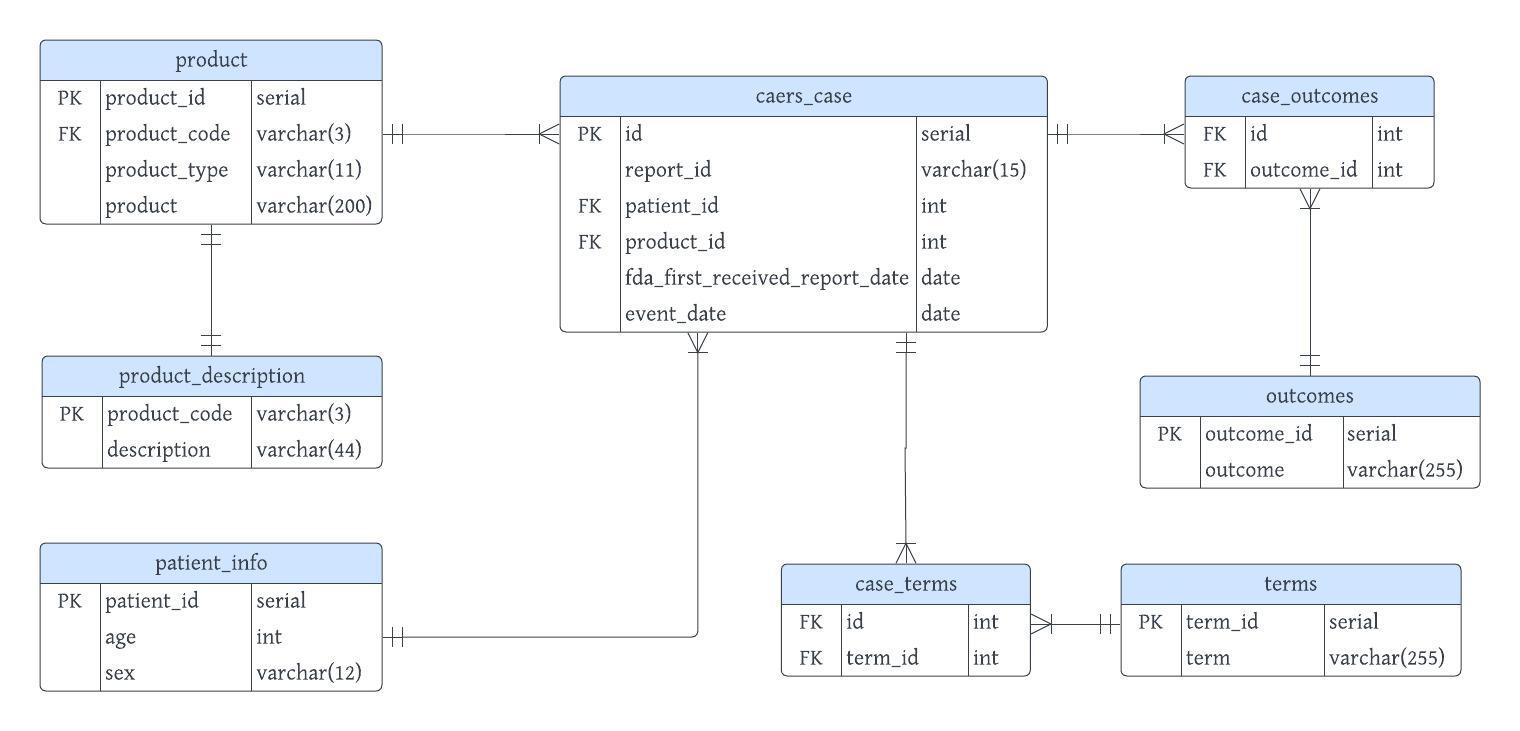
caers_case
- I made one caers case with column report_id, fda_first_received_report_date, event_date. I didn't use the first candidate key that I first assumed because I wanted to have seperate table for
productbecause uniqueproductcan be associated with manycaers_case, so that we can save database storage. For same reason, I wanted to seperatepatienttoo fromcaers_case. In addition to this, I needed to seperatecase_meddra_preferred_termsandcase_outcomecolumn because those two columns have multiple values. Therefore, I only keptreport_id,fda_first_received_report_date, andevent_datefrom original data and insertpatient_idandproduct_idfor table relation and addedidfor primary key
product
- I made seperate table for product. This table contains all information for product. Add
product_idfor primary key and setproduct_codeas foreign key for one-to-one table relationship withproduct_description
product_description
- I made seperate table for
product_codeanddescriptionbecause I noticed they are functionally dependet. Setproduct_codeas primary key.
patient_info
- I made seperate table for patient.
patient_ageandage_unitscan be combined together intoageby calculation with query, so I addedageinstead of two columns and addpatient_idas primary key.
case_terms
- I made join table for
caers_caseandtermsfor seperate multiple values incase_meddra_preferred_termscolumn. Setidandterm_idas foreign key for table relation
terms
- I made seperate table for each unique values in
case_meddra_preferred_termscolumn and connect withcaers_casemany-to-many relation with using join tablecase_term
case_outcomes
- I made join table for
caers_caseandoutcomesfor seperate multiple values incase_outcomecolumn. Setidandoutcome_idas foreign key for table relation
outcomes
- I made seperate table for each unique values in
case_outcomecolumn and connect withcaers_casemany-to-many relation with using join tablecase_outcomes